
Is Your Aging Gas Safety Valve a Ticking Time Bomb?
That critical pilot-operated gas safety valve is due for its 5-year inspection. The plan is to refurbish it. But what if that passed bench test is giving you a false sense of security, hiding a failure that’s just waiting to happen?
For critical gas safety valves, a full replacement after five years is often the only way to guarantee safety. The hidden degradation of soft seals and internal components creates an unacceptable risk that a simple functional test will not reveal.
Replace vs. Refurbish: The Hidden Risks in a 5-Year-Old Gas Safety Valve
Justifying the higher expense of a new valve over a refurbishment is a challenge. But this is not about spending more; it’s about eliminating unacceptable risk. The Total Cost of Ownership of a single failure always exceeds the proactive cost of replacement.
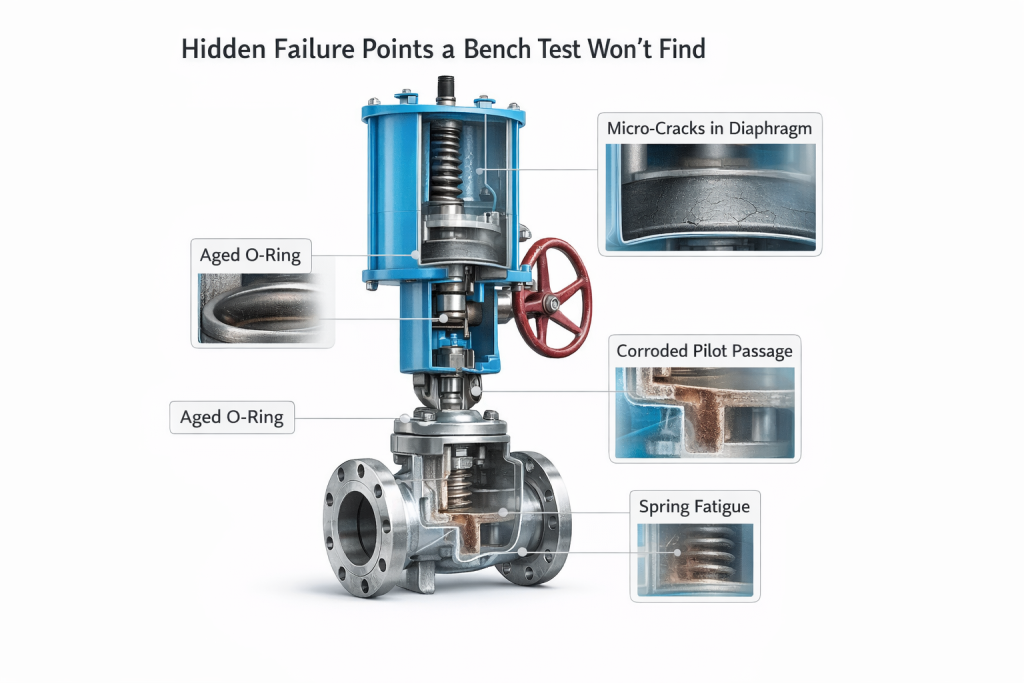
Hidden Failure Points a Bench Test Won’t Find

| Component | The Hidden Risk | Why a Bench Test Misses It |
|---|---|---|
| Pilot O-Rings/Seals | Embrittlement & Compression Set. Elastomers lose flexibility and no longer seal perfectly after actuation. | A single-cycle test can’t simulate the material fatigue that causes leaks later. |
| Main Valve Diaphragm | Chemical Attack & Micro-cracking. Invisible cracks form from process exposure. | A test’s smooth pressure rise won’t replicate a real event’s violent shock, which can cause a catastrophic tear. |
| Pilot Tubing & Passages | Internal Corrosion & Blockage. Minor buildup can create partial blockages. | A test with clean air won’t find a blockage that only fails under dirty process gas conditions. |
| Main Valve Spring | Creep & Relaxation. The spring slowly loses its strength under constant load. | A technician can easily re-calibrate the spring, masking the fact that it’s weakened and will degrade faster once re-installed. |
How Do You Decide When to Replace vs. Refurbish a Gas Safety Valve?
A blanket “replace-all” policy is not financially viable. The solution is to use a risk-based approach, classifying your valves by the potential consequence of their failure. Critical valves are non-negotiable replacement candidates.
A Risk-Based Decision Matrix
This framework turns risk into a clear, documented process, helping you focus your budget where it has the greatest impact on safety.
| Risk Level | Consequence of Failure | Recommended 5-Year Action |
|---|---|---|
| Critical | Catastrophic release (toxic/flammable); potential fatality; plant-wide shutdown. | Mandatory Replacement. |
| High | Unit shutdown; localized hazardous release; potential for injury. | Strongly Recommend Replacement. |
| Medium | Isolated equipment damage; minor process upset. | Refurbish with Full Soft Goods Kit. |
| Low | Minor interruption; redundant systems in place; no personnel risk. | Standard Test and Refurbish. |
Conclusion
For your most critical gas safety valves, the 5-year service interval should be a crucial decision point, not just a routine task. Proactive replacement eliminates the hidden risks of material degradation that a bench test can’t see, effectively resetting the safety clock. It is an investment in guaranteed reliability and the ultimate protection for your people and your plant.


 English
 Arabic
 Russian
 French
 Spanish