
Your Air Compressor Safety Valve: A Complete Q&A Guide
Your air compressor suddenly starts making a loud hissing sound. You are losing air, wasting electricity, and you can’t get your work done. The culprit is that little brass valve with the ring on it, and it’s trying to tell you something important.
That hissing part is your air compressor safety relief valve. It is the single most important safety device on your compressor tank. It’s a small, non-adjustable valve that automatically opens to release air if the pressure gets dangerously high, preventing a catastrophic tank rupture.

Why Does the Safety Valve Keep Opening on My Air Compressor?
That constant hissing from your safety valve is frustrating. You might think the valve itself is broken. In most cases, the safety valve is not the problem; it’s the hero. It’s opening because another part has failed: the pressure switch.
Troubleshooting the Hiss
Before you replace the safety valve, watch the pressure gauge and follow these steps:
| Observation | Most Likely Cause | What to Do |
|---|---|---|
| Valve opens and motor runs continuously past the shut-off pressure. | Faulty Pressure Switch. It’s failing to tell the motor to stop. | Replace the pressure switch. |
| Valve leaks constantly, even at low pressure. | Worn or Dirty Valve Seat. Debris or wear is preventing a seal. | Replace the safety valve. |
| Valve pops open before normal shut-off pressure. | Incorrect or Failed Safety Valve. Wrong PSI rating or a weak spring. | Verify PSI rating matches tank MAWP. If it’s correct, replace the safety valve. |
How Do I Check the Safety Valve on My Air Compressor?
You can and should manually test your air compressor safety relief valve periodically to ensure it is not stuck. This simple check confirms the valve’s mechanical parts can move freely.

The Pull-Ring Test
Always wear safety glasses and gloves when performing this test.
- Run the compressor until the tank is full and the motor shuts off.
- Firmly pull the ring on the safety valve. You should hear a powerful blast of air.
- Let go of the ring. The valve should snap shut immediately with no lingering hiss.
- If you hear any leak after it snaps shut, it’s time to replace the valve.
How Do I Adjust My Air Compressor Safety Valve?
You should not adjust your air compressor safety valve. These valves are factory-set and certified to open at a specific pressure. Tampering with this setting is extremely dangerous and could lead to catastrophic tank failure.
Why You Must Not Adjust
- Safety Certification: ASME/NB certified valves are factory-sealed. Breaking this seal voids the safety rating.
- No Way to Calibrate: You cannot accurately know what pressure your adjustment corresponds to.
- It’s Cheaper to Replace: These valves are inexpensive. If yours is faulty, the only safe action is replacement.
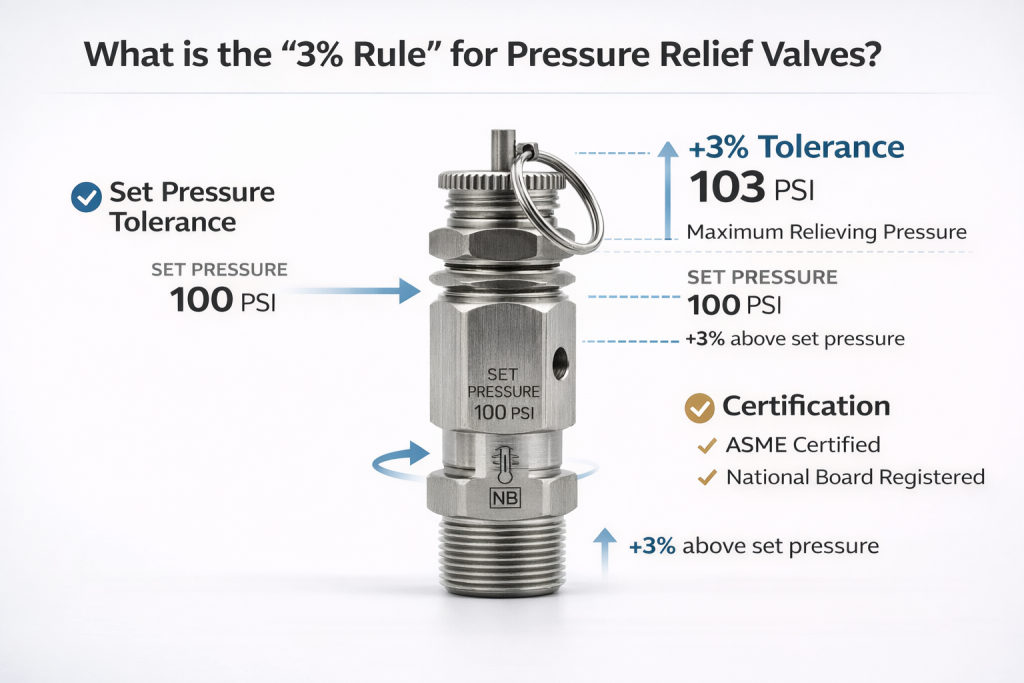
What is the “3% Rule” for Pressure Relief Valves?
The “3% rule” is an industrial standard (API 520) that relates to inlet pressure drop and valve stability in complex process systems. It does not apply to a standard air compressor safety valve.
What Rules Actually Apply to Your Compressor?
- Set Pressure vs. MAWP: Your valve’s set pressure must be at or below your tank’s Maximum Allowable Working Pressure (MAWP).
- Set Pressure Tolerance: ASME codes allow a +/- 3% tolerance on the set pressure for manufacturing. A 150 PSI valve can pop between 145.5 and 154.5 PSI and still be in-spec.
Conclusion
Your air compressor safety valve is a simple but non-negotiable part of your system. Understanding that it often acts as a messenger for other problems (like the pressure switch) is key to troubleshooting. Always test it regularly, never adjust its factory setting, and when in doubt, replace it. It’s an inexpensive part that provides priceless protection.


 English
 Arabic
 Russian
 French
 Spanish