
Introduction: Why Flow Control Precision Matters
In industrial systems worldwide, inconsistent flow can lead to inefficiencies, equipment damage, and costly downtime. For instance, chemical plants in Asia face challenges with additive dosing, HVAC systems in the Middle East experience variable chilled water flows, and food processing facilities in Europe deal with uneven ingredient mixing. Standard ball valves, though reliable for on/off operations, often fail to provide precise flow regulation due to their binary design.
This is where the vee port ball valve—also called a v port ball valve o v notch ball valve—emerges as a superior solution. These specialized valves offer precision throttling, ensuring stable and controlled fluid dynamics. This article explores how choosing a Vee Port Ball Valve can transform industrial performance, supported by authoritative standards and applications.
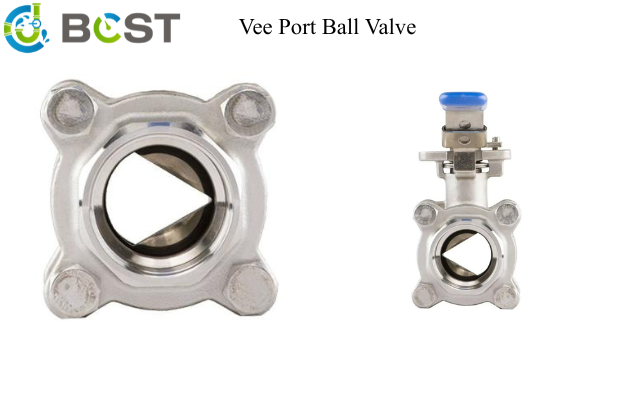
Definition: What Is a Vee Port Ball Valve?
Short Answer: A Vee Port Ball Valve is a control ball valve featuring a V-shaped notch that allows proportional flow adjustment instead of basic on/off function.
In detailed operation, as the ball rotates, the V-notch aligns with the fluid path to enable linear flow modulation. Unlike a standard ball valve, which opens fully or closes abruptly, the vee port provides predictable throttling performance, reducing cavitation and turbulence. This design follows ISA-75.01.01 control valve sizing standards for linear flow predictability.
How the Vee Port Design Enhances Flow Control
The vee port’s gradual opening design produces a linear control curve, preventing sudden pressure surges that cause water hammer and turbulence. It ensures smoother transitions between flow rates, making it ideal for sensitive systems.
Según ASME B16.34, which governs valve pressure-temperature ratings, the V-notch maintains sealing integrity under varied conditions.

| Característica | Vee Port Ball Valve | Válvula de bola estándar |
|---|---|---|
| Características del flujo | Linear or equal percentage for precise control | Non-linear; best for on/off |
| Capacidad de estrangulamiento | Excellent, gradual adjustment | Poor, prone to cavitation |
| Caída de presión | Low when open | Very low, unstable in modulation |
| Turbulence Reduction | High, due to V-notch geometry | Moderate to high in throttling |
| Aplicaciones | Flow control in dynamic systems | Isolation and shut-off |
This linearity gives ball valve flow control systems the accuracy required for automation and precision dosing.
Types of Vee Port Ball Valves
These valves vary by V-notch angle and material construction, allowing tailored use across flow ranges and environments.
Material Options
- CF8M Stainless Steel: Corrosion-resistant, compliant with API 608.
- Alloy 20: Acid-resistant; conforms to ISO 5208 for pressure testing.
- Forged Steel: High-pressure durability, aligns with ASME B16.34.
Port Angle Selection
Common notch angles include 30°, 60°, and 90°—smaller for fine control, larger for higher capacity.
Pressure Classifications
Rated per API 6D pipeline standards, ensuring compatibility across process industries.
Más información types of ball valves and their applications.
Key Advantages Over Standard Ball Valves
- Flujo lineal: Predictable modulation and precision control.
- Reduced Erosion: V-notch minimizes high-velocity wear.
- Durabilidad: Maintains accuracy over repeated cycles.
- Cost-Efficient: Up to 50% cheaper than globe valves.
These traits position vee port valves as superior in ball valve vs control valve comparisons.
Industrial Applications of Vee Port Ball Valves

- Procesamiento químico: Additive injection in Asia-Pacific plants per ISA standards.
- Sistemas HVAC: Energy-efficient chilled water modulation in Middle East facilities.
- Comida y bebida: Precision proportioning and CIP control in Europe.
- Generación de energía: Steam/fuel modulation meeting API 598 testing criteria.
These global examples demonstrate their importance in industrial ball valve applications worldwide.
Maintenance and Longevity Tips
- Monthly: Inspect for leaks, lubricate stem packing.
- Quarterly: Check V-notch edge, test actuation timing.
- Annually: Clean seats, pressure-test per ISO 5208.

FAQs
What is the difference between a V-port and a standard ball valve?
A V-port valve has a notched ball for proportional flow, while a standard ball valve only offers open/close operation.
Can a V-port ball valve be used for throttling applications?
Yes. Its V-notch design provides linear throttling ideal for process control.
What materials are best for corrosive media?
CF8M Stainless Steel and Alloy 20 are best, following API 608 y ASME B16.34 standards.
How do I select the right V-notch angle?
Choose 30° for fine control, 60° for balanced flow, and 90° for higher capacity needs.
What industries benefit most from V-port valves?
Chemical processing, HVAC, food & beverage, and power generation benefit most from improved precision and reliability.
Conclusion: Why Vee Port Ball Valves Are the Smart Choice
Vee Port Ball Valves combine the reliability of ball valves with the precision of control valves, making them indispensable for modern industrial flow systems. Explore our control valve types or contact Grupo BCST for expert consultation and tailored valve solutions.


 English
 Arabic
 Russian
 French
 Spanish