
Válvulas de bola are widely used in industry, mainly to control fluid flow in pipelines. They adjust the flow of the medium by rotating the ball. Ball valves are a type of valve with high efficiency, durability, and good sealing performance. They are widely used in various occasions, including chemical, petroleum, natural gas, electricity, food, pharmaceutical, and other industries.
When automatic control is realized, the válvula de bola must be equipped with an actuator for opening, closing, and regulating operations. Different working conditions and application scenarios require different actuators. Therefore, reasonably selecting actuators is crucial to the ball valve’s performance, efficiency, and follow-up.
1. Basic concepts of ball valves and actuators
A válvula de bola controls fluid flow by rotating a sphere with a hole. It has the advantages of simple structure, quick operation, and sound pressure resistance and is suitable for cutting off and regulating fluid flow. According to different structural forms and uses, ball valves can be divided into floating ball valves, fixed ball valves, eccentric semi-ball valves, and other types.
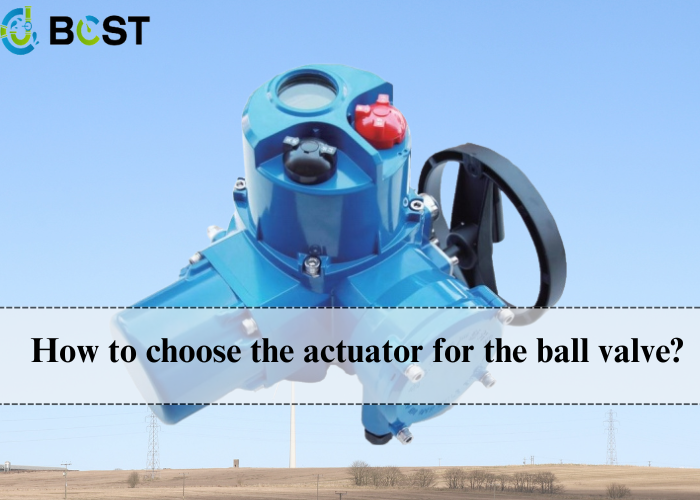
The actuator is a device used to drive the valve to open, close, or adjust its function. It receives the signal from the control system and converts electrical, gas, or hydraulic energy into mechanical motion, thereby causing the ball valve to rotate. Many types of actuators are suitable for different control requirements and working conditions.
2. Tipos y características de los actuadores
2.1 Actuador neumático
Pneumatic actuators are a common type of actuator in industrial applications. They use compressed air to drive the piston to open and close the ball valve. Pneumatic actuators are suitable for many industrial automation control systems. They have simple, improved structures and fast responses and are often used in situations that require fast opening and closing.
Features:
Fast response, suitable for close-close applications.
It has good explosion-proof performance and is suitable for flammable and explosive environments.
Simple structure, low cost, and easy maintenance.
It requires support from external gas sources and is subject to more significant environmental restrictions.
2.2 Actuador eléctrico
The electric actuator drives the gear or screw mechanism through the motor to pre-promote the rotation of the ball valve to achieve the opening, closing, or adjustment function. The electric actuator has high control accuracy and is suitable for occasions that require precise adjustment.
Features:
High control accuracy, suitable for applications that require precise flow regulation.
It supports remote control and automation and is suitable for modern automatic control systems.
The operation speed could be faster and more suitable for opening and closing situations.
Electrical components may generate sparks in flammable and explosive environments and are unsuitable for hazardous areas.
2.3 Actuador hidráulico
The hydraulic actuator drives the piston or gear system through hydraulic oil to open and close the valve. It has a greater driving force and is suitable for driving high-pressure and large-diameter ball valves.
Features:
It provides a robust sensor suitable for operating high-pressure, large-diameter ball valves.
The operation is smooth and suitable for a long-term continuous working environment.
It requires hydraulic system support and has higher maintenance and use costs.
Hydraulic oil leakage may occur, and the risk of environmental pollution will increase.
3. Choice of actuator
3.1 Valve specifications and types
En válvula de bola size and type determine the required operating force and air pressure. Small-diameter ball valves usually require less operating force and are suitable for pneumatic or electric actuators, while large-diameter or high-pressure ball valves require more torque, and hydraulic actuators may be more suitable.
Floating ball valve: suitable for medium and low-pressure occasions, usually using pneumatic or electric actuators.
Fixed válvula de bola: This is suitable for high-pressure and large-diameter working conditions. A hydraulic or electro-hydraulic linkage actuator is more appropriate.
3.2 Operating Environment
The working environment of the actuator also significantly impacts this choice. For example, the actuator must have the corresponding tolerance in a high-temperature, low-temperature, corrosive, or dead environment. Pneumatic actuators are usually suitable for flammable and explosive environments because they do not involve electrical components. In contrast, electric actuators are ideal for occasions where explosion-proof requirements are not high.
3.3 Control requirements
Electric or smart actuators are usually better choices if precise regulation of the fluid’s flow or pressure is required. Electric actuators can provide precise control and are suitable for precision automation systems. Pneumatic actuators are more appropriate for occasions with lower precision requirements but require fast opening and closing.
3.4 Frecuencia de funcionamiento
Applications with high operating frequencies require the selection of actuators with fast response speeds. Pneumatic actuators have improved their fast response characteristics and are suitable for systems with high-pressure operation. Although electric actuators have high operating accuracy, their response speed is slow and unsuitable for high-frequency opening and closing operations.
3.5 Explosion-proof requirements
Explosion-proof requirements are an essential actuator consideration in the flammable and explosive industries, such as the petroleum and chemical industries. Pneumatic actuators do not involve electrical components and will not produce sparks, so they have good explosion-proof performance. On the other hand, electric actuators need to be specially selected for explosion-proof applications.
3.6 Remote Control and Automation Requirements
Modern factories generally use automatic control systems, so the actuator’s remote control and automation functions are essential considerations. Intelligent electrical actuators have data feedback and self-diagnosis functions and can be seamlessly connected with automatic control systems to achieve remote control monitoring and operation.
4. Critical points of cooperation between the actuator and ball valve
4.1 Torque matching
The actuator’s output torque must meet the ball valve’s opening and closing torque requirements. The ball valve’s opening and closing torque depends on factors such as the type and size of the valve, the pressure and temperature of the medium, etc. When selecting an actuator, it is necessary to ensure the maximum opening and closing moment of the ball valve with the maximum rated torque.
4.2 Itinerary
The stroke of the actuator must match the stroke of the ball valve. For a 90-degree rotating ball valve, the rotation angle of the actuator should be precisely controlled at 90 degrees; otherwise, it will affect the opening and closing effect of the ball valve and even cause damage.
4.3 Feedback function
In modern industrial production, real-time monitoring of valves’ working status is essential for ensuring the safe operation of the system. Many actuators have feedback functions, which can provide real-time feedback on the opening and closing status, position, and other information of the ball valve, making it easier for the control system to perform remote monitoring and adjustment.
5. Application scenarios of ball valve actuators
5.1 Industria del petróleo y el gas
In the oil and gas industry, ball valves are often used to control the opening and closing of pipeline systems. Due to the site’s high pressure and flammable and explosive characteristics, pneumatic actuators are the first choice. In addition, electro-hydraulic actuators enhance the powerful operating force and are often used to control large ball valves.
5.2 Industria química
In the chemical industry, ball valves are used to control the pipeline and chemical mixing process. Electric or intelligent actuators are usually selected for high-level automation to control chemical processes precisely. At the same time, anti-corrosion materials and high-temperature resistance are also important considerations for actuator selection.
5.3 Water treatment industry
Pneumatic actuators are widely used in combination with ball valves in sewage treatment, water purification, etc. For example, pneumatic ball valves can quickly respond to the system’s opening and closing signals in sedimentation tanks, dosing systems, and sludge treatment systems. At the same time, electric actuators are also used to adjust water flow accurately in modern water treatment plants with automation requirements. Combined with advanced control systems, fine management of water flow can be achieved.
5.4 Food and pharmaceutical industry
The food and pharmaceutical industries have extremely high requirements for valves, especially in terms of hygiene standards, corrosion resistance, and control accuracy. Ball valves used in food processing must be equipped with food-grade materials for corrosion resistance and easy cleaning. With their signature and automation functions, electric actuators are the first choice for this industry, as they can ensure critical smoothness in the production process.
In the pharmaceutical industry, since drug production requires absolute precision and cleanliness, the actuator needs to be corrosion-resistant and easy to clean. Especially in high-purity water and drug preparation, every movement of the valve is required to be precise and error-free. Combining ball valves and electric actuators can ensure safety and hygiene in the production process.
6. Resuma
When selecting a ball valve’s actuator, you must thoroughly consider working conditions, application occasions, operating frequency, control accuracy, and safety requirements. Pneumatic, hydraulic, electric, and electro-hydraulic actuators have unique advantages and are suitable for different industry application scenarios. Reasonable actuator selection can improve the ball valve’s working efficiency and effectively extend its service life, thereby ensuring the operation of the entire system.
Choosing a suitable and efficient actuator is the key to ensuring the system’s safety, stability, and operation. It involves careful analysis of the actual working conditions and combining the characteristics of the ball valve itself.


 English
 Arabic
 Russian
 French
 Spanish