
How to Choose the Right Gas Solenoid Valve for Fuel Systems
In the fuel industry, choosing the wrong valve isn’t just a technical error, it’s a profound safety risk and a potential regulatory nightmare. The integrity of your fuel system, the safety of your personnel, and your operational continuity hinge on selecting components that precisely match your application’s demands. According to NFPA reports, manufacturing and industrial sites accounted for 30.5% of losses in large-loss fires in 2022, totaling over $530 million in property damage. So choosing a right gas solenoid valve is crucial for avoiding these kinds of problems. This guide simplifies the complex variables of valve selection to ensure system longevity, compliance, and ultimate reliability. For those needing a broader overview of these critical components, our Comprehensive Gas Solenoid Valve Guide provides a solid foundation.

Fundamental Selection Criteria for Fuel Gas Applications
The first step in selecting any valve for fuel systems involves a rigorous evaluation of the operating environment and the media it will handle. Overlooking these basics can lead to premature failure, leaks, or inefficient operation.
Media Compatibility and Seal Selection
The type of fuel gas are natural gas, propane, LNG, or fuel oil, dictates the necessary seal and body materials. Different fuels have different chemical compositions and viscosities, which can degrade incompatible materials over time. For instance:
- Natural Gas / Propane: Often compatible with NBR (Buna-N) seals due to their good resistance to petroleum-based products.
- Fuel Oil: Requires more robust elastomers like Viton (FKM) for enhanced chemical resistance against petroleum derivatives.
- LNG (Cryogenic applications): Special low-temperature materials and construction are required, often involving PTFE or specific metallic seals.
Ensure the wetted parts of the valve (body, seals, disc) are chemically compatible with the specific fuel media to prevent degradation, swelling, or hardening, which compromises sealing integrity.

Pressure Ratings: Understanding Static vs. Operating Pressure
Valves must be rated for the full pressure envelope of your system. This includes:
- Maximum Static Pressure: The highest pressure the valve might experience in a non-flowing, shut-off state.
- Maximum Operating Pressure: The highest pressure the valve will encounter during normal flow conditions.
- Minimum Differential Pressure: Crucial for pilot-operated valves (discussed next). Some valves require a minimum pressure differential between inlet and outlet to actuate properly.
Always specify a valve with a pressure rating safely exceeding your maximum system pressure.
Temperature Ranges: Ambient and Media Considerations
Both the ambient temperature surrounding the valve and the temperature of the fuel media itself impact valve performance and material longevity. Extreme temperatures (hot or cold) can affect seal materials, solenoid coil life, and valve body integrity. Verify that the valve’s specified operating temperature range covers both conditions in your application, especially for outdoor installations or processes involving preheated or cryogenic fuels.
Direct Acting vs. Pilot Operated: Which Does Your System Need?
Understanding the actuation mechanism of a gas solenoid valve is critical, as it directly impacts its ability to operate under specific pressure conditions.
The Zero-Pressure Requirement
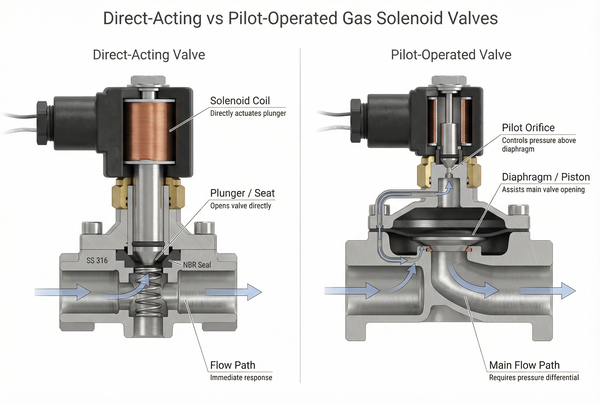
Direct-acting solenoid valves are ideal for applications requiring operation at zero differential pressure or for very low-pressure fuel lines. In these valves, the solenoid coil directly lifts the main valve plunger to open or close the orifice. This design makes them reliable for applications where inlet pressure might be very low or fluctuate significantly, as they do not rely on process pressure for actuation. They are typically used for smaller line sizes.
Handling High Flow with Pilot-Operated Valves
Pilot-operated (or internally piloted) solenoid valves leverage the system’s own differential pressure to assist in opening and closing the main orifice. A small pilot solenoid first operates, which equalizes or unbalances pressures across the main diaphragm or piston, allowing the much larger main port to open or close. This design enables them to handle higher flow rates and larger line sizes efficiently. However, they typically require a minimum differential pressure to operate reliably, meaning they may not function correctly in zero-pressure or extremely low-pressure scenarios. They are commonly found handling larger volumes of gas in industrial burners or main fuel lines.
Calculating the Flow Coefficient (for Industrial Burners
Proper sizing is paramount in any fluid control application, and even more so in fuel systems where both safety and efficiency are critical. The flow coefficient ($C_v$) is a valve’s capacity rating, indicating the volume of water (in US gallons per minute) at 60°F that will flow through a valve with a pressure drop of 1 psi.
Why Sizing Matters More Than Pipe Size
A common mistake is to simply select a valve based on the existing pipe size. This often leads to the “oversizing” trap, where a valve is much larger than required. An oversized valve operates closer to its closed position, leading to poor flow control, increased wear on seats, and potential issues like “hunting” in control loops. Conversely, an undersized valve restricts flow, leading to inadequate fuel delivery and reduced burner efficiency. Accurate $C_v$ calculation ensures the valve operates within its optimal range for precise control and longevity.
The Technical Formula for Gas Flow
Q = 1360 ⋅ Cv ⋅ P1 ⋅ √(ΔP / (P1 ⋅ G ⋅ T))
Where:
- Q = Flow rate (SCFH – Standard Cubic Feet per Hour)
- Cv = Flow coefficient
- P1 = Upstream pressure (psia)
- ΔP = Pressure drop across valve (psi)
- G = Specific gravity of gas (air=1)
- T = Absolute temperature of gas (°R = °F + 460)
Accurate calculation ensures optimal performance. Many valve manufacturers provide comprehensive sizing charts and specialized software tools to assist engineers in selecting the correct valve for their specific operating conditions, eliminating guesswork and ensuring precision.
Safety and Regulatory Compliance in the Fuel Industry
In the fuel industry, safety and regulatory compliance are non-negotiable. The consequences of non-compliance range from devastating accidents to severe financial penalties and reputational damage.
Explosion-Proof Ratings (ATEX, UL, FM)
For fuel system owners and operators, prioritizing “Hazardous Location” certifications for gas solenoid valves is paramount. Many fuel applications involve the presence of flammable gases or vapors, which necessitates explosion-proof solenoid valves. Key certifications include:
- ATEX (Europe): Mandates essential health and safety requirements for equipment intended for use in potentially explosive atmospheres.
- UL (Underwriters Laboratories): A North American safety certification that ensures equipment meets specific safety standards.
- FM Approved (Factory Mutual): Signifies that products have been tested to the highest property loss prevention standards.
These ratings ensure the valve’s electrical components are designed to prevent ignition of the surrounding atmosphere, providing a critical layer of safety.
Emergency Shut-Off (ESD) Requirements
Many fuel applications incorporate Emergency Shut-Off (ESD) systems, often requiring gas solenoid valves certified for specific safety integrity levels (SIL). These valves are designed to quickly and reliably cut off fuel supply in an emergency, preventing escalation of hazardous situations. Specify valves with fast response times and high reliability ratings for such critical safety functions.
Common Installation Pitfalls for Fuel System Owners
Even with the right valve chosen, improper installation can severely compromise its performance and safety. Fuel system owners must be aware of these common errors to ensure optimal operation.
Orientation and Mounting Constraints
Many solenoid valves, especially pilot-operated types, have specific orientation requirements for proper gravity-assisted operation of internal components. Mounting a valve sideways or upside down against manufacturer recommendations can lead to sluggish operation, incomplete closure, or premature failure. Always consult the installation manual for correct mounting position.
Filtration: Protecting the Valve from Pipeline Debris
Fuel gas lines, particularly older ones, can contain rust, pipe scale, or other particulate matter. This debris can foul pilot orifices in indirectly operated valves or scratch seal surfaces, leading to internal leakage and malfunction. Installing a suitable filter or strainer upstream of the solenoid valve is crucial to protect its internal mechanisms and ensure long-term reliability. Regularly inspect and clean these filters as part of your maintenance schedule.

Frequently Asked Questions About Gas Solenoid Valves for Fuel Systems
Q: Can I use a water solenoid valve for natural gas?
No, absolutely not. Water solenoid valves are not designed or certified for natural gas and using one creates an extreme safety hazard. The internal seal materials in water valves are typically not compatible with natural gas, leading to rapid degradation and dangerous gas leaks. Gas valves also have specific safety features and certifications (like explosion-proof ratings) that water valves lack.
Q: What is the difference between AC and DC coils for gas valves?
AC solenoid coils typically produce a slight audible hum and are more prone to overheating if voltage fluctuates. DC coils operate silently and generate less heat, making them often preferred for applications where noise reduction or lower power consumption is critical. The choice depends on the availability of power and specific application requirements.
Q: How often should fuel gas solenoid valves be replaced?
The lifespan of a fuel gas solenoid valve varies greatly by manufacturer, application, and operating conditions (e.g., cycle frequency, media cleanliness). Many manufacturers provide a rated number of cycles or a recommended service life (e.g., 5-10 years). Regular inspection and functional testing are crucial. For critical safety applications (e.g., ESD valves), replacement may be part of a scheduled preventive maintenance plan long before failure is anticipated.
Q: What does “Normally Closed” mean in a safety context?
“Normally Closed” (NC) means the valve is closed when de-energized (no power applied) and opens when power is applied to the solenoid. In a safety context, this is critical because in the event of a power failure or an emergency shutdown (cutting power), the valve automatically returns to its safe, closed position, cutting off the fuel supply. This “fail-safe” characteristic is highly preferred for most gas fuel applications.
Conclusión
Choosing the right gas solenoid valve for your fuel system application boils down to a “Rule of Three”: diligently check your media compatibility, accurately assess your pressure and temperature requirements, and stringently verify all necessary safety and regulatory certifications. Overlooking any of these critical factors can lead to operational inefficiencies, compromised safety, and significant compliance headaches. Reliability in the fuel industry starts with the right instrumentation, and the gas solenoid valve is a linchpin of that reliability.
Need help calculating your coefficient or choosing a specific certification?


 English
 Arabic
 Russian
 French
 Spanish