
Choosing the wrong valve leads to costly downtime. This mistake can shut down your entire production line. Understanding their core differences is the best way to prevent this problem.
Ball valves are a popular type of valve known for their simple design and reliable operation, making them widely used in industrial applications. The difference between 2-piece and 3-piece ball valves primarily lies in their construction, which affects their appearance, application range, and safety. This article will explore their differences in design, structure, application, and safety.
This choice might seem small, but it has huge effects on your plant’s operation and budget. As someone who grew up in the valve industry and has helped countless clients, I’ve seen this decision make or break a project’s budget. You need to look beyond the price tag and think like a chief engineer. To truly understand the difference between 2-piece and 3-piece ball valves, we must compare them directly across four key areas: their design, structure, application, and safety. This guide will give you the clarity to make the right choice.
Appearance and Visual Design
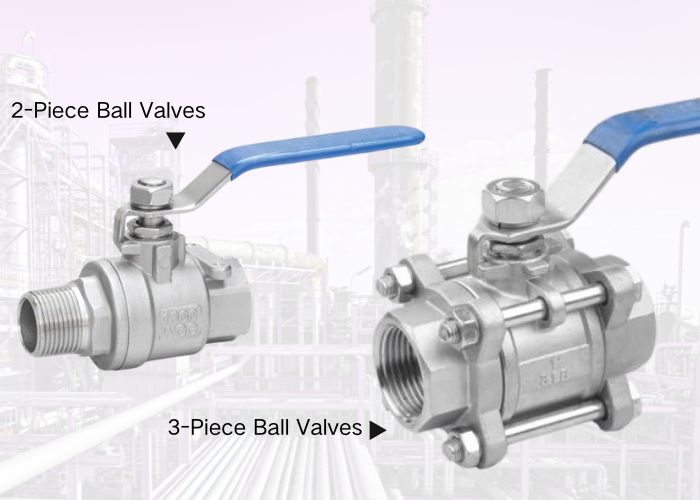
The difference between 2-piece and 3-piece ball valves is also evident in their appearance. A two-piece ball valve has a relatively simple structure and an overall spherical shape. Composed of one body and one ball, it is designed to achieve basic on/off control. Some two-piece ball valves feature a ball-and-seat sealing method, giving them a cleaner and more compact appearance. In contrast, a three-piece ball valve consists of a body, an end cap, and a ball, resulting in a more complex structure and requiring more installation space. Additionally, the three-piece design offers better sealing between the ball, stem, and body, making it suitable for demanding industries such as petrochemicals and water treatment.
![A 2-piece ball valve and a 3-piece ball valve shown side-by-side]](https://bcstvalve.com/wp-content/uploads/2026/02/Visual-Identification-of-2-Piece-and-3-Piece-Ball-Valves.jpg)
Diving Deeper into Visual Cues
At first glance, both valves might look similar—they are both ball valves. However, their body construction gives away their identity. This is the most immediate way to spot the difference.
Identifying a 2-Piece Valve
A 2-piece ball valve looks more solid, almost like a single piece. You will find one distinct seam where the end piece is threaded or bolted into the main body. This creates a simple, compact appearance. The body itself looks like one larger component connected to a smaller one. Because there are no external body bolts holding the main sections together, its profile is often smoother and more streamlined.
Identifying a 3-Piece Valve
The 3-piece valve is easily recognized by its “sandwich” construction. You can clearly see three separate parts: a central body and two end caps. The most telling feature is the set of long bolts and nuts (usually four or more) that clamp these three sections together. These bolts run parallel to the pipe, passing through flanges on the body and end caps. This bolted look immediately signals that it’s a 3-piece design, built for easy disassembly.
| Visual Feature | 2-Piece Ball Valve | 3-Piece Ball Valve |
|---|---|---|
| Body Seams | One large, often threaded, seam | Two seams, one on each side of the center body |
| Connection Method | Body parts screw or bolt into each other | Held together by long external bolts and nuts |
| Overall Look | More compact and solid | “Sandwich” or three-section look |
| Key Identifier | Absence of long body bolts | Presence of long through-bolts |
Key Structural Features
A valve’s internal design dictates its entire lifecycle. Choosing a structure that complicates maintenance leads to expensive downtime and frustration for your engineering team. This is a crucial point of comparison.
The difference between 2-piece and 3-piece ball valves is also reflected in their internal structure. It directly impacts how you service the valve and how long your production line must stop.
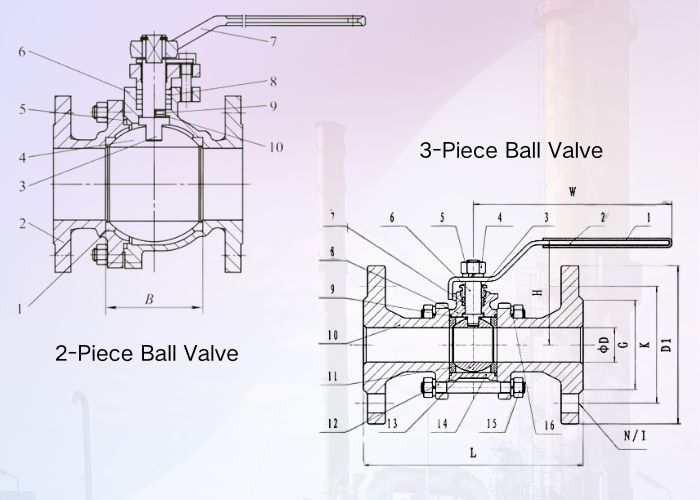
The 2-Piece Structure: Simple but Inflexible
A two-piece ball valve uses a single-piece ball and has a spherical appearance. A channel the same diameter as the pipeline is machined through the ball. The ball is connected to a stem, which rotates to control the flow of the medium. The structure of a two-piece ball valve is relatively simple and easy to operate. However, due to the weaker seal between the seat and the ball, it is prone to leakage during use.
The 3-Piece Structure: Designed for Service
In contrast, a three-piece ball valve is composed of a body, a ball, a stem, an end cap, and gaskets. The stem connects the ball on one end and the handle on the other, allowing the handle to open and close the valve. The three-piece ball valve features two symmetrical seats with the ball clamped between them, ensuring full contact between the two seats for a better seal. Additionally, multiple bolts connect the body and the end caps, greatly enhancing its safety.
| Structural Aspect | 2-Piece Ball Valve | 3-Piece Ball Valve |
|---|---|---|
| Main Components | One main body and one end cap | One central body and two end caps |
| Maintenance Method | Must be removed from the pipeline | Center section can be serviced in-line |
| Required Downtime | High (hours to days) | Low (often less than an hour) |
| Key Advantage | Lower manufacturing complexity and cost | Superior serviceability and speed of repair |
Scope of Application
Installing the wrong valve is a costly error. A cheap valve in a critical line can lead to huge losses from downtime, far outweighing the initial savings you thought you made.
2-piece valves are best for general, non-critical services like water or air lines where shutdowns are easy. 3-piece valves are essential for critical processes in industries like chemical, oil and gas, or steam, where downtime must be minimized and reliability is paramount.
Diving Deeper into Application
Two-piece ball valves are widely used in industries such as urban tap water, building drainage, wastewater treatment, chemical, petroleum, and metallurgy. Due to their simple structure, ease of operation, and relatively low price, they are highly favored by users.
Three-piece ball valves, on the other hand, are suitable for industries with higher sealing requirements, such as petrochemicals, water treatment, and natural gas. With a design that separates the valve body from the ball, three-piece ball valves make it easier to maintain and replace components, resulting in a longer service life.
Key to selection scenarios
| Application Factor | 2-Piece Ball Valve | 3-Piece Ball Valve |
|---|---|---|
| Ideal Industries | General Manufacturing, Water Treatment, HVAC | Chemical, Oil & Gas, Pharmaceutical, Power Generation |
| Typical Media | Water, Air, Non-hazardous fluids | Corrosive chemicals, Steam, Hazardous media, High-purity fluids |
| Cost Consideration | Low initial cost, but high potential TCO in critical lines | High initial cost, but lower TCO in critical lines |
| Decision Driver | Budget constraints and non-critical service | Minimizing downtime and ensuring easy maintenance |
Safety and Reliability
A sudden valve failure can cause a dangerous leak and a plant-wide emergency. This risk is directly tied to the valve’s body integrity under pressure, heat, and stress. The safety of your plant and personnel depends on the reliability of every component. The construction style of a valve plays a huge role in its ability to contain pressure safely over its lifetime. This is another key difference between 2-piece and 3-piece ball valves.
A 3-piece valve is generally safer and more reliable for demanding service. Its bolted body provides a stronger, more uniform seal that resists leaks better than the single threaded joint of a 2-piece valve, especially under conditions like vibration or temperature changes.
The Potential Weakness of a 2-Piece Joint
Two-piece ball valves feature a relatively simple seat and ball design, which keeps manufacturing costs low but compromises sealing performance, increasing the risk of leakage. Additionally, the operating handle on a two-piece valve can loosen over time and may even detach, potentially causing the valve to fail during operation—a notable safety concern. The single-seat structure of a two-piece valve relies heavily on preload force; while this can lead to more uniform wear in frequent cycling applications, it does not fully address inherent sealing limitations.
The Robustness of a 3-Piece Bolted Body
In contrast, the three-piece ball valve offers a more robust construction with enhanced safety features. Its stricter design standards for the end caps and gaskets effectively minimize the risk of leakage. The body and end caps are secured by multiple bolts, providing greater structural integrity and operational safety. The three-piece design typically incorporates a dual-seat structure, creating a bidirectional seal that is ideal for high-pressure differential applications. When closed, the ball is tightly clamped between the two seats—like a sandwich pressing out any potential leak paths—ensuring a more reliable shut-off.
Key Structural Differences Impacting Safety
A 2-piece valve usually has a floating ball. The ball moves with the flow to create a seal. A 3-piece valve often has a supported ball. It stays in place and is more stable under high pressure. So, if your work involves high pressure, high temperature, or dangerous materials, a 3-piece valve is the safer pick. For normal jobs, a 2-piece valve is still a good and safe choice.
| Safety & Reliability Aspect | 2-Piece Ball Valve | 3-Piece Ball Valve |
|---|---|---|
| Body Joint Integrity | Relies on one large threaded joint | Secured by multiple bolts for even pressure |
| Potential Leak Paths | Higher risk at the single body joint | Lower risk due to superior bolted design |
| Performance Under Stress | More susceptible to loosening from vibration/thermal cycles | More resilient to vibration and thermal cycles |
| Suitability for Hazardous Media | Suitable for low-risk media | Preferred choice for hazardous or high-pressure media |
Frequently Asked Questions (FAQ)
Q1: Is a 2-piece valve less safe than a 3-piece valve?
A: Not exactly. A 2-piece valve is safe as long as you use it in the right place. It works well under normal pressure and temperature. Problems only happen when you use it for the wrong job. If you put a 2-piece valve in a system with very high pressure or frequent on/off cycles, it may leak or break. That’s because those jobs need the stronger build of a 3-piece valve. So, neither type is “unsafe.” The most important thing is to pick the right valve for your needs.
Q2: What does “full port” mean for these valves?
A: “Full port” (or full bore) means the hole in the valve’s ball has the same internal diameter as the pipe it is connected to. This creates a straight, unobstructed flow path, minimizing pressure drop. “Reduced port” means the hole is smaller than the pipe diameter. Both 2-piece and 3-piece ball valves are available in full port and reduced port designs. This feature is separate from the body construction style.
Q3: How can I visually tell the difference between a 2-piece and a 3-piece valve?
A: Look at the valve body. A three-piece ball valve is like a sandwich. It has three parts: the body, the ends, and the middle seat. These parts are held together by bolts. A two-piece ball valve is different. Its body and end cap are directly connected. This makes it more compact, but you cannot open it.
Q45: Are repair kits interchangeable between 2-piece and 3-piece valves?
A: No, they are not. Repair kits are specific to the valve’s manufacturer, model, and construction type. A kit for a 3-piece valve will include soft goods like seats and stem packing, but also body seals that are not used in a 2-piece valve. Using the wrong kit will lead to improper sealing and valve failure. Always order repair kits using the exact model number of your valve.
Conclusion
Understanding the difference between 2-piece and 3-piece valves is essential for choosing the right solution that matches your maintenance and safety needs. Need expert help deciding? Contact BCST today for personalized guidance.


 English
 Arabic
 Russian
 French
 Spanish