
How to Determine the Correct Butterfly Valve Size for Your Application
Choosing the wrong butterfly valve size can lead to poor performance and premature failure. This mistake affects process control, safety, and operational costs in your plant.
To select the correct butterfly valve size, you must calculate the required flow coefficient (Cv) based on your process data. Do not simply match the valve size to the pipe diameter. Key factors include flow rate, fluid properties, pressure drop, and flow velocity.
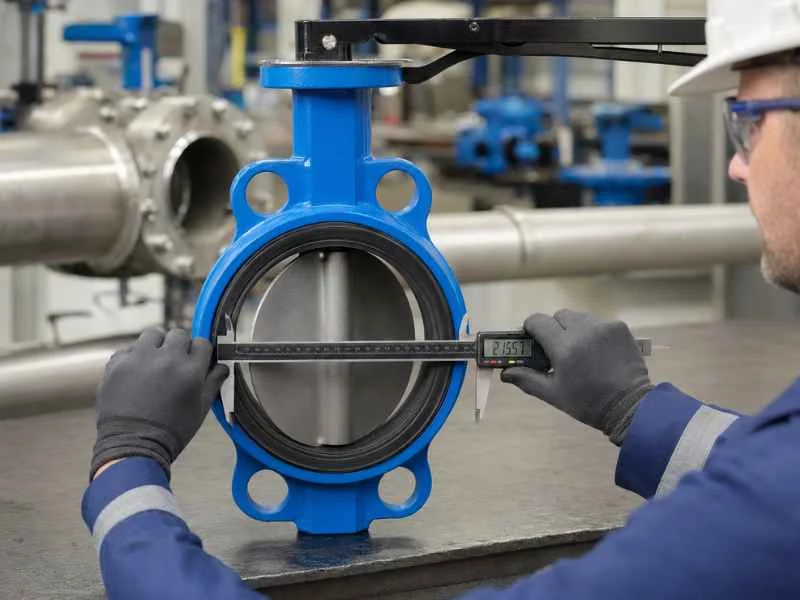
Relying only on pipe size is a common but costly error that often leads to installing an oversized valve. This guide will walk you through the essential factors for accurate butterfly valve sizing, ensuring optimal performance and reliability for your system.
Understanding Flow Coefficient (Cv) for Accurate Sizing
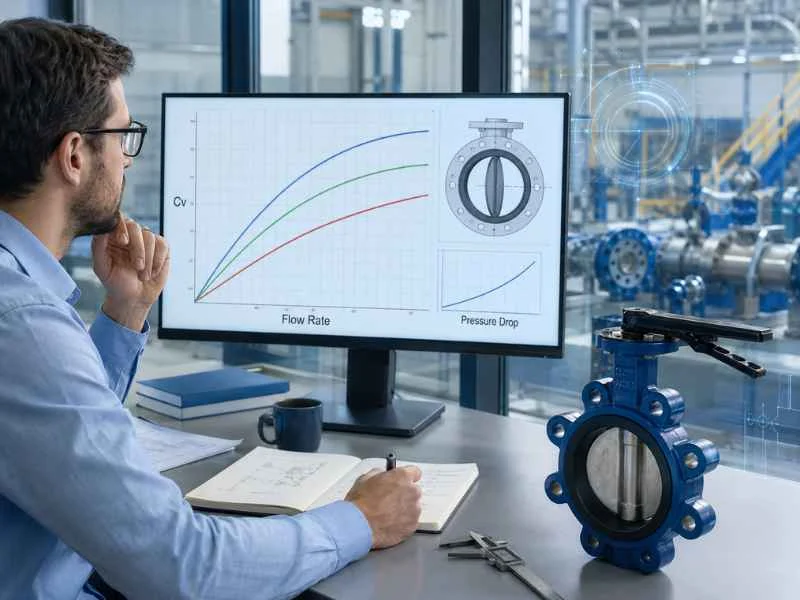
The flow coefficient, or Cv, is the most critical factor in valve sizing. It defines a valve’s capacity to pass fluid and directly impacts its performance in your system.
A valve’s Cv rating represents the volume of water in U.S. Gallons Per Minute (GPM) that will flow through it with a one-pound-per-square-inch (PSI) pressure drop. Calculating the required Cv for your application is the first step toward proper butterfly valve sizing.
Calculating the required Cv is the foundation of hydraulic sizing. For liquids, you can use a standard formula that connects flow rate, pressure drop, and the fluid’s specific gravity. The basic formula is:
Cv = Q * √(SG / ΔP)
Where:
- Cv is the required flow coefficient.
- Q is the flow rate (in U.S. GPM).
- SG is the specific gravity of the fluid (water = 1.0).
- ΔP is the pressure drop across the valve (in PSI).
Once you calculate the required Cv for your normal, minimum, and maximum flow conditions, you can consult a manufacturer’s sizing chart. These charts show the Cv values for a specific butterfly valve model at different opening angles (e.g., 30°, 60°, 90°). Your goal is to choose a valve where your normal operating flow rate occurs around 60-80% of the valve’s opening range. This provides good throttling capability and leaves room for adjustments. Avoid sizing a control valve to operate consistently below 20% or above 90% open, as this can lead to poor control and potential damage.
Remember that calculations for gases and steam are more complex. They involve factors like compressibility, temperature, and different pressure conditions (sub-critical or critical flow). Always use the correct formulas or sizing software for these applications.
Why You Shouldn’t Just Match the Butterfly Valve Size to the Pipe Size
A frequent mistake in valve selection is simply matching the valve’s nominal size to the pipeline’s diameter. This approach ignores the valve’s actual flow capacity and system requirements.
Matching the butterfly valve size to the pipe size often results in an oversized valve. An oversized valve operates at a very small opening angle for throttling duties, leading to poor flow control, seat erosion, and damaging vibration.
An oversized valve is particularly problematic in control applications. For instance, if you install a 10-inch valve in a 10-inch line when a 6-inch valve would suffice, the larger valve will likely operate in the first 10-20% of its rotational travel. In this range, a small change in the disc angle creates a large change in flow. This makes precise control nearly impossible, causing the system to “hunt” for the setpoint.
This low-opening operation also creates a high-velocity jet of fluid through the small gap between the disc and the seat. This jet can quickly erode the resilient seat or damage the metal sealing surfaces, leading to leaks and a short service life. The instability can also cause the disc to flutter or “chatter,” creating noise and mechanical stress on the stem and actuator.
In many cases, the correct approach is to install a smaller, properly sized butterfly valve using concentric reducers to transition from the larger pipe diameter. While this adds the cost of the reducers, it provides significant long-term benefits. The smaller valve is often less expensive, and the improved control and extended lifespan far outweigh the initial installation costs.
| Aspect | Oversized Valve (Matches Pipe Size) | Correctly Sized Valve (Based on Cv) |
|---|---|---|
| Control Range | Poor, operates at <20% open | Excellent, operates at 60-80% open |
| Flow Control | Unstable and difficult | Precise and responsive |
| Seat Wear | High due to jetting and chatter | Normal, even wear |
| Vibration/Noise | High risk of chatter and noise | Minimal, stable operation |
| Lifecycle Cost | High (frequent repairs/replacement) | Low (long service life, reliable) |
| Initial Cost | Higher valve cost | Lower valve cost (offset by reducers) |
Key Factors Beyond Cv: Pressure Drop and Flow Velocity
While calculating Cv is essential, it’s not the only piece of the puzzle. You must also consider the allowable pressure drop and the resulting flow velocity to ensure a safe and reliable butterfly valve size.
A correctly sized valve strikes a balance between an acceptable pressure drop and a safe flow velocity. High velocity can cause erosion, noise, and cavitation, while a very low pressure drop may indicate an oversized valve with poor control characteristics.
The Role of Pressure Drop (ΔP)
Every component in a piping system, including valves, consumes energy from the fluid, which manifests as a pressure drop. When sizing a control valve, you must ensure sufficient pressure drop is available for the valve to effectively regulate flow. If the pressure drop across the valve is too low compared to the total system pressure drop, the valve will have limited authority to control the flow.
As a general engineering guideline for control valves, it is good practice to assign 15-30% of the system’s total dynamic pressure loss to the control valve itself. A smaller valve will create a higher pressure drop for the same flow rate, offering better control. However, this also means more energy is lost. Your sizing must work within the pressure limits your pump can provide and what the process can tolerate.
Checking for Destructive Flow Velocity
Flow velocity through the valve is another critical parameter. If the velocity is too high, it can cause significant operational problems.
- Erosion: High-velocity fluid, especially if it contains abrasive particles, acts like a sandblaster against the valve’s internal components. It can quickly wear away the disc edge and seat, leading to leakage and failure.
- Noise and Vibration: Excessive velocity is a primary source of hydrodynamic noise. In more severe cases, it can lead to cavitation or flashing. Cavitation is the formation and collapse of vapor bubbles, which can cause severe pitting damage to the valve body and downstream piping.
- Actuator Sizing: High velocity also creates high dynamic torque on the valve disc, which must be considered when sizing the actuator to ensure it can reliably open and close the valve.
As a rule of thumb, for clean liquids, the velocity at the valve outlet should generally be kept below 7 m/s (23 ft/s). For fluids with suspended solids, this limit should be much lower. Always verify the manufacturer’s recommended velocity limits for the specific valve model and materials you are considering. A proper butterfly valve size will keep the flow velocity within these safe operating limits.
Frequently Asked Questions (FAQ)
1. What is the most common mistake when choosing a butterfly valve size?
The most common mistake is assuming the valve size should match the pipe size. This often leads to an oversized valve, causing poor control, high seat wear, vibration, and a shortened service life. Proper sizing should always be based on process conditions like flow rate and pressure drop, not just pipe diameter.
2. How does flow rate affect butterfly valve size selection?
Flow rate is a primary factor. You need to calculate the required flow coefficient (Cv) based on your minimum, normal, and maximum flow rates. The goal is to select a valve size where your normal flow rate positions the valve disc between 60% and 80% open. This ensures you have precise control and a stable process.
3. What happens if the butterfly valve size is too large?
An oversized butterfly valve operates in the first few degrees of its opening range. This results in poor throttling control, as a tiny movement causes a large change in flow. It also creates high-velocity jets that erode the seat, cause disc chatter, and lead to premature failure, increasing maintenance costs and downtime.
4. What is the role of the Cv value in determining butterfly valve size?
The flow coefficient, or Cv, measures a valve’s flow capacity. Calculating the required Cv using your system’s flow rate, fluid type, and pressure drop is the most accurate method for sizing. You then match this required Cv to manufacturer’s charts to find a valve that will operate effectively within its ideal control range.
5. How does pressure drop influence the choice of butterfly valve size?
Pressure drop is critical for control. A control valve needs to consume a portion of the system’s energy (pressure) to effectively regulate flow. Sizing a valve for a specific pressure drop ensures it has “authority” over the system. A smaller valve creates a higher pressure drop, which can improve control but also increases energy loss. The selection must balance control needs with system efficiency.
Final Thought
Selecting the correct butterfly valve size is more than just matching a number to your pipe’s diameter. It is a technical decision that balances flow capacity (Cv), pressure drop, and velocity. Getting this right is fundamental to achieving reliable process control, ensuring plant safety, and maximizing the valve’s service life.
Always base your decision on sound engineering calculations. For expert guidance on your specific application and to ensure you choose the most reliable and cost-effective butterfly valve size, contact our team of engineers today.



 English
 Arabic
 Russian
 French
 Spanish