
How to Connect Different Pipe Sizes: A Guide to Reducing Adapters
In plumbing and industrial fluid systems, it’s a common scenario: you have a pipe of one size, but the valve or equipment you need to connect has a different diameter. This mismatch, if not handled correctly, can lead to leaks, inefficient flow, or even system damage. Fortunately, a range of specialized fittings known as reducing adapters are designed precisely for this purpose, allowing you to seamlessly transition between varying pipe sizes.
This guide from BCST Valve will walk you through the essential types of reducing adapters, explain how they work, and provide best practices for choosing and installing them for a secure, leak-free connection. For a broader understanding of all valve adapter challenges, be sure to check out our Complete Guide to Ball Valve Adapters.
Why Do You Need to Connect Different Pipe Sizes?
The need to adapt between different pipe sizes arises in countless situations:
- Integrating New Components: A new pump, filter, or valve might have inlet/outlet ports that don’t match your existing piping.
- Optimizing Flow Rate: Upsizing or downsizing might be necessary to control fluid velocity, pressure drop, or accommodate specific equipment requirements.
- Repair & Retrofit: Replacing an old component with a new one that has different connection sizes.
- Standardization: Adapting to common sizes after a long run of specialized piping.
Using the correct reducing adapter ensures system integrity, maintains optimal flow dynamics, and prevents the creation of weak points prone to leakage.
Key Types of Reducing Adapters
Reducing adapters come in various forms, each designed for specific connection types and pipe materials. Here are the most common ones:
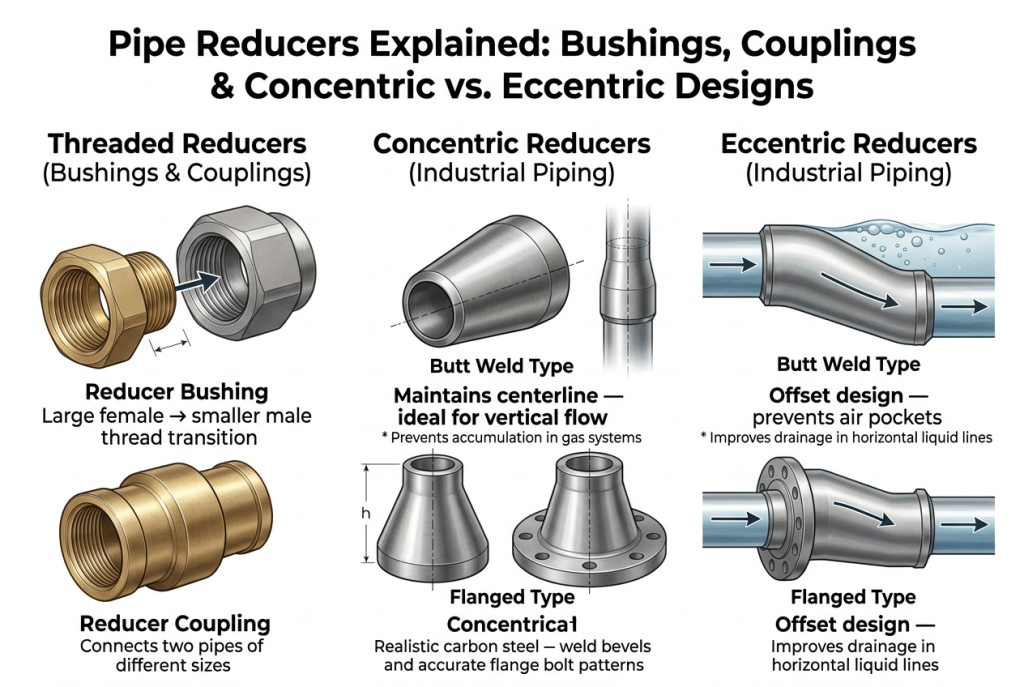
1. Reducer Bushings (Threaded)
A reducer bushing is a compact fitting with male threads on the outside and smaller female threads on the inside. It’s used when you have a larger female threaded port (e.g., on a ball valve or a tee) and need to connect a smaller male threaded pipe.
- Configuration: Male thread (larger size) on the outside, female thread (smaller size) on the inside.
- Example Use: Installing a 1/2″ pipe into a 3/4″ valve port.
2. Reducer Couplings (Threaded)
Reducer couplings are generally used to connect two sections of pipe with different diameters, where both connections are either female or male threads. They act as a direct connector in the line.
- Configuration: Two different sized female threads, or sometimes male/female combinations, designed to couple two pipe ends directly.
- Example Use: Connecting a 1″ pipe to a 3/4″ pipe within a run.
3. Bell Reducers / Reducer Sockets (Socket Weld & Solvent Weld)
These are common in PVC, CPVC, copper, or steel piping systems where connections are made by solvent welding (PVC) or brazing/soldering (copper/steel). They have a larger socket (or bell) on one end and a smaller socket on the other.
- Configuration: Larger female socket on one end, smaller female socket on the other.
- Example Use: Reducing a 2″ PVC line to a 1.5″ PVC line using solvent cement.
4. Concentric & Eccentric Reducers (Butt Weld & Flanged)
Primarily used in larger industrial pipelines (often butt-welding or flanged connections), these reducers transition between two different pipe IDs. They are designed to manage fluid flow and prevent turbulent eddies.
- Concentric Reducer: Cone-shaped, maintaining the centerline of the pipes. Ideal for vertical flow or preventing accumulation in horizontal gas lines.
- Eccentric Reducer: Features an offset design, where one side is flat. Used for horizontal liquid lines to prevent air pockets at the top or improve drainage at the bottom.

5. Specialty Reducers (e.g., Push-to-Connect)
Modern plumbing offers solutions like push-to-connect reducers that can connect different sizes of PEX, copper, or CPVC piping without special tools.
How to Choose the Right Reducing Adapter
Selecting the correct adapter is crucial. Consider these factors:
- Identify Both Pipe Sizes: Measure the nominal pipe size (NPS or DN) of both the larger and smaller connections. Don’t confuse outer diameter (OD) with nominal size.
- Determine Connection Type: Are both ends threaded (male/female)? Is one a socket for welding/gluing? Is it flanged?
- Verify Thread Standards: If threaded, ensure you know if they are NPT, BSPP, or BSPT. Mixing these will lead to leaks.
- Material Compatibility: The adapter’s material must be compatible with the fluid, pressure, temperature, and surrounding pipe material. Brass, stainless steel, PVC, and CPVC are common choices.
- Pressure and Temperature Ratings: The adapter’s ratings must meet or exceed your system’s operating conditions.
- Flow Impact: Consider if the reduction will cause an unacceptable pressure drop or flow restriction for your application.
Step-by-Step Installation Best Practices
Once you’ve selected the right reducing adapter, follow these general steps for a secure installation:
Tools Needed:
- Wrenches (for threaded), solvent cement & primer (for PVC), soldering torch & solder (for copper).
- Pipe thread sealant (PTFE tape or pipe dope) for threaded connections.
- Pipe cutters/hacksaw, deburring tool.
- Safety glasses and gloves.
Procedure:
- Safety First: Turn off the water supply, depressurize the system, and drain any fluid from the line you’re working on. Use lockout/tagout procedures in industrial settings.
- Prepare Pipes: Cut pipes cleanly and precisely. Deburr the edges to prevent damage to seals or obstructions to flow. Clean the pipe ends (e.g., with sandpaper for copper, cleaner for PVC).
- Apply Sealant (Threaded Adapters): Apply 2-3 wraps of PTFE (Teflon) tape clockwise to the male pipe threads, or a quality pipe dope. Ensure no sealant enters the pipe to avoid contamination.
- Install the Adapter:
- Threaded: Hand-tighten the adapter, then use wrenches (one to hold the valve/pipe, one to turn the adapter) to tighten securely. Do not over-tighten, which can crack fittings or strip threads.
- Socket Weld (PVC/CPVC): Apply primer to both pipe and fitting, then solvent cement evenly. Insert pipe fully into the socket and give a quarter turn to distribute cement. Hold for 30 seconds.
- Sweat (Copper): Thoroughly clean and flux the pipe and fitting. Heat evenly and feed solder into the joint until a complete seal is formed.
- Connect the Second Pipe: Repeat the preparation and installation steps for the other side of the adapter, connecting the second, different-sized pipe.
- Test for Leaks: Slowly restore water pressure to the system. Inspect all connections carefully for any signs of leaks. Tighten slightly if minor weeping occurs, or disassemble and re-do if leaks persist.
Common Mistakes to Avoid
- Ignoring Thread Type: Assuming all threads are the same (e.g., NPT vs. BSP) is the quickest way to leaks.
- Cross-threading: Starting the threads improperly, which damages both the pipe and the adapter.
- Over-tightening: Can crack fittings (especially plastic), strip threads, or deform metal components, leading to failure.
- Not Using Sealant: For tapered threads (NPT, BSPT), sealant is critical. For parallel threads (BSPP), an appropriate gasket is needed.
- Incompatible Materials: Mixing metals without a dielectric union can lead to galvanic corrosion.
- Inadequate Support: Heavy valves or long runs of pipe need proper support to prevent stress on connections.
Conclusion
Connecting pipes of different sizes is a fundamental skill in fluid handling, and selecting the right reducing adapter is key to a robust, leak-free system. By understanding the various types of adapters available and following careful installation practices, you can confidently tackle any pipe size transition.
At BCST Valve, we provide a wide range of high-quality ball valves and accessories, including durable reducing adapters, designed to meet the demands of any application. Our commitment to precision ensures reliable performance wherever you need to manage fluid flow.
Have unique pipe transition challenges?


 English
 Arabic
 Russian
 French
 Spanish