
Unlocking Serviceability and Ease of Maintenance
In any fluid handling system – be it plumbing, industrial processing, or irrigation – the ability to isolate and control flow is paramount. Ball valves are a
go-to choice for their reliability and quarter-turn operation. However, a standard ball valve, once installed, can become a permanent fixture, making maintenance or replacement a headache. This is where the simple yet incredibly ingenious addition of a union transforms the game, offering unparalleled serviceability and long-term cost savings.
This definitive guide from BCST Valve will pull back the curtain on the magic of ball valves with unions. We’ll explore what these indispensable components are, their fundamental benefits, the different types available, common materials, and what to consider for selection. Whether you’re a seasoned plumber, an advanced DIYer, a pool maintenance professional, or an MRO technician, understanding the strategic advantage of a removable ball valve is crucial for efficient and well-designed systems.
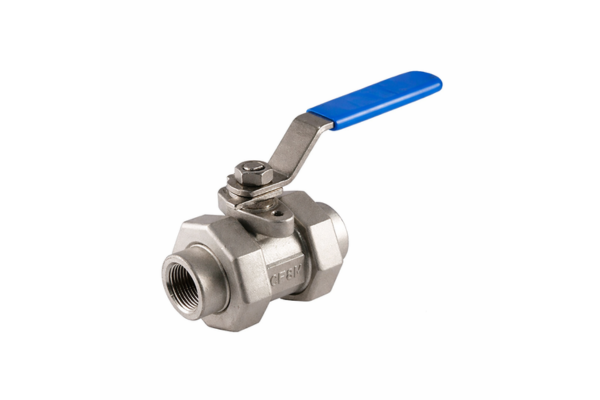
What is a Union and Why Does It Matter for Ball Valves?
At its core, a union fitting is a type of pipe fitting that allows permanent pipe sections to be joined together or disconnected without disturbing the entire pipeline. It typically consists of three parts:
- A female threaded end or solvent weld end.
- A male threaded end or solvent weld end.
- A nut that draws the two ends together, often compressing a gasket for a leak-tight seal.
When integrated into a ball valve – creating a “ball valve with union” – this design becomes incredibly powerful. Instead of needing to cut pipes, apply heat for soldering, or struggle with difficult-to-reach threaded connections when a valve needs servicing or replacement, the union allows you to simply unscrew the nut, remove the valve, and then reinstall or replace it with ease.
The Core Benefit: Unmatched Serviceability and Cost Savings
The primary advantage of a ball valve with unions is its inherent serviceability. Imagine a critical piece of equipment breakdown in an industrial plant or a leak in your home’s main water shut-off. If the primary isolation valve is hard-piped, replacing it could mean hours of labor, pipe cutting, re-soldering/re-gluing, and significant system downtime.
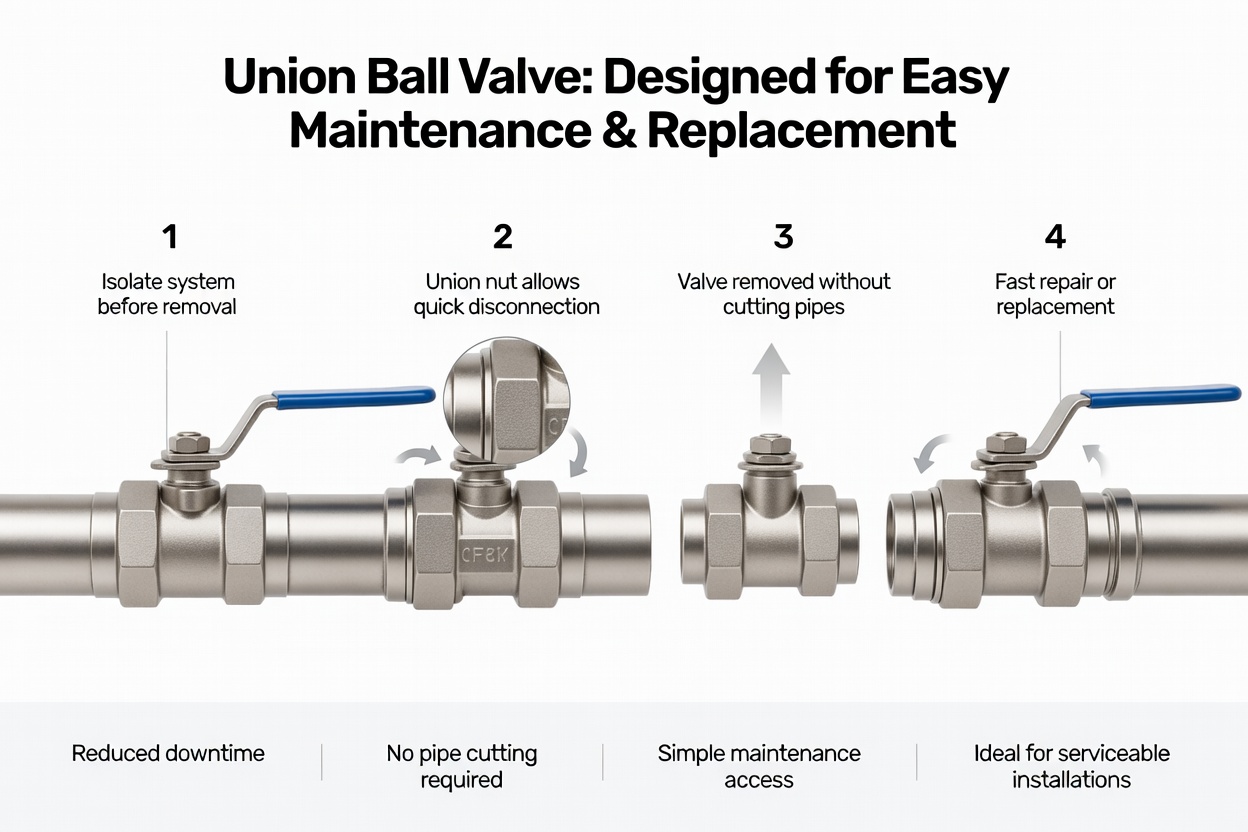
With a union ball valve, the process is streamlined:
- Close the union valve and upstream isolation valve.
- Simply loosen the union nut(s).
- Remove the valve from the line without disturbing the piping.
- Replace or repair, and then reassemble.
This ability to remove a valve without cutting pipe saves enormous time and money in labor, materials, and reduced operational downtime. We break down the full impact in Why Your Plumbing System Needs Serviceable Valves: 3 Key Benefits.
Types of Ball Valves with Integrated Unions
While the core concept remains the same, union ball valves come in different configurations to suit varying needs:
- Standard Ball Valve with One or Two Unions: These are standard ball valves that have union connections integrated into one or both ends. If it has only one union, the other end is typically a fixed connection (e.g., threaded, solvent weld).
- True Union Ball Valve: This is the ultimate in serviceability. A “true union” ball valve features a union on *both* ends of the valve body. This allows the entire center section of the valve to be removed from the line by unscrewing two nuts, leaving the piping undisturbed. This design is exceptionally convenient for situations where the main valve body or internal components need frequent inspection, cleaning, or replacement.
While adding unions to any valve provides benefits, a specific design known as a ‘true union’ offers maximum serviceability. We explore the critical differences in our expert comparison: True Union vs. Standard Ball Valves: Which Should You Choose?
Common Materials for Union Ball Valves
Ball valves with unions are available in a variety of materials, each suited for different applications based on media compatibility, temperature, pressure, and cost.
- PVC (Polyvinyl Chloride): Lightweight, corrosion-resistant, and cost-effective. Ideal for cold water lines, irrigation, pools, and low-pressure chemical applications. Limited temperature range.
- Brass: Durable, rust-resistant (though not truly corrosion-proof), and suitable for a wide range of temperatures and pressures. Commonly used in residential and commercial plumbing for water and natural gas.
- Stainless Steel (304, 316): Offers superior corrosion resistance to brass, especially 316 in marine or chemical environments. Excellent for high-temperature and high-pressure industrial applications, food processing, and aggressive media.
- CPVC (Chlorinated Polyvinyl Chloride): Similar to PVC but with a higher temperature rating, making it suitable for hot water applications.
Connection Types and Installation Considerations
The type of connection integrated into the union will dictate how it attaches to your piping system:
- Threaded (NPT): Common for residential, commercial, and industrial applications. Requires thread sealant (tape or compound).
- Solvent Weld (Slip): Primarily for PVC and CPVC systems. Requires primer and solvent cement for a strong, permanent bond.
- Solder (Sweat): For copper piping, requiring flux and solder.
Where are Ball Valves with Unions Most Effective? (Applications Overview)
Studies said, True Union valves made from thermoplastics like PVC, CPVC, or PVDF are the “gold standard” for chemical processing. The serviceability offered by union ball valves makes them highly desirable in a multitude of applications where future maintenance or replacement is a certainty. This serviceability is not just a convenience; it’s a necessity in many systems.
- Residential Plumbing: Main shut-off valves, water heater connections, manifold systems, and any appliance connection (washer, dishwasher, filter systems).
- Commercial Buildings: HVAC systems, process water lines, equipment bypass lines.
- Pool & Spa Systems: Essential for pumps, filters, and heater bypasses to facilitate easy winterization and equipment servicing.
- Industrial Applications: Any process line requiring frequent valve inspection, cleaning, or replacement due to aggressive media, high cycle counts, or critical uptime requirements. Think chemical dosing, water treatment, or lubrication systems.
- Irrigation: Pump connections and master shut-off points.
Learn where they are most effective in our guide to the Top 5 Applications for a Ball Valve with Union.
Conclusion: Embrace Serviceability, Save Time and Money
The inclusion of unions transforms a standard ball valve from a potential replacement nightmare into a versatile, easily maintainable component. By investing in ball valves with unions, you’re not just buying a valve; you’re investing in the future serviceability, efficiency, and cost-effectiveness of your entire fluid handling system. For plumbers and technicians, they are a professional courtesy; for system owners, they are an operational boon.
At BCST Valve, we specialize in manufacturing high-quality ball valves across various materials and configurations, including innovative union designs. Our commitment to durability and intelligent engineering ensures your systems run smoothly and maintenance is always manageable.
Ready to upgrade your system with serviceable ball valves?


 English
 Arabic
 Russian
 French
 Spanish