
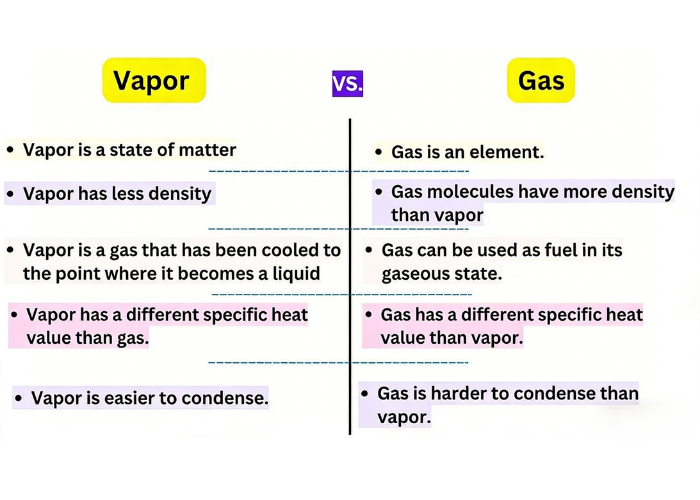
Sizing a valve for a “gas” seems simple, right? But if that gas is actually a vapor, like steam, a small drop in temperature can turn it back into a liquid, causing catastrophic failure.
The key difference is their state at room conditions. A gas, like oxygen, exists naturally as a gas. A vapor is the gaseous phase of a substance, like water, that is normally a liquid. This distinction is crucial for predicting how it will behave under pressure and temperature changes.
What Makes a Liquid Behave So Predictably?
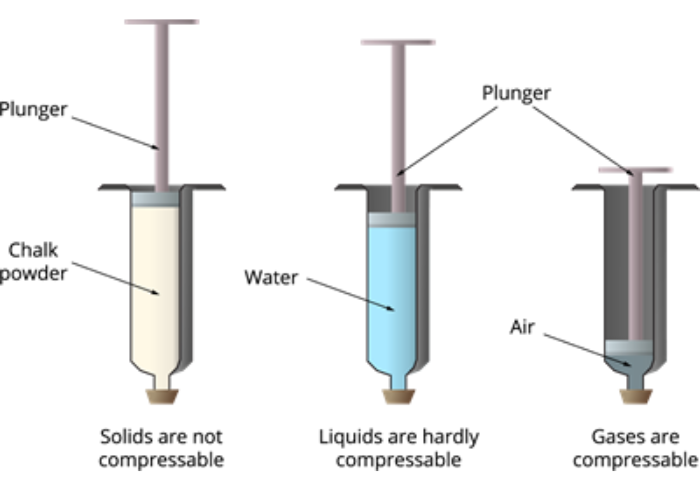
Are you assuming that all fluids are compressible? For liquids, this is a dangerous mistake. Their predictable volume is a core principle in engineering, but it also creates immense risks if not handled correctly.
A liquid is a state of matter with a definite volume but no fixed shape. Its molecules are closely packed but can still move past one another, allowing it to flow. This makes it virtually incompressible, a property critical for hydraulics.
Why Liquids Are Considered Nearly Incompressible in Engineering
When you look at a liquid like water or oil, its nature seems simple. It takes the shape of its container but doesn’t expand to fill it. This behavior comes from the forces between its molecules. They are strong enough to keep the molecules close together, giving the liquid its fixed volume. However, they aren’t strong enough to lock them into a rigid structure like a solid.
This incompressibility is a double-edged sword in industrial settings.
- The Advantage: We use this property in hydraulic systems. Pushing on a liquid in a sealed pipe transfers force almost perfectly, allowing us to lift heavy things with minimal effort.
- The Danger: Because it can’t be compressed, if you trap liquid in a pipe and heat it, it will expand. This thermal expansion can create enormous pressure, easily high enough to rupture a pipe or destroy a valve. That’s why relief valves are non-negotiable in any system that can trap liquid.
Hassan once told me about a junior engineer who failed to account for thermal expansion in a pipeline carrying hydraulic oil. They installed isolation valves at both ends. On a hot day, the sun heated the pipe, and the trapped oil expanded. The pressure built up until a valve bonnet failed, spraying hot oil everywhere. It was a costly lesson in the fundamental properties of a liquid.
How Are Gases Fundamentally Different from Liquids?
Ever used a single regulator for both compressed air and propane? This could be a critical error. Gases have unique properties, and assuming they all behave identically ignores crucial differences in density, flammability, and reactivity.
A gas is a state of matter with no fixed shape and no fixed volume. Its molecules are far apart and move randomly and rapidly. This allows a gas to expand to fill any container and makes it highly compressible.
Why Gas Molecules Move Freely and Expand Easily
The defining characteristic of a gas is the freedom of its molecules. The intermolecular forces are so weak that the molecules fly around independently, only interacting when they collide. This leads to key physical properties that stand in stark contrast to liquids.
| Property | Liquid | Gas |
|---|---|---|
| Volume & Shape | Fixed volume, takes shape of container. | Expands to fill volume and shape of container. |
| Molecular Spacing | Close together. | Very far apart. |
| Movement | Molecules slide past each other. | Molecules move randomly and at high speed. |
| Compressibility | Nearly incompressible. | Highly compressible. |
In an industrial plant, we use gases for everything from inerting tanks with nitrogen to fueling furnaces with methane. When selecting a valve for gas service, you have to think differently. For a liquid, you’re primarily concerned with pressure rating and material compatibility. For a gas, you also have to consider the seat leakage rate. Since gas molecules are so small and energetic, they can find their way through tiny gaps that would easily hold a liquid. That’s why valves for critical gas applications, like hydrogen, often require special soft seats and rigorous bubble-tight testing.
So, What Exactly Makes a Vapor So Special?
Why do we have a separate word, “vapor,” if it’s just a substance in a gaseous state? The distinction is critical because a vapor is always close to its condensation point, and treating it like a true gas is asking for trouble.
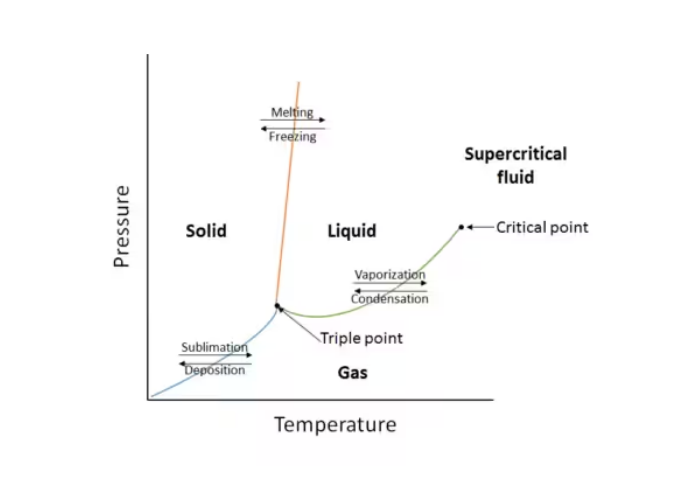
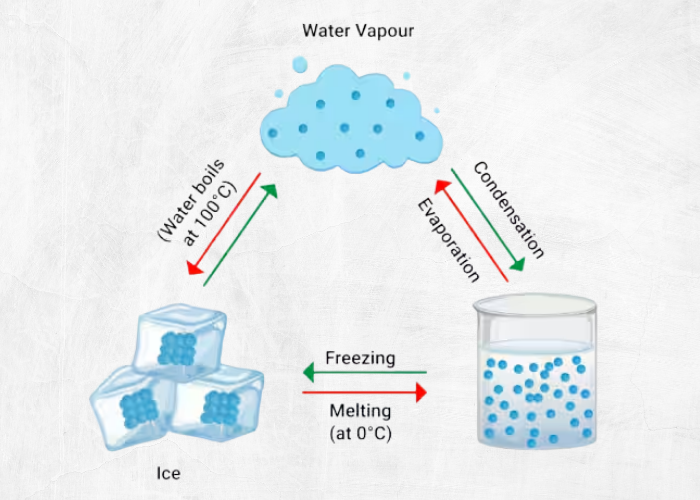
A vapor is the gaseous phase of a substance that is normally a liquid or solid at room temperature and pressure. Unlike a “true” gas, a vapor can be turned back into a liquid by simply increasing the pressure, without lowering the temperature.
Why Vapor Exists Close to the Liquid Phase
The single most important difference between a vapor and a gas is its relationship to its liquid phase. A vapor is essentially a gas that hasn’t forgotten it was once a liquid. This makes it temperamental.
- Gas: To turn a gas like nitrogen into a liquid, you have to cool it down to an extremely low temperature (-196°C).
- Vapor: To turn a vapor like steam back into a liquid (water), you just have to cool it down a little bit or squeeze it hard enough.
This brings us to two crucial types of vapor:
- Saturated Vapor (or Saturated Steam): This is vapor at the exact boiling point for its pressure. It’s in perfect equilibrium with its liquid phase. If you remove any heat, some of it will immediately condense into water. This mixture of steam and water droplets is very common in industrial systems.
- Superheated Vapor (or Superheated Steam): This is vapor that has been heated above its boiling point. It behaves much more like a true gas because it’s not on the verge of condensing.
When sizing a control valve, Hassan always asks, “Is it for superheated steam or saturated steam?” A control valve for saturated steam must be able to handle potential water droplets (condensate) and the “flashing” that can occur as pressure drops. Using the wrong valve can lead to severe erosion and failure in a matter of weeks. The vapor vs. gas distinction isn’t academic; it’s a fundamental engineering reality.
What Are the Biggest Misconceptions About Vapor and Gas?
Do you think steam is just hot, wet air? This misunderstanding can lead to serious design flaws. The truth is that a vapor’s behavior is far more complex and requires a deeper understanding to manage safely.
The most common misconception is that vapor and gas are the same. In reality, their key difference lies in their thermodynamic conditions. A superheated vapor behaves like a gas, but a saturated vapor is a completely different beast, ready to condense at a moment’s notice.
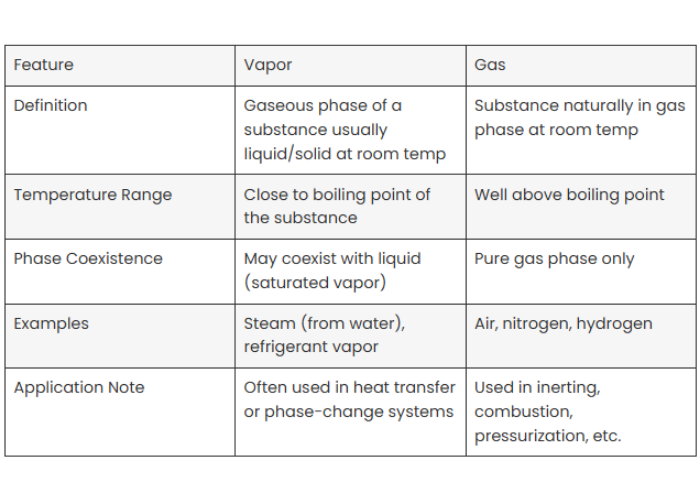
Common Myths and the Scientific Facts
Let’s tackle these misunderstandings head-on. Getting this right is crucial for anyone working in process industries.
Myth 1: Vapor is always a mix of liquid and gas.
This is only true for saturated vapor. Superheated vapor is 100% in the gaseous phase and contains no liquid droplets. It is “dry.” You can put your hand in superheated steam without getting wet (though you would be severely burned!).
Myth 2: The molecules of vapor and gas are physically different.
At the microscopic level, a molecule of water vapor (H₂O) is identical to a molecule of liquid water. The difference isn’t in the molecule itself, but in the energy it possesses and the space between it and its neighbors. A water vapor molecule and an oxygen gas molecule both behave according to the gas laws when they are far apart from other molecules.
The Critical Distinction: Origin and Proximity to Phase Change
The real difference is all about context:
- Origin: Vapors originate from liquids (or solids) through boiling or evaporation. True gases exist as gases under normal conditions.
- Thermodynamic State: This is the most important part for engineers. A vapor exists at a temperature and pressure where it can coexist with its liquid phase or be easily returned to it. A gas exists far from its condensation point under normal operating conditions.
This is why Hassan specifies different types of valves and even different pipeline designs for air systems versus steam systems. An air line can have low points without much issue. A steam line with a low point will collect condensate, which can lead to dangerous “water hammer” if not properly drained.
FAQs
1. Is steam a vapor or a gas?
Steam is the vapor of water. When it is at its boiling point, it’s a saturated vapor. When heated further, it becomes a superheated vapor, which behaves very much like a gas.
2. Can a vapor exist below the boiling point?
Yes. Evaporation allows a liquid to turn into a vapor at any temperature. The steam you see rising from a warm cup of coffee is water vapor.
3. What is easier to compress, a liquid or a gas?
A gas is much easier to compress because its molecules are very far apart. A liquid is considered incompressible for most practical engineering purposes.
4. Why is the liquid, vapor, and gas difference important for valves?
It affects everything: sizing (due to density differences), material selection (for temperature), and seat design (for sealing). A valve for a gas may not handle the two-phase flow of a wet vapor.
Conclusion
The differences between liquid, vapor, and gas are not just textbook definitions. They are fundamental principles that dictate how we safely design, operate, and maintain industrial process control systems.


 English
 Arabic
 Russian
 French
 Spanish