
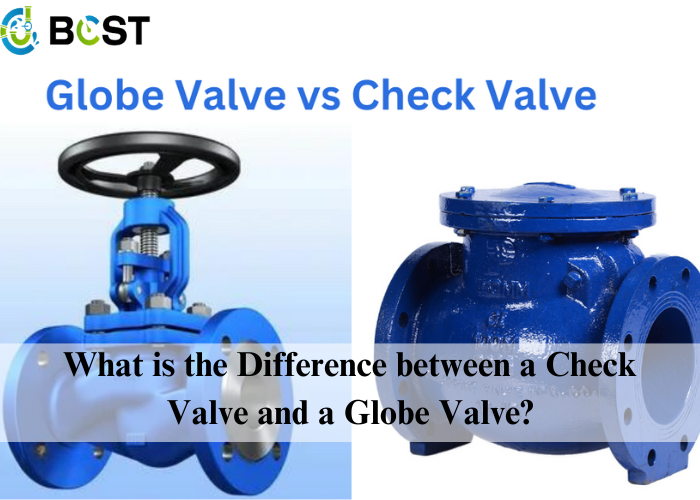
In industrial manufacturing and pipeline engineering, check valves and globe valves are two common types of valves. Although they are somewhat similar in appearance and function, there are significant differences in their operating principles, structural design, applicable scenarios and usage. Understanding these differences for the selection and proper use of these two valves is essential, especially in ensuring system efficiency and safety.
Ⅰ. The basic concept and working principle of the check valve
Check valve (Check Valve), also known as one-way valve or check valve, is a kind of automatic valve used to prevent the media back flow. Its working principle is very simple, when the pipeline medium flows in a predetermined direction, the valve opens; and when the medium tries to flow backward, the valve flap in the medium of the reaction force automatically closed, thus preventing the occurrence of back flow.
1.1 The structure of Check valve
Check valve is usually composed of valve body, valve cover, valve flap and spring and other major components. According to the different design, check valve can be divided into swing check valve, lift check valve and butterfly check valve and other types.
– Swing check valve: the valve flap rotates around the hinge axis, and the internal flow path of the valve body is designed at a certain angle, so that the valve flap opens when the fluid flows in the forward direction, and closes when it flows in the reverse direction.
– Lift check valve: the valve flap rises or falls along the straight line direction within the valve body, when the fluid flows in the forward direction, the valve flap is lifted up, and when it flows in the reverse direction, the valve flap falls down and closes automatically under the action of gravity or spring force.
– Butterfly type check valve: adopts flake type valve flap, in forward flow, the valve flap is pushed open, while in reverse flow, the valve flap will be closed automatically under the action of fluid pressure.
1.2 Application of check valves
Check valves are mainly used to prevent the media back flow occasions, such as the outlet end of the pump, to prevent the media back flow damage to the equipment; or in some of the process with stringent health requirements, to prevent pollutants back flow into the clean piping system. Check valve in the piping system is usually automatic operation, without external control signals, which makes it in the need for high reliability and low maintenance applications are very suitable.
Ⅱ. The basic concept and working principle of the globe valve
Globe valve (Globe Valve), is a widely used to cut off or regulate the flow of fluid valves. Unlike check valves, the operation of globe valves usually requires the participation of manual or automatic control system, which mainly realizes the control of fluid by moving the distance between the valve flap and the valve seat.
2.1 Structural composition of globe valve
The structure of globe valve is relatively complex, mainly including valve body, valve cover, valve stem, valve flap and handwheel (or actuator) and other parts. Valve flap through the valve stem to adjust the degree of contact with the valve seat, thereby controlling the fluid and flow.
– Straight-through globe valve: fluid flows through the valve body in a straight line, and the valve flap usually moves perpendicular to the direction of the fluid.
– Right-angle globe valve: fluid in the valve body to change direction, usually used for large angle, space constraints.
– Y-type globe valve: designed to reduce the form of fluid resistance, the valve body and the direction of the fluid to form a certain angle, so that the fluid can pass more smoothly.
2.2 Application Scenarios of Globe Valves
Globe valves are mainly used in occasions that require precise adjustment and reliable closure, such as in petroleum, chemical, electric power and other industries, to strictly control and regulate the fluid medium. Due to the excellent sealing performance of the globe valve, it needs to be frequently opened and closed and high pressure, high temperature conditions are especially widely used.
Ⅲ. The main difference between check valves and globe valves
3.1 Functional differences
The main function of the check valve is to prevent back flow of media, to ensure that the fluid in the piping system can only flow in one direction. It is automatic, does not require external power or manual operation. While the globe valve is mainly used to cut off and regulate the flow of fluid, its functions are diverse, can be manually or automatically controlled to achieve precise control of the flow of media.
3.2 Structure design differences
Check valve structure is relatively simple, usually does not have the function of regulating the flow, it is designed to focus on the ability to quickly close the medium back flow. The structure of the globe valve is relatively complex, through the valve stem, valve and other parts of the precision cooperation, in order to realize the effective control of the fluid.
3.3 Difference in Installation and Usage Scenarios
Check valves are usually installed at the outlet of pumps or in places where back flow needs to be prevented, while globe valves are widely used in piping systems where precise flow control is required. Check valves can only be installed in horizontal or vertical upward flow pipelines, while the installation direction of globe valves is more flexible.
3.4 Difference in operation
Check valves rely on the flow of the medium itself to work without manual intervention. Globe valve needs to be opened and closed by manual or automatic operation, the operation process can be very precise.
Ⅳ. Check valve and globe valve selection recommendations
In the selection of check valves and globe valves, need to take into account the specific requirements of the piping system, the characteristics of the medium, the ease of operation and maintenance of the complexity. Usually, if you need to prevent back flow of media and do not need to regulate the flow, then the check valve is the most appropriate choice; and if you need to accurately control the flow, or need to operate the valve frequently, you should choose the globe valve.
4.1 Check valve selection recommendations
When selecting check valves, the following factors need to be emphasized:
– The flow characteristics of the medium: for example, the viscosity of the medium, corrosiveness, etc., will affect the selection of check valves.
– The opening pressure of the valve: the opening pressure of the check valve should be matched with the system pressure to avoid back flow of media or the valve can not be opened properly.
– Installation space and location: the installation location of the check valve is usually more fixed, so in the selection of the need to pay attention to the requirements of the installation space.
4.2 Globe valve selection recommendations
When selecting globe valves, the following aspects should be paid attention to:
– Medium characteristics: different media will affect the choice of valve materials, such as corrosive media may require corrosion-resistant material globe valve.
– Operation mode: manual operation or automated control, you need to decide the valve operation mode according to the process requirements.
– Sealing performance: for high-pressure and high-temperature conditions, sealing performance is particularly critical, selection should be selected with excellent sealing performance of the globe valve.
V. Summary
Check valves and globe valves may be similar in appearance, but they have significant differences in function, structure, application scenarios and mode of operation. In the actual engineering applications, understand and master the difference between the two types of valves, to ensure the stable operation of piping systems and extend the service life of the equipment is of great significance.
Check valves are suitable for the need to prevent back flow of media occasions, while the globe valve is more for the need to control the flow or completely cut off the fluid piping system. In practice, choosing the right type of valve can not only improve system efficiency, but also reduce maintenance costs and operational complexity. Therefore, a proper understanding and application of the differences between these two types of valves is the key to ensuring the safe and reliable operation of industrial systems.


 English
 Arabic
 Russian
 French
 Spanish