
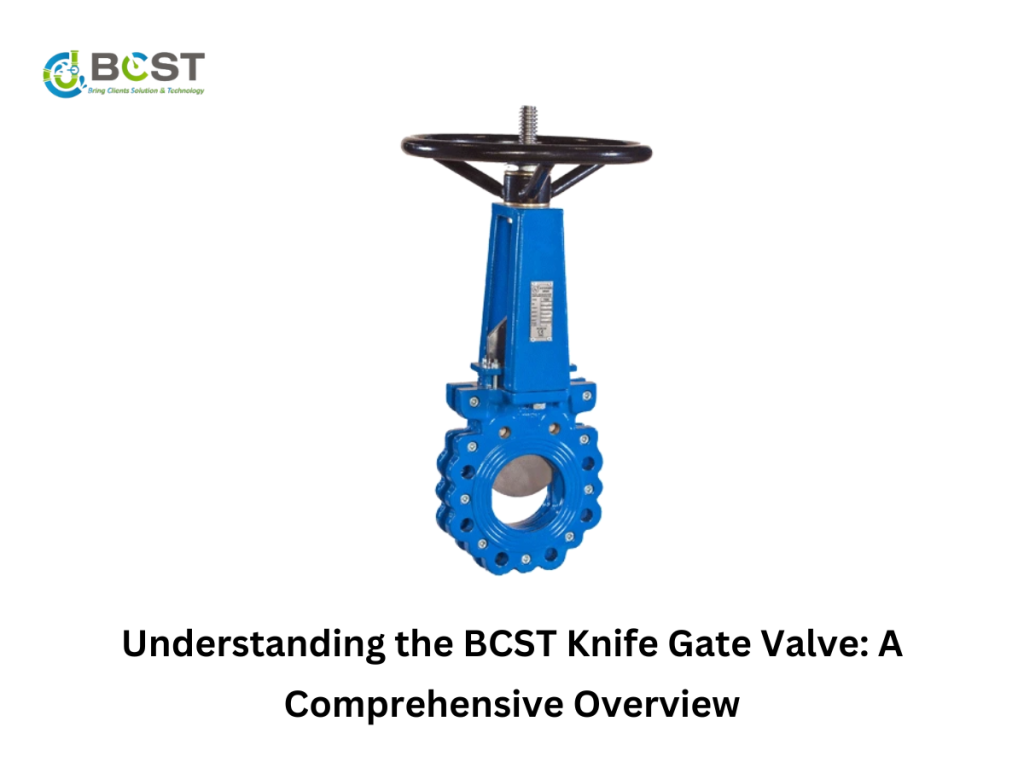
The knife gate valve is an essential tool in various industries due to its unique design and functionality. This valve is particularly well-suited for handling difficult-to-control fluids like slurry, powder, and fiber, making it invaluable in sectors such as paper making, petrochemicals, mining, drainage, and food processing.
Types of BCST Knife Gate-Valves
BCST offers a diverse range of knife-gate valves, each designed to meet specific industrial requirements:
- Bi-directional Knife Gate Valve: This type allows flow in both directions, enhancing versatility in complex piping systems.
- Bolted Bonnet Knife Gate Valve: Known for its robust design, this valve ensures a tight seal and easy maintenance.
- Through Conduit Knife Gate Valve: Ideal for applications requiring minimal flow disruption, this valve provides a smooth passage for fluids.
- Square Knife Gate Valve: Designed for applications involving square piping systems, ensuring compatibility and efficient flow control.
- Electric Actuated Knife Gate Valve: Offers precise control through electric actuation, perfect for automated systems.
- Electric Hydraulic Knife Gate Valve: Combines electric control with hydraulic power for high-pressure applications.
- Hydraulic Knife Gate Valve: Operates on hydraulic power, suitable for heavy-duty industrial tasks.
- Bevel Gear Knife Gate Valve: Features bevel gear operation for smooth and easy manual control.
- Handle Wheel Knife Gate-Valve: A traditional option with manual operation, suitable for straightforward applications.
Knife Gate Valve Quality Control
BCST’s commitment to quality is evident in its rigorous quality control processes. Each valve undergoes meticulous checks and tests to ensure it meets the highest standards:
Design and Technical Validation
- Technical Software Calculation: Advanced software is used to design and simulate valve performance.
- Technical Team Meeting: Collaboration among experts ensures the design meets all operational requirements.
- CAD Drawing Confirmation: Final designs are validated through detailed CAD drawings.
Raw Material Inspection
- Chemical Analysis: Ensures the material’s chemical composition meets industry standards.
- Mechanical Property Checks: Tests for strength, flexibility, and durability.
- Dimension Checks: Precise measurements ensure components fit perfectly.
- Visual Checks: Manual inspection for surface defects.
- Non-destructive Examination: Ensures material integrity without causing damage.
Machining and Component Testing
- CNC Machining: Precision machining for accurate component fabrication.
- Visual and Dimensional Checks: Ongoing inspections during production.
- Liquid Penetration Test: Detects surface cracks or defects.
- Spare Part Test: Includes visual checks, hardness tests, and lapping to ensure component quality.
Assembly and Hydrostatic Testing
- Installation and Calibration: Ensures the valve functions correctly upon assembly.
- Hydrostatic Tests: Multiple tests, including shell, sealing, leakage, air, and function tests, verify the valve’s reliability under pressure.
Final Treatment and Packing
- Surface Polish and Painting: Enhances durability and resistance to environmental factors.
- Visual Inspection: Final check before packing.
- Thickness Checks: Ensures the coating meets specified thickness for protection.
- Packing: Securely packed in marked, export-grade wooden boxes for safe transportation.
FAQs
1. What Are the Differences Between that Valve and a Gate Valve?
The main differences lie in their application areas, function, and structure:
- Application Areas:
- These Valves are ideal for slurry, powder, and liquid applications, commonly used in pulp and paper, mining, food, and wastewater treatment industries.
- Gate Valves are typically used in potable water systems, such as mains and distribution networks.
- Function:
- These Valves use a sharp blade to cut through tough fluids, providing quick shutoff.
- Gate Valves control fluid flow by raising or lowering a gate, more suitable for regulating flow and pressure.
- Structure:
- These Valves have a thin, sharp disc for cutting through media, with an O-ring for sealing.
- Gate Valves feature a thicker gate plate, usually with a metal-to-metal seal, controlled by a screw mechanism.
2. Sealing Mechanism Differences:
- Gate Valves: Rely on external force to press the gate to the valve seat, ensuring a tight seal.
- Knife Gate Valves: Utilize medium pressure to press the sealing surface against the gate, offering a self-sealing capability.
3. Which Valve Should You Choose?
- Knife Gate Valve: Choose this for applications requiring rapid fluid shutoff and where space is a concern.
- Gate Valve: Opt for this when you need precise flow and pressure control.
BCST valves stand out for their light operation, compact design, and ease of installation and dismantling. They are engineered for durability and efficiency, making them a superior choice in many industrial applications. If you’re interested in learning more or purchasing these valves, visit BCST’s website for further details.


 English
 Arabic
 Russian
 French
 Spanish