
The burgeoning industry of Carbon Capture, Utilization, and Storage (CCUS) presents unique challenges for fluid control, especially when dealing with Supercritical CO2. This isn’t just high-pressure CO2 vapor; it’s a fluid unlike any other, demanding specialized engineering solutions. For operators involved in carbon capture skids, the stark reality is that standard control valves, designed for conventional liquids or gases, inevitably fail.
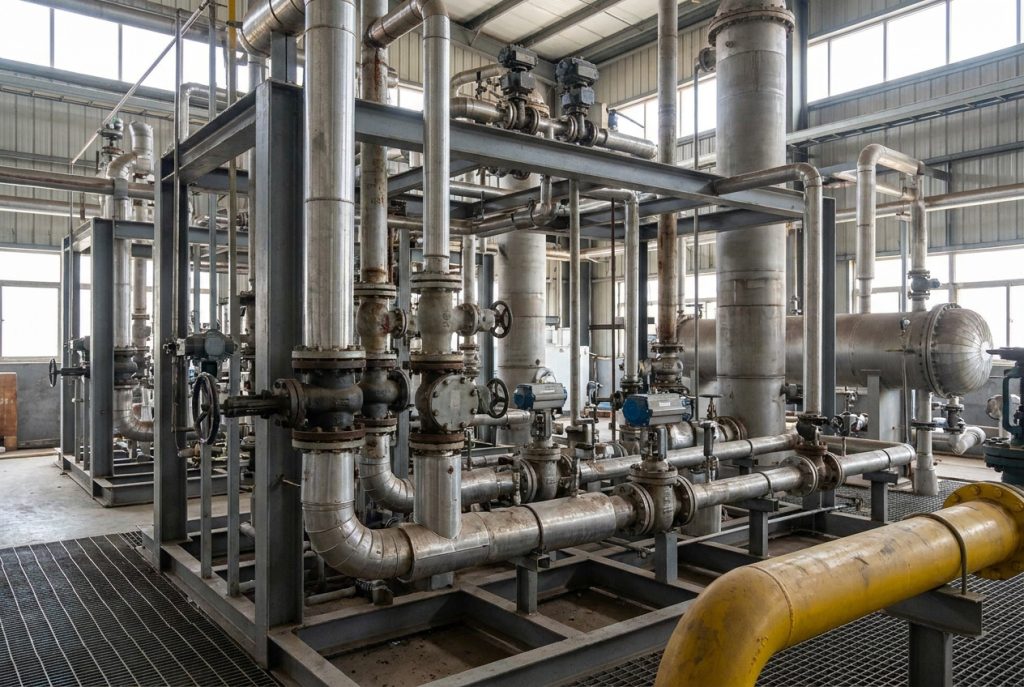
The Supercritical CO2 Paradox: Neither Liquid Nor Gas
Supercritical CO2 (sCO2) exists above its critical temperature (31.1°C) and critical pressure (7.38 MPa or 1070 psi). In this state, it exhibits properties characteristic of both a liquid and a gas: it has a gas-like viscosity and diffusivity but a liquid-like density, making it a powerful solvent and an energy-efficient working fluid.
Density and Viscosity at Supercritical Conditions
The behavior of Supercritical CO2 is highly sensitive to small changes in temperature and pressure around its critical point. Its density can fluctuate dramatically, affecting mass flow rates and creating complex control challenges. Its low viscosity, similar to gas, means it can leak through seals that would hold liquids, yet its high density means a small leak can translate to significant mass loss.
The Core Problem: Phase Change Management
Supercritical CO2 is notorious for rapidly flashing into vapor or condensing into liquid with minor pressure or temperature changes. This unpredictable phase behavior is the root cause of many CCUS valve failure incidents.
Why Standard Valves Fail: The Joule-Thomson Effect & Elastomer Degradation
Conventional control valves are not designed to handle the temperamental nature of Supercritical CO2. Their limitations become glaringly apparent in carbon capture skids.
1. The Joule-Thomson Effect Problem: Actuator Freezing
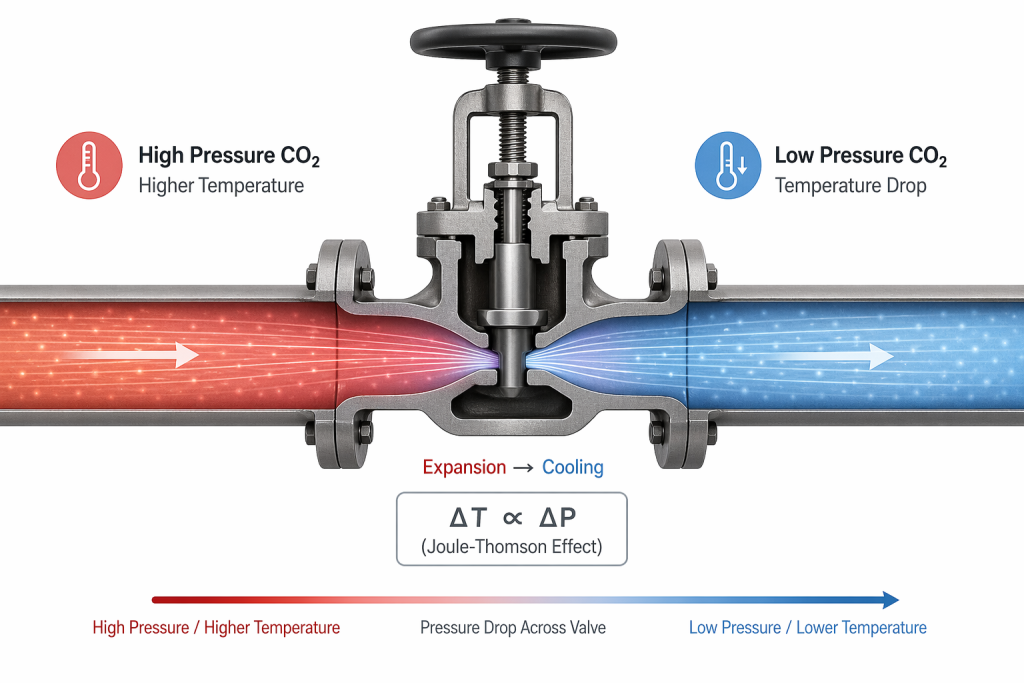
One of the most critical issues is the Joule-Thomson effect valve freezing. When sCO2 undergoes a pressure drop across a valve, it experiences a significant temperature reduction. If this temperature drops below the triple point of CO2 (-56.6°C), dry ice can form within the valve trim, plug, or even the actuator packing. This can:
- Freeze valve internals: Locking the valve in an open or closed position.
- Damage soft seats and packing: Leading to immediate leakage.
- Cause actuator malfunction: Impeding control and leading to catastrophic process instability.
2. Fugitive Emissions: The Challenge of Sealing sCO2
The low viscosity and high solvent properties of high-pressure CO2 contribute to increased fugitive emissions valves problems. Standard elastomer seals (like O-rings or V-rings) can soften, swell, or degrade when exposed to sCO2, leading to seal failure and significant leakage, often above acceptable EPA and regulatory limits.
Furthermore, the rapid temperature cycling associated with phase changes can cause materials to expand and contract unevenly, compromising the integrity of seat and packing seals over time. This makes effective isolation crucial, hence the requirement for cryogenic CO2 valve expertise.
Engineered Solutions: BCST’s High-Pressure CO2 Control Valves
BCST Valve recognizes that Supercritical CO2 control valve applications demand purpose-built solutions. Our BCST CO2 valves are specifically engineered to counteract the unique challenges of carbon capture systems.
Key Design Features for sCO2 Reliability
- Extended Bonnets & Cooling Fins: To mitigate the Joule-Thomson effect valve freezing in the packing area, special bonnets move seals away from the cold zone, ensuring stem movement.
- Pressure-Balanced, Multi-Stage Trims: Precisely engineered trims distribute pressure drops across multiple stages. This prevents localized supersonic flow and extreme temperature drops, essential for stable high-pressure CO2 valve control. (Learn more about multi-stage trims and noise reduction in our article: The Physics of Decibel Reduction).
- Specialized Material Selection: We utilize robust body materials (e.g., A182 F316L, Duplex F51, Super Duplex F55) and high-performance, CO2-compatible sealing materials (e.g., PEEK, PCTFE, graphite-filled PTFE) that resist embrittlement and degradation.
- Live-Loaded Packing: Ensures consistent seal compression against the stem, even during temperature fluctuations, drastically reducing fugitive emissions valves.
BCST’s Certification & Testing for High-Pressure CO2 Applications
BCST Valve’s dedication to quality is paramount for critical applications like carbon capture systems. Our high-pressure CO2 valve certification includes stringent testing beyond standard requirements:
- Cryogenic Proof & Leakage Tests: Simulating low-temperature operation to ensure seal integrity against phase changes.
- High-Pressure Gas Hydrostatic Tests: Verifying shell integrity at up to 1.5 times the maximum allowable working pressure.
- Fugitive Emissions Testing (ISO 15848-1): Quantifying leak rates to ensure compliance with strict environmental regulations for CO2 leakage prevention.
- Material Traceability & NDE: Full material certification and non-destructive examination (NDE) to guarantee metallurgical integrity, especially for cryogenic valves.
Conclusion: Reliable Control for the Future of Carbon Capture
The unique fluid dynamics and thermodynamic challenges posed by Supercritical CO2 mean that standard control valves are fundamentally inadequate for carbon capture skids. The risks of Joule-Thomson effect valve freezing, unmanageable fugitive emissions valves, and catastrophic CCUS valve failure are too high to overlook.
BCST Valve offers a robust portfolio of high-pressure CO2 control valves, specifically designed and rigorously tested for the harsh realities of Supercritical CO2 systems. By choosing BCST, you invest in a solution that ensures reliable, leak-free, and precise control, safeguarding your operations and contributing to the success of your carbon capture initiatives.
Don’t Compromise on Critical CO2 Control.
Ensure the reliability and safety of your carbon capture system with BCST’s engineered valve solutions.


 English
 Arabic
 Russian
 French
 Spanish