
Ever tried to measure flowing liquids or gases and wondered if you’re tracking the right thing? In industries from chemical processing to managing your building’s air conditioning, accurately measuring how much fluid is moving is crucial. But there are two main ways to quantify this: Mass Flow and Volume Flow. They sound similar, but understanding their key differences is vital for accuracy, efficiency, and even safety. Let’s dive in and clear up the confusion.
1. Introduction
In the world of fluid dynamics and industrial measurement, mass flow and volume flow are fundamental concepts. They both tell us about fluid movement, but they focus on different aspects. Getting them wrong can lead to inefficient processes, incorrect billing, or even failed chemical reactions. This article breaks down their definitions, highlights the core differences, explains why choosing the right one matters, and looks at the tools used to measure them.
2. Definitions: Understanding the Basics
Let’s start with what each term actually means.

2.1 Mass Flow
- What it is: Mass flow measures the mass (think ‘amount of stuff’ or weight) of a fluid passing through a specific point or cross-section per unit of time. Imagine counting how many kilograms of natural gas flow through a pipe each second.
- Units: Typically measured in kilograms per second (kg/s), pounds per hour (lb/hr), or grams per minute (g/min).
- Relationship: Mass flow rate is related to the fluid’s density, the cross-sectional area of the flow, and the fluid’s velocity. The basic idea is: Mass flow rate = Density x Area x Velocity
- Key Idea: Mass flow tells you the actual amount of substance moving, which is critical when the material quantity itself is important, like in chemical reactions or fuel consumption.
2.2 Volume Flow
- What it is: Volume flow measures the volume (think ‘amount of space occupied’) of a fluid passing through a specific point or cross-section per unit of time. Imagine tracking how many cubic meters of water are delivered to a building each hour.
- Units: Commonly measured in cubic meters per second (m³/s), liters per minute (L/min), gallons per minute (GPM), or cubic feet per minute (CFM).
- Relationship: Volume flow rate is determined by the cross-sectional area of the flow and the fluid’s velocity: Volume flow rate = Area x Velocity
- Key Idea: Volume flow tells you how much space the fluid takes up as it moves, often used for sizing pipes, tanks, or understanding flow in distribution systems like HVAC.
3. Core Differences: A Quick Comparison

Here’s a table highlighting the essential distinctions:
| Aspect | Mass Flow | Volume Flow |
|---|---|---|
| Measurement Focus | How much substance (mass) is moving? | How much space is the fluid occupying? |
| Units Example | kg/s, lb/hr | m³/s, GPM, L/min |
| Effect of T & P | Generally independent of temp/pressure changes | Affected by temp/pressure (density changes) |
| When Accuracy Rules | Better for material balance, energy calcs | Needs density info for comparable mass accuracy |
| Typical Use Cases | Chemical reactions, fuel usage, custody transfer | Pipe sizing, HVAC airflow, water delivery |
4. Why the Difference Matters: Real-World Impact
Choosing between mass and volume flow isn’t just academic; it has practical consequences:
4.1 Why Mass Flow is Crucial:
- When Mass is King: Processes involving chemical reactions depend on precise mass ratios of reactants. Measuring by volume can lead to errors if densities fluctuate. Similarly, calculating energy content (like in natural gas combustion for heating) directly relates to mass, not volume.
- Dealing with Density Changes: Mass flow measurement is largely unaffected by changes in temperature and pressure that alter a fluid’s density (how much mass is packed into a given volume). This makes it ideal for gases (like compressed air, steam, natural gas) where density varies significantly, or for liquids near their boiling point. Accuracy is maintained even when conditions change.
4.2 Why Volume Flow is Essential:
- Focus on Space and Speed: Volume flow is perfect when you need to know how much space the fluid occupies or how fast it’s moving to fill something. This is key for designing infrastructure like pipes, pumps, ducts, and storage tanks. You need to ensure they can handle the required volume per unit time.
- Stable Fluids & Distribution: For incompressible fluids like water or oil where density is relatively stable, volume flow is often simpler and sufficient for tasks like monitoring water distribution or ventilation system airflow (HVAC).
- The Density Catch: Remember, if you measure the volume flow of a compressible fluid (like air or gas) but need to know the mass, you MUST also know its density at the specific operating temperature and pressure. Volume alone isn’t enough information in these cases.
5. Conversion Between Mass and Volume Flow: Bridging the Gap
The link between mass flow and volume flow is the fluid’s density. Density is simply mass per unit volume (often measured in kg/m³). You can convert between the two flow types using this relationship:
Mass Flow Rate = Volume Flow Rate x Density
- Example: If water (which has a density of approximately 1000 kg/m³) is flowing at a volume rate of 0.2 m³/s, the mass flow rate is: 0.2 m³/s x 1000 kg/m³ = 200 kg/s (That’s 0.2 cubic meters per second multiplied by 1000 kilograms per cubic meter equals 200 kilograms per second.)
- Important Note: For gases, density changes significantly with temperature and pressure. Accurate conversion requires knowing these conditions or using calculations to find the density in real-time.
6. Application Scenarios: When to Choose Which
So, how do you decide which measurement to use?
6.1 Choose Mass Flow When:
- Fluid density is unstable or changes: Think natural gas pipelines (pressure varies), steam systems (temperature changes), or processes with varying compositions.
- Precise material quantity or energy matters: Crucial for chemical reactions, pharmaceutical dosing, custody transfer (selling/buying fluids like fuel based on mass), and accurate energy calculations. Mass flow measurement provides direct insight into the amount of substance.
6.2 Choose Volume Flow When:
- Fluid density is stable and known: Often suitable for liquids like water, gasoline, or oils under consistent conditions.
- Infrastructure design is the goal: Sizing pipes, ducts, channels, pumps, or fans primarily depends on the volume of fluid they need to handle.
- Monitoring volumetric output: Tracking water usage, ventilation rates in buildings (HVAC airflow), or irrigation system output.
Ultimately, the best choice depends on your specific application, the fluid’s properties, and the level of accuracy needed.
7. Measurement Instruments: The Tools for the Job
Different technologies are used to measure mass and volume flow:
7.1 Mass Flow Meters (Measure Mass Directly or Infer It)
- Coriolis Meters: These are highly accurate “true” mass flow meters. They work by vibrating tubes and measuring the tiny twisting forces caused by the mass of the fluid flowing through them. They directly measure mass flow independent of density, temperature, or viscosity, and can often measure density simultaneously.
- Thermal Mass Flow Meters: Primarily used for gases, these meters introduce a small amount of heat and measure the temperature change caused by the flowing gas. Since heat capacity relates to mass, they can calculate the mass flow rate.
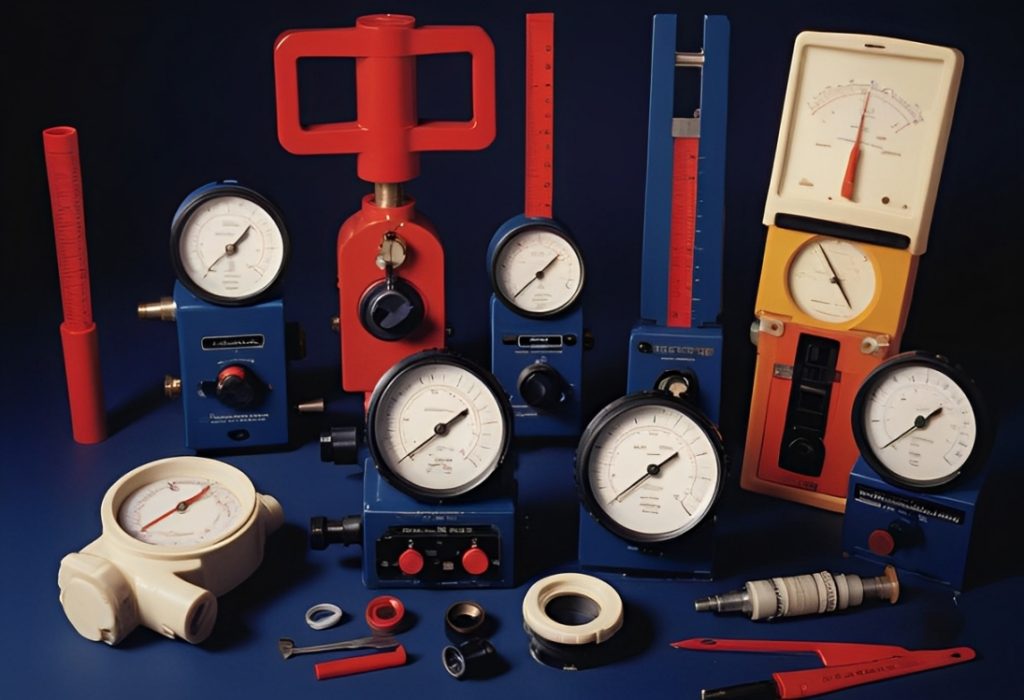
7.2 Volume Flow Meters (Measure Velocity/Displacement to Calculate Volume)
- Turbine Meters: A rotor with blades spins as fluid passes through. The speed of rotation is proportional to the fluid velocity, which is used to calculate volume flow. Simple and effective for clean fluids.
- Ultrasonic Meters: Use sound waves to measure fluid velocity. Transit-time meters measure the time difference for sound pulses traveling with and against the flow. Doppler meters measure the frequency shift of sound waves reflected off particles or bubbles. They are non-intrusive (clamp-on versions available).
- Electromagnetic Meters (Magmeters): Work only with conductive fluids (like water-based liquids). They apply a magnetic field and measure the voltage generated by the fluid flowing through it (based on Faraday’s Law). The voltage is proportional to the fluid velocity, allowing volume flow calculation. No moving parts and obstruction-less.
- Other types include: Positive Displacement (PD) meters, Variable Area (Rotameters), Orifice Plates, Venturi tubes, etc.
Meter selection depends heavily on factors like fluid type, required accuracy, flow range, pressure/temperature conditions, and budget.
8. Key Takeaway
The core distinction is simple: Mass flow measures the amount of substance passing by, while Volume flow measures the amount of space it occupies. Mass flow is often preferred when accuracy in material quantity or energy is critical, especially if density changes. Volume flow is commonly used for infrastructure sizing and tracking fluid movement when density is stable. Understanding both concepts, their relationship via density, and the tools used to measure them is essential for reliable and efficient operations across countless industries.
Summary: Choosing the Right Measurement Partner
In the ever-evolving field of flow measurement, partnering with experts who understand the nuances between mass and volume flow is crucial. Companies like BCST Group, with deep industry experience and a commitment to innovation, offer a comprehensive range of both mass flow (e.g., Coriolis, Thermal) and volume flow (e.g., Magnetic, Ultrasonic, Turbine) meters. Their expertise ensures customers get not just a meter, but a solution tailored to their specific application needs whether it’s standard requirements or complex custom challenges. Access to global service and support further ensures optimal performance throughout the instrument’s lifecycle, reflecting the importance of choosing knowledgeable partners in achieving precise and reliable flow measurement.


 English
 Arabic
 Russian
 French
 Spanish