
Lug vs Wafer Butterfly Valve: The Definitive Engineer’s Guide
Choosing the wrong valve creates project delays and risks. This simple choice has huge consequences for your pipeline’s integrity. Understanding the key differences saves you time, money, and future headaches.
The main difference between lug and wafer butterfly valves is how they mount. A wafer valve is sandwiched and held by long bolts between two pipe flanges. A lug valve has threaded “lugs” (holes) and is bolted directly to each flange, allowing for independent connection.
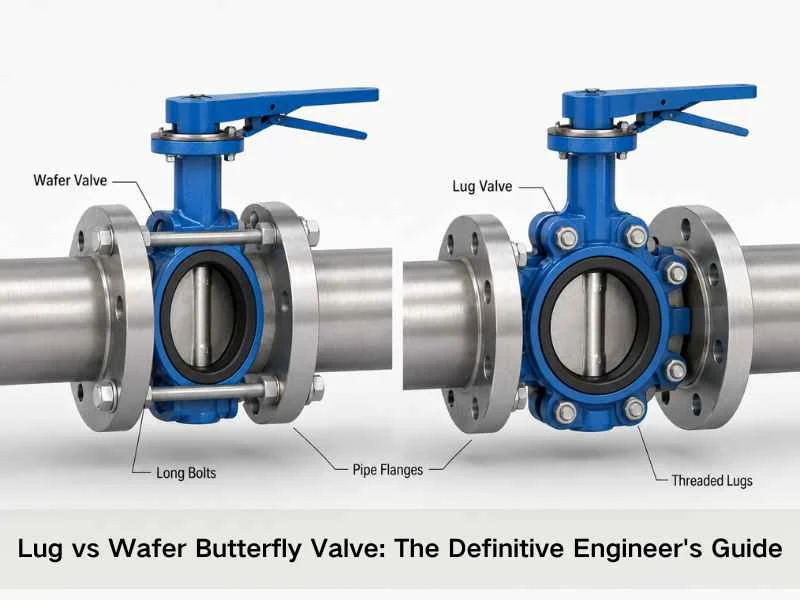
Choosing butterfly valve between a lug and a wafer seems simple at first. Many engineers just look at the price tag and pick the cheaper option. But this can be a big mistake. I’ve seen projects face costly shutdowns and complex maintenance issues all because the initial valve choice wasn’t right for the long-term needs of the system. Your decision here impacts installation speed, maintenance procedures, and even the overall safety of your plant. Let’s go deeper than just the price and explore the practical differences that truly matter for your project’s success.
Installation and Removal Process Dictates Timelines
Complex valve installation increases labor costs and project delays. A slow process can become a bottleneck for your entire construction schedule. Choosing the right valve type helps you meet your project’s speed requirements.
Wafer valves are generally faster to install. They are centered between two flanges, and long bolts pass through the entire assembly to clamp it together. Lug valves need more time. Each side is bolted to its flange separately, requiring more bolts and more precise alignment work.
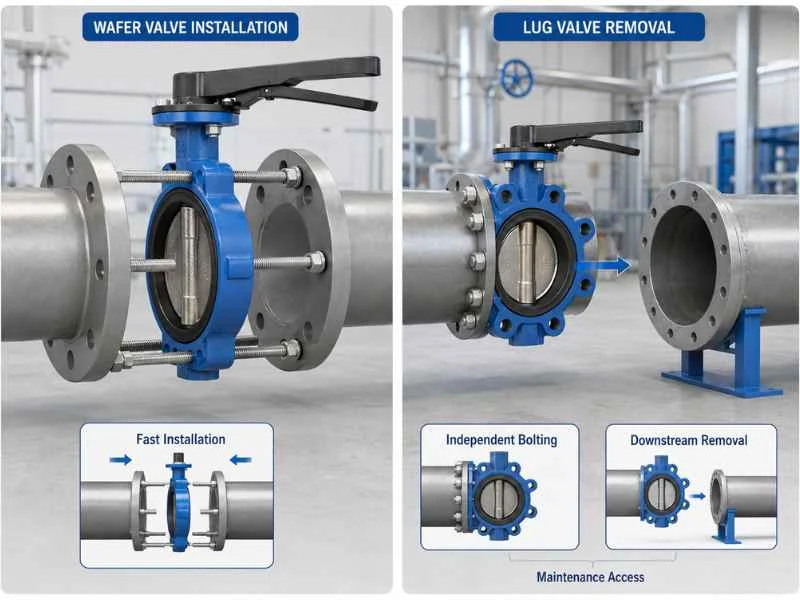
When you are managing a large-scale project, installation efficiency is key. For a Chief Engineer like Hassan, who oversees a multidisciplinary team, saving a few minutes on each valve installation adds up to significant savings in labor hours.
Installation Steps Compared
| Feature | Wafer Butterfly Valve | Lug Butterfly Valve |
|---|---|---|
| Alignment | Self-centering between flanges. | Requires careful manual alignment for each bolt. |
| Bolts | Fewer, longer bolts (studs) go through the entire assembly. | More, shorter bolts (cap screws) for each flange. |
| Time | Faster. Fewer individual connections to make. | Slower. Each bolt must be individually tightened. |
| Removal | Entire line section must be shut down and depressurized. | Can be removed from one side while the other stays attached. |
The key takeaway is control versus speed. The wafer valve is built for speed and simplicity. It’s great for long, straight pipe runs where you won’t need to perform frequent maintenance. The lug valve, however, gives you more control during installation and, more importantly, during removal. This is a critical trade-off to consider in your design phase.
Lug Valves Excel in Dead-End Service Applications
You need to service a downstream pump, but you cannot shut down the entire system. Using the wrong valve means a complete system shutdown for even simple maintenance tasks. Lug valves provide the isolation capability you need.
Lug-style butterfly valves are built for dead-end service. This means you can remove all the piping on one side of the valve, and the valve will stay attached to the other flange, holding back the system’s pressure. A wafer valve cannot do this.
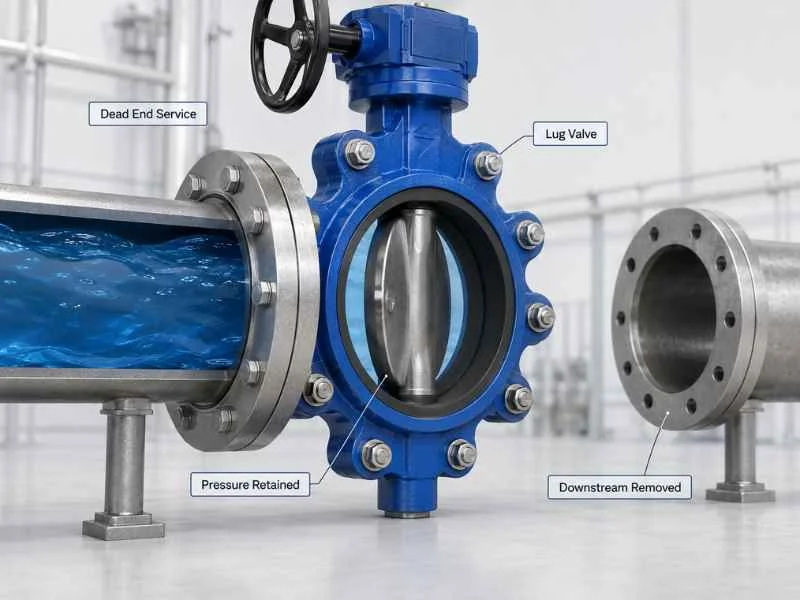
For anyone responsible for plant operations and maintenance, dead-end service capability is not a luxury; it’s a necessity. Imagine you have a heat exchanger that needs cleaning or a pump that needs repair. With a lug valve installed upstream, you can close the valve, unbolt the downstream flange, and remove the equipment for service. The lug valve stays in place, holding the line pressure securely.
Why Wafer Valves Fail in Dead-End Service
A wafer valve relies on the compressive force from being sandwiched between two flanges. The tension from the long bolts holds it and the gaskets in place. If you remove the downstream flange:
- Loss of Compression: The clamping force is lost.
- Seal Failure: The valve and its gasket can no longer hold back the pressure.
- System Breach: This results in a dangerous and costly release of the pipeline’s contents.
This makes lug valves the only safe choice for any point in your P&ID where you anticipate needing to isolate equipment for maintenance while keeping the rest of the system live. It prevents costly downtime and enhances worker safety.
Wafer Valves Offer a Lighter, More Compact Profile
Your pipeline design has tight space and weight restrictions. A heavy, bulky valve might require extra structural support, which adds cost and complexity to your project. The wafer valve’s design minimizes both weight and space.
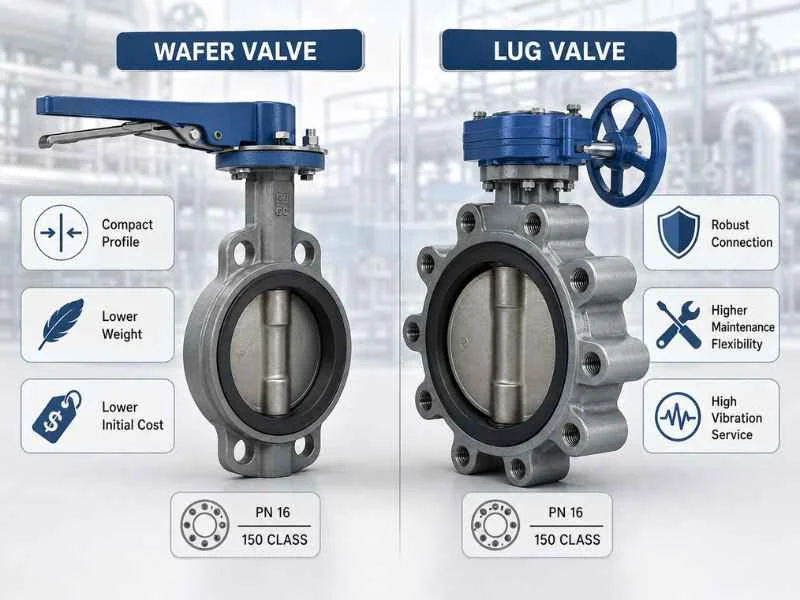
Wafer butterfly valves are significantly lighter and have a thinner body (face-to-face dimension) than lug valves. This makes them the perfect choice for systems where saving space and reducing weight are top priorities. This reduces the load on your piping supports.
In a modern chemical plant or refinery, space is a premium. Pipe racks are often crowded with lines running in parallel. As the lead engineer, Hassan has to think about the entire system. Using a lighter, more compact valve can have a big impact.
Impact on System Design
- Reduced Structural Load: The lower weight of wafer valves means you may be able to use smaller or fewer pipe supports. This saves money on materials and installation labor.
- Easier Handling: Lighter valves are easier for a single worker to handle and install, especially in larger pipe diameters. This can improve safety and speed up work.
- Tighter Spacing: The slim profile allows pipes to be installed closer together. This is a huge advantage in dense piping environments or inside modular skids.
Here is a general weight comparison for a standard Class 150 valve:
| Valve Size (Inches) | Typical Wafer Valve Weight (kg) | Typical Lug Valve Weight (kg) |
|---|---|---|
| 4″ | 5 | 7 |
| 8″ | 16 | 22 |
| 12″ | 35 | 48 |
While the difference for one valve may seem small, think about a project with hundreds of valves. The total weight savings can be massive, simplifying the structural engineering and reducing overall construction costs.
Analyzing the True Cost Beyond the Initial Price Tag
Focusing only on the purchase price can lead to much higher costs later. Unexpected maintenance expenses and operational downtime can destroy your budget. You must evaluate the total cost of ownership for the valve.
Wafer valves almost always have a lower initial purchase price. But, a lug valve might have a lower total cost of ownership. This is true in applications that need frequent maintenance, because of their dead-end service capability.
A smart engineer looks at the whole picture. The price you pay for the valve is just the beginning of its cost. The total cost of ownership (TCO) includes the initial price, installation costs, maintenance costs, and the cost of any downtime caused by the valve. The great debate of lug vs wafer butterfly valve often comes down to this financial calculation.
Breaking Down the Costs
- Initial Purchase Cost: This is the sticker price. For a standard valve, the wafer style is typically 10-20% cheaper than the equivalent lug style.
- Winner: Wafer
- Installation Cost: Wafer valves are faster to install, which means fewer labor hours. This can be a significant saving on large projects.
- Winner: Wafer
- Maintenance Cost & Downtime: This is where the calculation changes. If you have to shut down an entire production line to service a pump because you used a wafer valve instead of a lug valve, the cost of that lost production can be huge. A single hour of downtime can cost a plant thousands of dollars. In this scenario, the slightly more expensive lug valve pays for itself the very first time you use its dead-end service feature.
- Winner: Lug (in maintenance-heavy applications)
The best choice depends on your specific application. For a simple utility line like cooling water, where you can easily shut down the whole loop for maintenance, a wafer valve is a smart, cost-effective choice. But for a critical process line, the added security and flexibility of a lug valve is a wise investment.
Understanding Pressure Handling and Flange Standards
A mismatch between your valve and flange ratings can lead to a leak or failure. A leak under high pressure is a major safety incident that must be avoided. You must ensure your valve is rated for the system pressure and matches the flange.
Both lug and wafer valves are available in standard pressure classes like ASME Class 150, 300, and 600. However, lug valves provide a more secure connection. Each bolt takes a direct load, making them a preferred choice for higher-pressure or high-vibration services.
This is one of the first lessons I learned in the valve business. I remember my father, the founder of BCST, taking me through the factory when I was young. He picked up a heavy, finished lug valve. He told me, “Emily, this is for when the connection absolutely cannot fail. Each bolt is a promise of security. A wafer valve is held by a sandwich, but a lug valve is bolted in place.”
Connection Security and Integrity
That lesson always stayed with me. A wafer valve’s stability depends entirely on the consistent tension of the long stud bolts. If there is pipeline vibration, thermal expansion and contraction, or improper bolt torquing, the compressive seal can be compromised over time.
A lug valve offers a more robust connection for several reasons:
- Direct Bolting: The cap screws thread directly into the valve body’s lugs. This creates a secure, flanged joint on each side of the valve.
- Vibration Resistance: This direct connection is inherently more resistant to loosening from pipeline vibration.
- Independent Connections: A problem on the downstream flange (like a stripped bolt) does not compromise the upstream connection.
Because of this, many engineering standards and company specifications require lug-style valves in applications with high vibration (e.g., near compressors or pumps), high thermal cycles, or in higher-pressure classes where connection integrity is the absolute top priority. This is a crucial detail in the lug vs wafer butterfly valve comparison.
Frequently Asked Questions (FAQ)
Q1: What is the main difference in the lug vs wafer butterfly valve debate for installation?
A1: The main installation difference is speed versus control. Wafer valves are faster to install because they are self-centering and use fewer, longer bolts. Lug valves take more time as they require individual bolting to each flange, but this allows for more precise alignment and independent flange connections.
Q2: When choosing between a lug vs wafer butterfly valve, which is better for dead-end service?
A2: The lug-style butterfly valve is the only correct choice for dead-end service. Its threaded lugs allow it to be bolted to a single flange, holding back pressure even when the downstream piping is removed. A wafer valve cannot do this safely.
Q3: In a lug vs wafer butterfly valve comparison, which is typically more expensive?
A3: Initially, the lug-style butterfly valve is typically more expensive than a wafer-style valve of the same size and material. This is due to the more complex body casting with threaded lugs. However, you must consider the total cost of ownership, where a lug valve can save money in maintenance-heavy applications.
Q4: Can I use a wafer valve for dead-end service in a lug vs wafer butterfly valve scenario?
A4: No, you should never use a wafer valve for dead-end service. It relies on being compressed between two flanges to create a seal. Removing one flange will cause a loss of compression and a near-certain failure of the seal, leading to a dangerous leak.
Q5: How does weight factor into the lug vs wafer butterfly valve decision?
A5: Weight is a significant factor. Wafer valves are lighter and more compact. This reduces the structural load on pipe supports and makes them easier to handle, especially in large sizes. This is a key advantage in crowded pipe racks or systems with weight limitations.
Q6: For high-vibration pipelines, what is the recommendation in a lug vs wafer butterfly valve choice?
A6: For high-vibration services, a lug-style butterfly valve is generally recommended. The direct bolting of the valve to each flange creates a more rigid and secure connection that is less likely to loosen over time compared to the compression-fit of a wafer valve.
Final Thought
The choice between lug and wafer butterfly valves is not about which is better, but which is right for your job. Wafer valves are ideal for cost-sensitive, simple applications. Lug valves provide the safety and flexibility needed for critical maintenance and robust connections. At BCST, we help engineers like you make the right choice.


 English
 Arabic
 Russian
 French
 Spanish