
The Inversion Temperature Trap: Why Hydrogen and Helium Can Warm Instead of Cool Across a Control Valve
The simplified textbook rule states: “When a gas expands across a valve, it cools.” For most industrial gases and process conditions, this rings true, and engineers factor in the Joule-Thomson effect to anticipate cooling and potential thermal shock failures. However, for specialty gases vital to the green energy sector—specifically hydrogen control valve applications and processes involving helium gas expansion—this rule is not only incomplete but dangerously misleading. At common ambient temperatures, these gases can actually *warm* rather than cool when undergoing a pressure drop.
Quick Answer: Unlike most gases, hydrogen and helium have very low Joule-Thomson inversion temperatures (well below typical ambient conditions). This means that during expansion across a control valve, they experience warming, not cooling, a critical factor for valve engineers in specialty gas handling.
Why the “All Gas Expansion Cools” Rule is Incomplete
The assumption that all gas expansion leads to cooling stems from the ideal gas law and daily experience (e.g., aerosol cans cooling upon discharge). This effect, known as the Joule-Thomson (JT) effect, is indeed prevalent for many gases under typical operating conditions. However, it’s not universal.
Understanding the Inversion Temperature
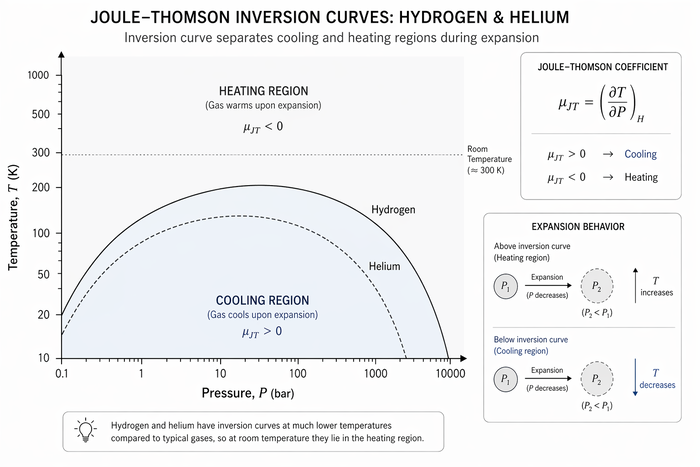
The direction of temperature change during throttling (cooling or warming) depends on the gas’s Joule-Thomson coefficient (μJT) at the specific pressure and temperature being considered. Crucially, every gas has an inversion temperature. Above this temperature, μJT is negative, and the gas *warms* on expansion. Below it, μJT is positive, and the gas *cools* on expansion.
- Most Gases: For gases like Nitrogen (N₂), Methane (CH₄), and Carbon Dioxide (CO₂), the inversion temperature is well above ambient (e.g., CO₂’s upper inversion point is ~150°C, N₂’s is ~300°C). Thus, at room temperature, they cool on expansion, leading to concerns like CO2 valve freezing.
- Hydrogen (H₂) and Helium (He): These light gases have very low inversion temperatures:
- Hydrogen: Upper inversion point is approximately -73°C (-99.4°F).
- Helium: Upper inversion point is even lower, around -223°C (-369.4°F).
This means that at room temperature (and up to these inversion points), both hydrogen warming during expansion and helium warming during expansion control valve behavior are to be expected.
Joule-Thomson Coefficient Explained for Valve Engineers
The Joule-Thomson coefficient is defined as the change in temperature (dT) with respect to a change in pressure (dP) at constant enthalpy (H):
μJT = (∂T/∂P)H
For valve engineers, understanding this is crucial because it directly dictates the thermal behavior during throttling. A positive μJT means cooling, while a negative μJT means warming. For hydrogen valve temperature rise pressure drop scenarios, μJT will be negative under most common operating conditions.
Material and Seal Implications: Beyond Thermal Shock
The thermal behavior of hydrogen and helium has significant implications for valve design and material selection, extending beyond the typical concerns of thermal shock and freezing prevalent with other gases.
Why Hydrogen and Helium Need Different Thermal Assumptions
While the temperature rise for H₂ and He is typically less dramatic than the cooling effect experienced by CO₂ (e.g., few degrees Celsius for H₂ vs. tens of degrees for CO₂), it’s critical for specific applications:
- High-Temperature Processes: In processes that are already operating at elevated temperatures (e.g., hydrogen-cooled generators, fuel cells), even a modest temperature increase across a valve can push internal components beyond their design limits, accelerating degradation of seals or lubricants.
- Material Stability: Hydrogen valve thermal management in applications with sensitive materials must consider this warming. For instance, specific polymer seals or coatings might have upper-temperature limits that are approached or exceeded by this warming.
- System Design: Overall system thermal balance can be impacted. If expecting cooling for a downstream process, and warming occurs instead, it can throw off subsequent heat exchangers or reaction kinetics, highlighting the importance of accurate inversion temperature valve sizing hydrogen.
| Gas Type | Inversion Temp. (Upper) | Behavior at Ambient (20°C) | Valve Concern |
|---|---|---|---|
| Hydrogen (H₂) | ~ -73°C | Warming | Unexpected temperature excursions, material limits |
| Helium (He) | ~ -223°C | Warming | Similar to H₂ but less pronounced due to lower pressures |
| Carbon Dioxide (CO₂) | ~ 150°C | Cooling | Freezing, brittle fracture (thermal shock) |
When Thermal Modeling Matters in Valve Selection
For standard applications, rules of thumb or simplified calculations suffice. However, for specialty gases like hydrogen and helium, explicit thermal modeling valve selection is indispensable.
- High-Pressure Hydrogen: In the emerging hydrogen economy, with pressures exceeding 700 bar (10,000 psi) in some applications, accurate prediction of temperature changes (even warming) is critical for system efficiency and safety.
- Ultra-High Purity Gas: Small thermal shifts can affect the properties of ultra-high-purity gases being delivered to sensitive analytical equipment.
- Sealing Technology: Precise sealing for hydrogen valve temperature management is crucial. For instance, specific metal-to-metal seating or specialized polymer compounds may operate optimally within a narrow temperature band, making even slight warming a concern. This is particularly relevant when considering the molecular escape challenges of hydrogen.
- Safety Systems: For critical safety functions like blowdown or emergency relief, understanding the exact thermal profile ensures long-term integrity of valve components.
FAQ on Hydrogen/Helium Joule-Thomson Effect in Valves
What is the “inversion temperature trap” for hydrogen?
The “inversion temperature trap” for hydrogen (and helium) refers to the fact that their Joule-Thomson inversion temperatures (-73°C for H₂) are significantly below ambient. This means that at typical room temperatures, hydrogen will warm, not cool, when expanding across a valve, contrary to most other gases.
Why does hydrogen warming across a valve matter for engineers?
It matters because traditional thermal designs expect cooling. Unexpected warming can degrade seals, affect lubricant performance, push materials beyond their safe operating limits, or disrupt downstream processes that rely on specific temperature stability, necessitating different valve material and sizing considerations.
Are there any gases that always warm on expansion?
No, all real gases have an inversion temperature. The distinction for hydrogen and helium is that their inversion temperatures are so low that they typically operate in the ‘warming’ region (below their inversion temperature) under normal industrial conditions, while other gases operate in the ‘cooling’ region (above their inversion temperature).
Conclusion: Precision Engineering for Specialty Gases
The inversion temperature trap for hydrogen and helium is a prime example of why valve engineering for specialty gases cannot rely on generalized assumptions. Understanding the nuances of the Joule-Thomson effect, specifically hydrogen warming during expansion, is critical for accurate inversion temperature valve sizing hydrogen and ensuring system integrity.
BCST Valve stands at the forefront of engineering customized solutions for the demanding requirements of hydrogen control valve applications and helium gas expansion. Our expertise in thermal modeling and advanced material selection ensures that our valves perform reliably and safely, whether your process leads to cooling or warming across the control point.
Need a Control Valve for Hydrogen, Helium, or Other Specialty Gas Service?
Send BCST Valve your gas type, inlet pressure, and temperature range for expert thermal modeling and valve selection.


 English
 Arabic
 Russian
 French
 Spanish