
In the gritty, demanding world of mining and mineral processing, pipelines are the arteries of operation, tirelessly transporting tons of pulverized ore, tailings, and process chemicals as thick, abrasive slurries. It’s a relentless environment where the constant flow of sharp, hard particles acts like liquid sandpaper, waging war on every piece of equipment in its path. For the valves controlling this flow, it’s the ultimate test of endurance. Standard valves simply don’t stand a chance, quickly succumbing to extreme wear, jamming, and leakage, leading to crippling downtime, escalating maintenance costs, and a constant threat to safety and environmental compliance.
Conquering this abrasive onslaught requires more than just any valve; it demands a specialized solution. While the basic knife gate valve design offers a starting point for handling solids, only truly engineered knife gate valves mining can stand up to the severe challenges of abrasive slurry control. These aren’t your average valves; they are precision-built workhorses designed to provide reliable, leak-tight isolation and long operational life where other valve types fail.
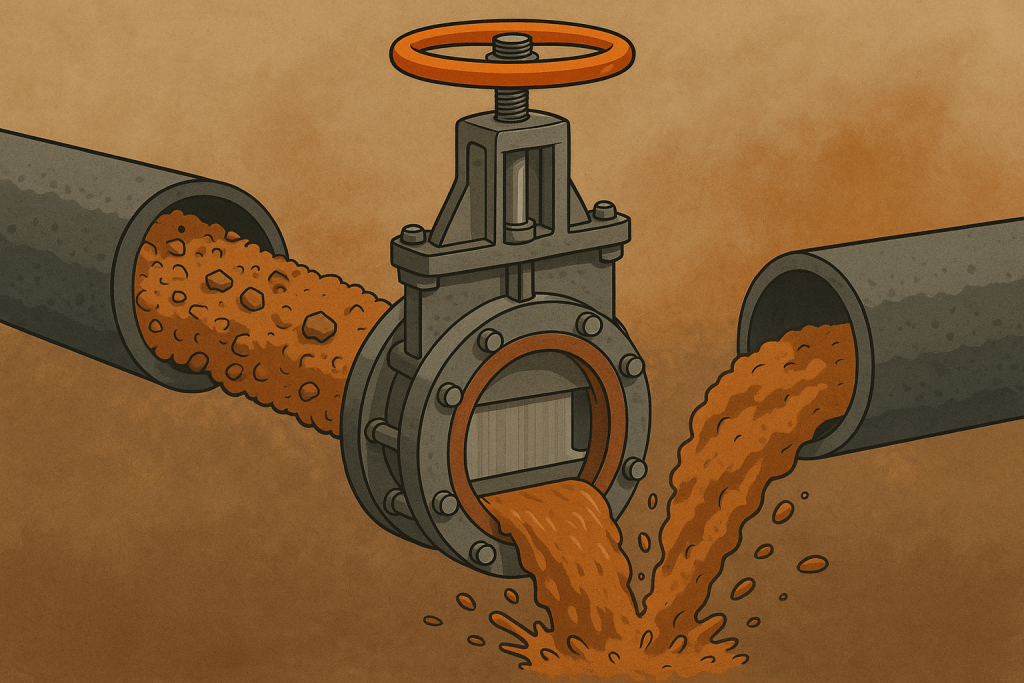
The Basic Knife Gate’s Role (and Limits) in Slurry
Traditional gate valves, with their wedge or parallel disc designs, are ill-suited for slurries. Solids can easily accumulate in the body cavity, preventing full closure and damaging the sealing surfaces as the gate attempts to move through the obstruction.
The knife gate valve emerged as a better alternative for simply cutting through viscous media and solids. Its fundamental design features a flat, relatively thin gate (the “knife”) that slides through a packing seal to open or close the flow path. When fully open, it offers a clear, full-port pathway, minimizing obstruction. This design is effective for basic on/off service in applications with light slurries or dry solids that aren’t highly abrasive.
However, when faced with the extreme conditions of mining slurries – high concentrations of hard, abrasive particles often under significant pressure – even a basic knife gate valve has critical vulnerabilities:
- Vulnerable Sealing Surfaces: The areas where the gate contacts the seat and packing are directly exposed to the abrasive flow.
- Particle Entrapment: Despite the “cutting” action, fine abrasive particles can still get lodged between the gate and seats or packing.
- Accelerated Wear: The sliding motion of the gate against abrasive-laden packing and seats causes rapid erosion and abrasion.
- Body Cavity Issues: While better than traditional gates, some designs can still allow solids to accumulate, leading to jamming or wear.
This is why a standard knife gate valve, while capable of handling some solids, quickly fails in severe abrasive slurry service. Mining slurry knife gate valve applications demand a higher level of engineering.
Specific Wear and Sealing Challenges
Understanding how abrasive slurries attack a valve is crucial to appreciating the need for specialized designs. The damage occurs through several interconnected mechanisms:
- Erosion: This is the primary mode of attack. High-velocity abrasive particles impinge on valve surfaces, gradually wearing away material. This is particularly destructive in areas where flow direction changes or velocity increases.
- Abrasion: As the knife gate slides through the packing and across seating surfaces, embedded or trapped abrasive particles cause scratching and gouging, accelerating wear on both the gate and the sealing components.
- Corrosion: Often, the liquid phase of mining slurries is corrosive, weakening valve materials and making them more susceptible to mechanical wear from erosion and abrasion.
- Physical Damage: Larger or harder particles can cause chipping, pitting, or deformation of seating surfaces and the gate edge, directly compromising the valve’s ability to seal.
These wear mechanisms directly lead to the most critical functional failure in slurry valves: loss of sealing integrity. Particles lodging between the gate and seat prevent full closure. Wear of the packing and stem allows slurry to leak to atmosphere. Damage to seating surfaces creates bypass leakage even when the valve is fully closed. Effectively addressing these sealing challenges requires a valve designed from the ground up for the harsh reality of abrasive slurries.
Design Features That Build a Slurry-Mastering Knife Gate Valve
This is where the “engineered” in engineered knife gate valves mining truly makes a difference. Specialized designs incorporate advanced materials and unique features to withstand the abrasive attack and maintain reliable sealing.
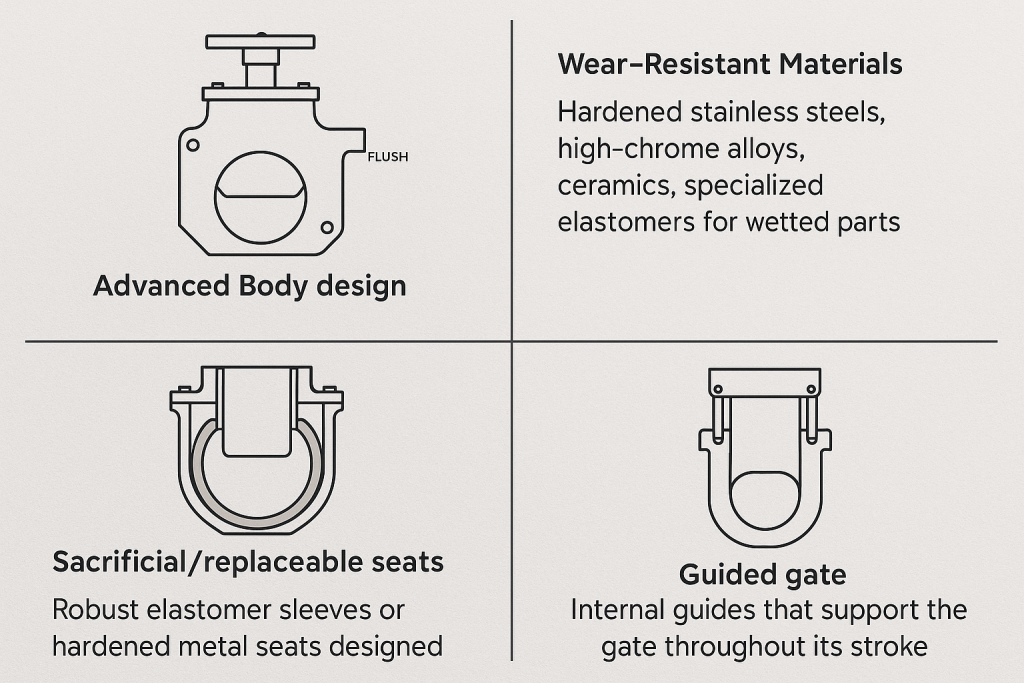
Here are some key engineered solutions found in high-performance abrasive slurry knife gate valves:
Table 1: Engineered Design Features for Abrasive Slurry Resistance
| Feature | Description | Benefit for Abrasive Service & Sealing |
|---|---|---|
| Advanced Body Design | Full-port, chamberless, or wide-body castings; integrated flushing ports. | Minimizes areas for solids accumulation, reducing jamming & wear; enables flushing of valve interior. |
| Wear-Resistant Materials | Hardened stainless steels, high-chrome alloys, ceramics, specialized elastomers (PU, premium rubber) for wetted parts. | Significantly extends component life by resisting erosion and abrasion from hard particles. |
| Sacrificial/Replaceable Seats/Sleeves | Robust elastomer sleeves (often polyurethane or reinforced rubber) or hardened metal seats designed as primary wear components. | Protects the main valve body; wear is focused on easily replaceable parts; maintains tight seal as sleeves encapsulate gate. |
| Guided Gate | Internal guides that support the gate throughout its stroke. | Prevents gate deflection or binding due to side loads from slurry pressure, ensuring smooth operation & preventing damage to seals/seats. |
| Heavy-Duty Packing System | Multi-layer packing with abrasion-resistant materials and often a scraper ring or external flushing capability. | Creates a more robust stem seal capable of handling abrasive particles and preventing external leakage. |
| Optimized Gate Design | Beveled or profiled gate edges; hard-faced or coated gate surfaces. | Improves cutting action through solids; resists wear on the gate surface, maintaining sealing edge integrity. |
These design choices aren’t arbitrary; they are the result of extensive engineering focused on combating the specific wear patterns and sealing challenges posed by abrasive slurries in mining. For example, using a resilient, wear-resistant polyurethane sleeve as the primary sealing surface allows the gate to compress into the sleeve, creating a tight seal while the sleeve material resists abrasion and encapsulates small particles. Full-port designs ensure minimal flow restriction and turbulence, reducing localized erosion.
Actuation and Operation: Powering Through Solids
Reliable actuation is paramount for slurry knife gate valves. The actuator must provide enough force to drive the knife gate not only through a static column of potentially settled solids but also against the dynamic forces of the flowing slurry and the friction of abrasive packing/seals.

- Sizing is Critical: Actuator sizing for abrasive slurry service must account for significantly higher torque or thrust requirements compared to clean service. Under-sizing can lead to incomplete closure, jamming, or damage.
- Common Types: Pneumatic, hydraulic, and electric actuators are all used. Pneumatic actuators offer speed and simplicity. Hydraulic actuators provide high force density for larger valves or higher pressures. Electric actuators offer precision control and diagnostics.
- Integration: The actuator must be robust and properly coupled to the valve stem/shaft to ensure efficient power transmission without introducing play or misalignment that could impact sealing or accelerate wear.
Maintenance and Longevity: Keeping Slurry Knife Gates Running Leak-Free
Even the most engineered knife gate valve in mining service requires appropriate maintenance, but good design can drastically reduce the frequency and complexity. Features that facilitate easier maintenance directly contribute to less downtime and sustained sealing performance.
Look for valves with:
- In-Line Replaceable Wear Parts: The ability to replace components most susceptible to wear, like seat sleeves or packing, without removing the entire valve body from the pipeline is a significant advantage.
- Accessible Packing: Easily adjustable or replaceable packing helps maintain the stem seal.
- Flushing Ports: Integrated ports allow for flushing abrasive solids away from critical sealing areas.
- Robust Construction: A well-built body and yoke resist distortion that could impact gate travel and sealing.
Implementing a proactive maintenance schedule based on the specific slurry’s abrasiveness and the valve’s operating cycles is crucial. Monitoring valve performance, listening for unusual sounds, and inspecting for external leakage can help identify potential issues early.
Applications and The Engineered Advantage
Engineered knife gate valves are the backbone of many critical systems in mining. They are essential for positive isolation in applications such as:
- Tailings lines to disposal ponds.
- Thickener underflow lines.
- Filter press isolation.
- Slurry pump isolation.
- Autoclave isolation in leaching circuits.
In these services, the upfront investment in a high-quality, engineered knife gate valve that offers superior knife gate valve wear resistance mining and reliable sealing against abrasive slurries quickly pays for itself through reduced maintenance costs, minimized downtime, and increased plant safety and productivity. They represent a strategic choice for operators looking to optimize performance in the face of extreme abrasive challenges.
Conclusion: The Engineered Advantage in the Face of Abrasion
Abrasive slurries in mining present one of the most formidable challenges for industrial valves. Standard gate or knife gate valves are simply not built to withstand the relentless attack of erosion and abrasion while maintaining a reliable seal.
Engineered knife gate valves, with their specialized materials, robust body designs, advanced sealing systems, and focus on wear resistance, are specifically designed to meet this challenge head-on. By providing superior knife gate valve wear resistance mining and reliable sealing against abrasive slurries, these valves minimize costly leaks, reduce downtime, and extend service life in the most demanding applications. For any mining or mineral processing operation dealing with abrasive slurries, choosing an engineered knife gate valve is not just a maintenance decision – it’s a critical factor in achieving operational efficiency, safety, and long-term profitability. They truly master the art of abrasive control.


 English
 Arabic
 Russian
 French
 Spanish