
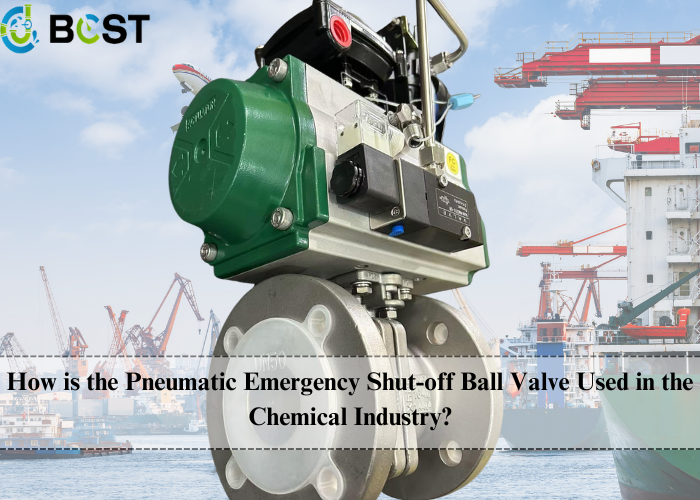
Pneumatic Emergency Shut-Off Valve is a commonly used industrial automation control equipment, widely used in the fields of petroleum, chemical industry, electric power, etc. Due to the material characteristics, process complexity and high risk in the chemical industry, pneumatic emergency shut-off valve plays a vital role in ensuring safety, improving process stability and emergency operation. This article will analyze in detail the functional principle of pneumatic emergency shut-off valve, its main application scenarios in the chemical industry, successful application cases, and precautions in selection and maintenance.
1. The principle and function of pneumatic emergency shut-off ball valve
The pneumatic emergency shut-off ball valve is mainly composed of a valve body, a pneumatic actuator and a control system. Its basic principle is to use compressed air to drive the actuator to quickly rotate the valve core to open, close or adjust the fluid. Its core function is to quickly cut off the flow of media in the pipeline in an emergency (such as leakage, fire or equipment failure) to protect downstream equipment, ensure personnel safety and prevent environmental pollution.
1.1 Basic characteristics of BCST pneumatic emergency shut-off ball valve
The characteristics of the pneumatic emergency shut-off ball valve include the following aspects:
- Efficient and fast cutting:The pneumatic actuator responds quickly and can open or close the valve in a very short time after receiving an emergency signal.
- Safe and reliable:The double sealing design can adapt to high pressure, high temperature and highly corrosive media, ensuring the sealing effect during long-term operation.
- Remote and automated control:Can be integrated with DCS, PLC and other control systems to achieve remote operation and reduce the risk of human error.
1.2 Function of pneumatic emergency shut-off ball valve
In the chemical industry, BCST pneumatic emergency shut-off ball valves can play the following roles:
- Emergency shut-off: In an emergency, quickly cut off the flow of fluid to isolate the source of the accident and prevent the accident from spreading.
- Process Control:Used as a switch valve or regulating valve in the production process to achieve precise control of fluid flow and optimize the production process.
- Dielectric Isolation:Prevent cross contamination by isolating different media, especially when it is necessary to switch production or clean pipelines, it can effectively avoid mixed reactions.
2. Application scenarios of pneumatic emergency shut-off ball valves in the chemical industry
The production process of the chemical industry is complex, and the raw materials and products are mostly flammable, explosive, and corrosive. Therefore, pneumatic emergency shut-off ball valves are widely used in high-risk process nodes. The following are several typical application scenarios in the chemical industry:
2.1 Safety assurance of high temperature and high pressure reaction equipment
In the chemical production process, high temperature and high pressure reaction devices are one of the areas with high accident rates. The pneumatic emergency cut-off ball valve can quickly cut off the feed valve when the reaction temperature or pressure rises abnormally to avoid further reaction. At the same time, it can be integrated with the automation system to achieve linkage between early warning and automatic shutdown.
2.2 Emergency protection in flammable and explosive areas
In the production of oil refining and fertilizer, flammable and explosive substances are often involved, and once leaked, they may cause fire or explosion. By installing pneumatic emergency cut-off ball valves at key pipeline locations, the material flow can be immediately cut off when a leak is found, preventing the further spread of flammable and explosive gases, and the valve can be automatically closed in conjunction with the fire alarm system.
2.3 Isolation and control of highly corrosive media
In chemical production, the pipeline control requirements for corrosive media such as acid and alkali solutions are particularly strict. Pneumatic emergency shut-off ball valves are usually made of corrosion-resistant materials, such as stainless steel or fluorine-lined materials, to ensure the stability of the seal and durability for long-term use. When the corrosive medium leaks or penetrates, the pneumatic emergency shut-off ball valve can quickly shut off and effectively prevent the further spread of equipment corrosion.
3. Analysis of successful application cases
In order to better understand the application effect of BCST pneumatic emergency shut-off ball valve in the chemical industry, the following is an in-depth analysis through several specific cases.
3.1 Case 1: Emergency shut-off protection in a petrochemical plant
background:A large petrochemical enterprise has configured pneumatic emergency shut-off ball valves at key positions in the crude oil processing unit to protect the temperature and pressure control during the crude oil cracking process.
question: In actual production, the device experienced abnormalities many times due to unstable reaction temperature, resulting in medium leakage in the pipeline and increasing the risk of fire.
Solution:The company installed multiple sets of pneumatic emergency shut-off ball valves on the key pipelines between the cracking unit and the storage tanks, connecting the fire alarm system and temperature and pressure sensors. When an over-temperature or fire signal is detected, the system can automatically close all inlet and outlet valves within 5 seconds, effectively isolating the leaking medium and reducing the risk of fire spread.
Effect: In the event of an abnormal reaction temperature, the pneumatic emergency cut-off ball valve successfully cut off the fluid flow, isolated the leaking medium within the system, and ultimately prevented the accident from happening.
3.2 Case 2: Safety Management of Hazardous Chemicals Storage
background:A chemical company installed a BCST pneumatic emergency shut-off ball valve in the warehouse where sulfuric acid is stored to prevent sulfuric acid leakage from threatening the environment and personnel.
question: Sulfuric acid is a highly corrosive medium. Once leaked, it will cause serious consequences such as equipment corrosion and personal injury.
Solution:BCST Pneumatic emergency shut-off ball valves are installed in the sulfuric acid inlet and outlet pipelines and connected to the liquid level monitoring, corrosion monitoring and other systems. When leakage is detected or the risk of pipeline corrosion increases, the system will trigger an alarm and automatically close the valve.
Effect:The system has successfully handled sulfuric acid leaks many times, reducing the amount of leaked sulfuric acid to within safety limits, effectively protecting the safety of storage equipment and personnel.
3.3 Case 3: Emergency Shutdown System in Acrylonitrile Production
Background:Acrylonitrile is a highly toxic and flammable chemical. A chemical plant has installed a pneumatic emergency cut-off ball valve in its acrylonitrile production device to ensure safe production.
question: Once acrylonitrile leaks, it may cause an explosion and cause serious pollution to the surrounding environment.
Solution: Install a pneumatic emergency shut-off ball valve between the acrylonitrile storage tank and the delivery pipeline, and link it with the toxic gas detector and fire alarm system. When the acrylonitrile gas concentration exceeds the standard, the valve will immediately close and cut off the delivery pipeline.
Effect: Through this system, two leaks that occurred during the acrylonitrile production process were effectively controlled, avoiding the occurrence of explosion accidents.
4. Selection and maintenance points of BCST pneumatic emergency shut-off ball valve
4.1 Selection points
When selecting a pneumatic emergency shut-off ball valve in the chemical industry, factors such as medium characteristics, operating environment and working pressure need to be considered comprehensively:
- Material selection: When dealing with corrosive media, corrosion-resistant materials (such as stainless steel or alloy materials) must be selected; heat-resistant materials should be used in high-temperature situations.
- Sealing form:According to different working conditions, choose the appropriate sealing form, such as soft seal, hard seal, etc.
- Response speed: Ensure that the valve response speed meets safety requirements, especially in high-risk working conditions.
- Control method: According to system requirements, select manual, automatic or remote control to cope with different operation needs.
4.2 Maintenance points
BCST pneumatic emergency shut-off ball valves are easily affected by the medium and environment in chemical environments. Therefore, regular maintenance is very important:
- Seal inspection: Regularly check the wear and aging of seals to prevent leakage due to seal failure.
- Actuator maintenance: Regularly lubricate and test the air tightness of pneumatic actuators to ensure flexibility and stability of their movements.
- Detection system calibration: For pneumatic emergency shut-off ball valves linked to the control system, the accuracy of the sensor needs to be calibrated and tested regularly to ensure reliable response in emergency situations.
V. Conclusion
The application of BCST pneumatic emergency shut-off ball valves in the chemical industry is crucial, providing safe and reliable protection for emergency shut-off in the process. Through actual case analysis, it can be seen that pneumatic emergency shut-off ball valves can respond quickly under high-risk conditions and play an effective emergency shut-off role. Reasonable selection and maintenance can further improve its service life and stability, and escort the safe production of the chemical industry. In the future, with the improvement of automation level and the application of intelligent control technology, the application prospects of pneumatic emergency shut-off ball valves in the chemical industry will be broader.


 English
 Arabic
 Russian
 French
 Spanish