
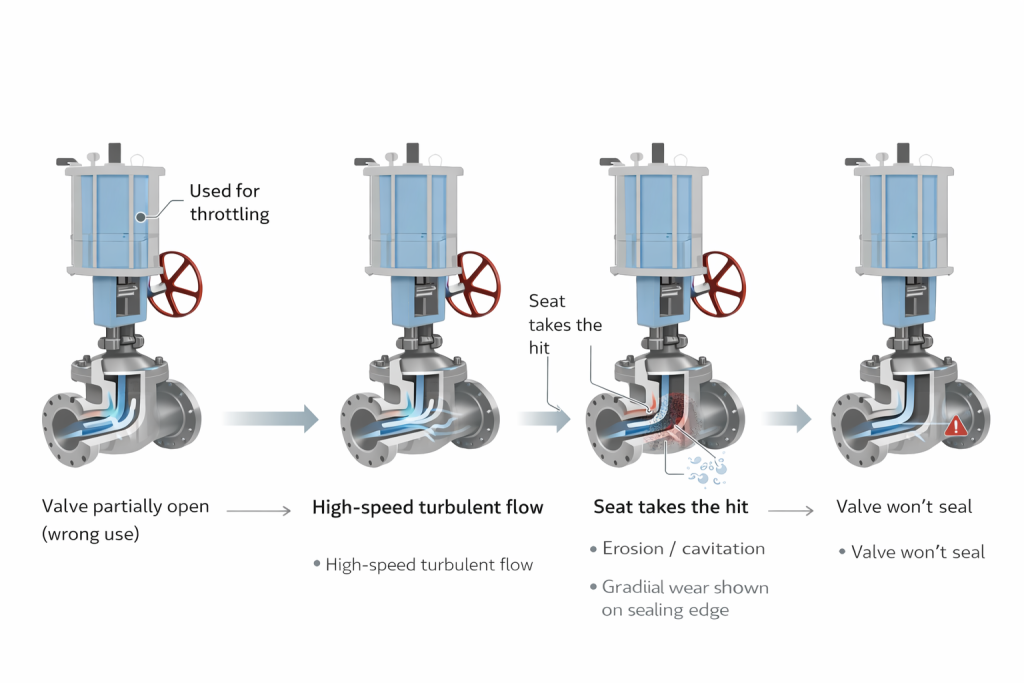
You need to reduce flow in a pipeline, and you have a standard ball valve installed. The temptation is overwhelming: just crack it open part-way. It seems like a simple, free solution, but it’s a costly mistake that will lead to catastrophic valve failure.
Using a standard on-off valve for throttling creates high-velocity, turbulent flow that physically blasts away the valve’s critical sealing surfaces. This damage, known as erosion or cavitation, guarantees the valve will soon be unable to provide a tight shutoff, leading to dangerous leaks.

How Does Throttling Destroy a Ball Valve?
You can hear a strange rumbling or hissing from that partially open ball valve. You might think that’s the sound of flow control, but it’s actually the sound of your valve eating itself alive.
When a ball valve is partially open, it forces the entire flow through a narrow gap. This skyrockets the fluid’s velocity, creating extreme turbulence and a sharp pressure drop that can boil the liquid—a phenomenon called cavitation—which then rips apart the ball and seats.
Dive Deeper: The Destructive Physics of Partial Opening
An on-off valve is designed for an unobstructed, full-bore path. Its sealing surfaces are safely out of the flow. When you throttle, you expose them to two destructive forces.
- Velocity Becomes a Weapon: The restricted area turns slow fluid into a high-pressure jet. Any suspended solids act like tiny bullets, sandblasting the sealing edge of the ball and seat.
- The Horror of Cavitation: In liquids, the high velocity causes a pressure drop that boils the fluid, creating vapor bubbles. As pressure recovers downstream, these bubbles violently implode, creating microscopic jets that blast away metal, leaving behind telltale pitting and damage.
| State | Ball Valve (Fully Open) | Ball Valve (Throttled) |
|---|---|---|
| Flujo | Unobstructed, smooth | Restricted, turbulent |
| Primary Wear | Minimal, normal seat wear | High-velocity Erosion, Cavitation |
| Resultado | Long service life, tight shutoff | Rapid seat destruction, failure to seal |
Why Are Control Valves Built to Survive Throttling?
Control valves throttle all day without failing. What makes them different and justifies their higher cost?
Control valves are engineered for throttling. They use specially shaped internal components (trim) made of highly hardened materials. These designs direct destructive, high-velocity flow away from the delicate final seating surfaces, allowing for precise control without self-destruction.
Dive Deeper: It’s All About the Trim
The “trim” (plug, stem, seat, cage) is where a control valve’s value lies. It’s engineered to manage flow energy safely.

- Protecting the Seat: The part of the trim that handles high-velocity throttling is separate from the part that provides the final shutoff. The main seating surface is shielded from erosive flow until the very last moment of closing.
- Hardened Materials: Trim is made from or coated with robust materials like Stellite o Tungsten Carbide to withstand the abuse.
- Anti-Cavitation Cages: For severe services, special cages force the pressure to drop in several small steps, preventing cavitation from ever forming.
Conclusion: The Right Tool for the Right Job
Using the right valve is the first rule of reliable engineering. On-off valves provide tight isolation, while control valves provide precise regulation. Confusing their roles always leads to premature failure, costly downtime, and potential safety risks.
- On-Off Valves: Use for stop/start service only.
- Válvulas de control: Use for regulating flow or pressure.
Throttling Application? Let Us Help.
Our experts can engineer the correct control valve solution for your specific pressure, temperature, and flow requirements.


 English
 Arabic
 Russian
 French
 Spanish