
Struggling to choose the right valve for your project? The wrong choice leads to leaks, downtime, and costly failures. Knowing your options is the first step toward building a reliable system.
Gate valves are simple, on-off valves. Their main job is to open a pipe for full flow or close it for a tight seal. Understanding the different gate valve types ensures you pick the perfect one for your system’s pressure, temperature, and the fluid it handles.
Picking the right valve feels like a huge challenge, but it doesn’t have to be. I grew up around valves, spending time in my father’s factory. He once showed me a cut-open gate valve and said, “Emily, think of it as a door for a pipe. The secret is knowing which door to use for which hallway.” That simple idea stuck with me. It’s the core of making sure every project is safe and efficient. Knowing the basic gate valve types isn’t just about memorizing facts; it’s the foundation of a dependable industrial system. Let’s break down the key differences so you choose with confidence and sidestep the common mistakes that get a project into trouble.
Understanding Different Válvula de compuerta Types is Critical for Project Success
Your whole operation depends on controlling what flows through your pipes. Choosing the wrong valve is like putting a weak link in a strong chain; it’s a risk you will not take.
The only job of a gate valve is to start or stop flow—that’s it. You don’t use them to throttle or adjust flow. Getting familiar with the various gate valve types ensures you match the right valve to your job, which is key for long-term safety and reliability.
I’ve seen how a single valve choice makes or breaks a huge project. A chief engineer I work with, Hassan, told me a story about a team he knew that used a standard water valve in a high-pressure steam line because it “looked about right.” That valve failed in just a few weeks. It caused an emergency shutdown that cost the company hundreds of thousands of dollars. Stories like that are why the basics are so important. A gate valve isn’t just a hunk of metal. It’s a critical piece of safety equipment. It has one main job: complete isolation. When it’s wide open, fluid flows through with almost no resistance, which makes it super efficient. When it’s closed, it creates a perfectly tight seal, often under incredible pressure. The different gate valve types are built to handle these jobs under very different conditions. Making the right choice stops leaks, protects your expensive equipment, and, most importantly, keeps your people safe.
What are the Types of Gate Valves?
Domestic production of gate valve manufacturers is relatively large, and the connection size is mostly not uniform.
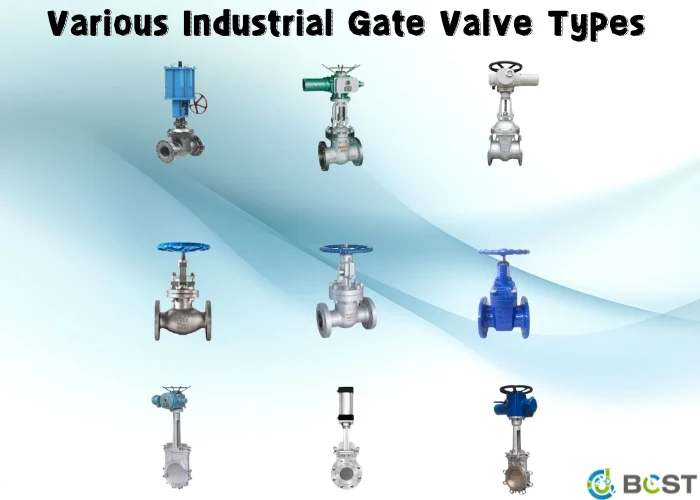
1. Gate valves can be divided into wedge type and parallel type according to the different structures of the gate. The wedge-type gate valve has three forms: single gate, double gate, and resilient gate.
Wedge Type Gate Valve
A wedge válvula de compuerta is a kind of gate valve. So it is named because its sealing surface and the vertical centerline make some angle, that is, the two sealing surfaces into a wedge shape. In general, the angle between the sealing surface and the vertical centerline of the two sealing surfaces into a wedge-shaped gate valve is 2°52′, 3°30′, 5°, 8°, 10°, etc. The wedge gate valve is divided into a rising stem gate valve and a non-rising stem gate valve, a wedge-shaped single gate valve, and a wedge-shaped double gate valve.
Parallel type Gate Valve
Parallel válvula de compuertas have two sealing surfaces perpendicular to the axis of the pipe, i.e., they are gate valves with two sealing surfaces parallel to each other.
A parallel gate valve is a sliding valve with a parallel gate closing member. The closing member can be a single or double gate with a spreading mechanism between them. The gate pressure on the seat is controlled by the medium acting on the floating gate or floating seat. In the case of a double gate parallel gate valve, this force is supplemented by a spacer mechanism between the two gates.
2. Depending on the type of structure, gate valves can be divided into flat gate valves and knife gate valves.
flat gate valve
The flat válvula de compuerta is a sliding valve with a parallel gate as the closing element. The closing member can be a single or double gate with an interlocking mechanism. The compression force of the gate seat is controlled by the medium pressure acting on the floating gate or floating seat. In the case of a double gate flat gate valve, this force is supplemented by a spreader mechanism between the two gates.
The flat gate valve can be divided into manual flat gate valve, pneumatic flat gate valve, and electric flat gate valve according to the driving mode. Furthermore, according to the purpose and use, the gate valve can be divided into guide plate gate valve, non-guide plate gate valve, oilfield plate gate valve, pipeline plate gate valve, gas plate gate valve, etc.
knife gate valve
The opening and closing member of the knife válvula de compuerta is the gate. The direction of motion of the gate is vertical to the direction of the fluid. The gate valve relies on a knife blade gate that can cut fiber material off the medium. The gate has two sealing surfaces; the most common pattern is wedge-shaped. The wedge angle varies with the valve parameters and is usually 5°. It can make the gate of a wedge-type knife gate valve into a single unit, called a rigid gate. You can also make it into a gate that can produce a small deformation to improve its processability. It can make up for the deviation of the sealing surface angle in the process, this kind of gate is called the resilient gate. The valve body does not have a chamber. Instead, the gate is raised, lowered in the side guide groove, and pressed against the seat by the bottom lug. We can use O-ring seats to achieve bi-directional sealing for high media tightness. The installation area of knife gate valve is small. It has low working pressure, is not easy to accumulate debris, and is less expensive.
When the knife gate valve is closed, the sealing surface can rely only on the medium pressure to seal. That is, it depends on the medium pressure to press the sealing surface of the gate plate to the other side of the valve seat to ensure the sealing surface is self-sealing. Most gate valves are forced to seal. In other words, when the valve is closed, it depends on the external force to force the gate plate to the seat to ensure the sealing surface of the seal. Therefore, it should generally install this type of valve in the pipeline vertically.
- The gate valve can be divided into an electric gate valve, pneumatic gate valve, and manual gate valve according to the driving method.
Válvula de compuerta eléctrica
En electric gate valve simply means that an electric actuator controls the valve to realize the opening and closing of the valve. It can be divided into two parts: upper and lower. The upper part is the electric actuator, and the lower is the valve. It can adjust the speed of the electric gate valve switching action. It is simple in structure and easy to maintain. And it is not easy to be damaged by jamming during the move because of the buffering characteristic of the gas itself. But there must be a gas source, and its control system is more complicated than other electric valves. Nevertheless, the electric gate valve is responsive, safe, and reliable.
Válvula de compuerta neumática
En pneumatic gate valve is the valve that the closing member (gate) moves in the vertical direction along the center line of the pathway. Pneumatic gate valves in the pipeline can only be used for full open and full off and can not be used for regulation and throttling. Therefore, a pneumatic gate valve is a valve with a wide range of use.
Válvula de compuerta manual
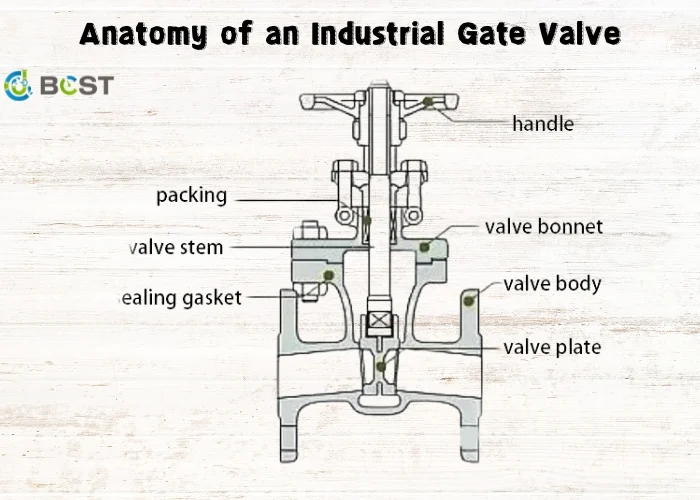
A manual válvula de compuerta is a common type used on equipment and installations. The handle and handwheel operate it. Generally, the clockwise rotation of the handle and handwheel is specified as the closing direction, and the counterclockwise rotation is defined as the opening direction. However, some valves open and close opposite the above; we should focus on checking the opening and closing signs before operation.
The valve can be opened and closed by turning the handwheel and the threaded entry and exit of the valve stem and by raising or lowering the valve plate connected to the valve stem.
- Gate valve stem is divided into rising stem (lifting shaft) and non-rising stem (rotary shaft) according to the form of movement.So the gate valve is divided into two kinds: rising stem gate valve and non-rising stemgate valve.
Vástago ascendente válvula de compuerta
The handwheel (or another driving device) is fixed on the stem nut. When the handwheel (or another driving device) rotates the stem nut, the stem will move up and down, thus driving the gate valve for lifting movement and opening and closing the pipeline.
When the rising stem gate valve is opened, the stem extends from above the handwheel, which can directly show the opening degree of the gate valve. The stem trapezoidal thread is in the upper part of the stem. It is not in direct contact with the medium and is not corroded by the medium, and the section lubricates all aspects. Therefore, it is suitable for corrosive media, foul media, and high-temperature steam media. The valve’s degree of opening and closing can be seen directly from the thread, and the ease of operation is also one of its advantages. The disadvantage is that, due to the thread leakage, it is easy to stick to the dust in the air and accelerate the tread wear, so you should install it indoors as much as possible. Nevertheless, it is still more widely used.
Non-rising stem válvula de compuerta
The handwheel (or another driving device) is fixed on the stem. And the stem thread is set on the top of the gate. When the handwheel (or another driving device) rotates, the stem threads drive the gate for lifting motion. The stem can only do the rotational movement. The advantage is that the stem does not rise when opening and the installation space required is small. Therefore, it is often used as a significant passage gate valve or where the installation space is limited. However, since the stem does not lift, it cannot show the degree of opening by the length of the stem extension, like the open stem gate valve. Therefore, it should be equipped with an openness indicator.
The threaded part of the stem and stem nut of the non-rising stem gate valve is in contact with the medium inside the valve cavity. Therefore, it is vulnerable to media corrosion. Also, the stem threads are challenging to be lubricated.
Selecting the Right Gate Valve Types for Your Specific Application
A valve’s design is only half the story. If you don’t match it to the fluid and the conditions, it is going to fail. That means dangerous leaks and system shutdowns.
This is all about matching the valve to its job. You have to pick the right materials to fight corrosion and wear. You also need to know about special gate valve types, like heavy-duty API 600 valves for oil and gas or knife gates for thick slurries.
My father’s motto was always “the right valve for the right pipe.” This is what he meant. A valve that handles drinking water is completely different from one that has to survive inside a chemical plant. This is where you have to think about materials. You’re not just picking a mechanical part; you’re choosing how to safely contain what’s flowing through your pipes.
Material-Based Selection
The valve body and its internal parts must stand up to the fluid running through them. If not, they will corrode and fail.
- Hierro fundido: Inexpensive and good for low-pressure water and air. You don’t use it for anything high-pressure or high-temperature.
- Carbon Steel: This is the workhorse for the heavy hitters like oil, gas, and power plants. It’s strong and takes the heat, but it rusts if you expose it to a lot of chemicals or salt water.
- Stainless Steel: When you’re dealing with anything that rusts out standard steel, like chemicals or food products, stainless is a must. It costs more, but it’s necessary for clean or corrosive services.
- Alloy Steels: For extreme jobs, like the main steam lines in a power plant, you need special alloys. They are designed to stay strong at crazy high temperatures and pressures.
| Material | Common Application | Ventajas clave |
|---|---|---|
| Hierro fundido | Water Distribution, HVAC | Low cost |
| Acero al carbono | Oil & Gas, Steam, Power | High strength & temperature resistance |
| Acero inoxidable | Chemical, Food, Pharma | Excellent corrosion resistance |
| Acero aleado | High-Temp Steam, Refining | Strength at extreme temperatures |
Service-Specific Gate Valves
Now let’s talk about the specialists. Some jobs need a unique type of gate valve.
- API 600/API 602 Valves: These are the tanks of the gate valve world. They are built to tough standards from the American Petroleum Institute, with thicker walls and stronger construction for refineries and chemical plants. Hassan won’t use anything else for his critical process lines.
- Cryogenic Valves: Handling something super cold like liquefied natural gas (LNG) requires a special design. These valves have a long neck, or “extended bonnet,” that keeps the valve’s seals from freezing solid and failing.
- Válvulas de guillotina: These have a thin, sharp gate that’s designed to slice through thick stuff like pulp slurries or wastewater. They aren’t meant for high-pressure seals, but they’re perfect for pipes with solids.
All this knowledge about gate valve types is exactly what my father built his business on, and it’s what I practice every day. It’s not about just shipping a box with a valve in it. At BCST, we want to be part of your team. We look at what you’re trying to do and help you find the derecha valve for the job, not just any valve. That’s what we do.
Frequently Asked Questions (FAQs)
What is the main purpose of a gate valve?
A gate valve’s main purpose is for on/off isolation of fluid. It is designed to be either fully open to allow full flow, or fully closed to provide a tight shutoff.
Can I use a gate valve for throttling or regulating flow?
No, you should never use a gate valve for throttling. Partial opening causes high-velocity flow that creates vibration and turbulence, which will severely erode and damage the gate and seats.
How do I know if a rising stem gate valve is open?
You can easily tell by its stem. If the stem has risen visibly above the handwheel, the valve is open. If the stem is flush or low, the valve is closed.
Final Thought
Look, getting the gate valve right is one of those things that ensures you sleep at night. It’s about safety and reliability. Don’t guess. At BCST, we have the experience to make sure you have the perfect valve for your application, every single time.


 English
 Arabic
 Russian
 French
 Spanish