
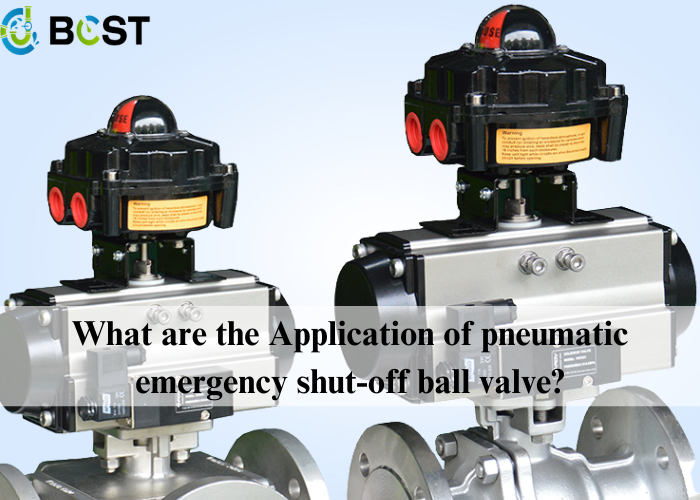
The pneumatic emergency shut-off ball valve is a key industrial equipment widely used in petroleum, chemical industry, natural gas, electric power, water treatment, and other fields. Its main function is to quickly cut off the fluid in the pipeline in an emergency to ensure the safety and stability of the system. This article will discuss in detail the basic principles, structural characteristics, application scenarios, installation, maintenance, and future development trends of pneumatic emergency shut-off ball valves.
1. Basic principles of pneumatic emergency shut-off ball valve
The pneumatic emergency válvula de bola de cierre consists of a pneumatic actuator and a ball valve. The pneumatic actuator drives the valve stem to rotate through compressed air, thereby driving the ball core of the ball valve to rotate to achieve switch control. Here’s how it works:
Normal operation: Under normal working conditions, the pneumatic actuator adjusts the pressure of the compressed air through the signal received by the control system, so that the valve stem drives the ball core to rotate to a predetermined position to control the on and off of the fluid.
Emergency cut-off: When the system detects an abnormal situation or receives an emergency stop signal, the pneumatic actuator immediately releases or supplies compressed air, quickly drives the valve stem to rotate 90 degrees, turns the ball core from the open position to the closed position, and quickly cuts off the fluid.
A pneumatic emergency shut-off ball valve has the advantages of rapid response, complete shut-off, and simple operation. It is suitable for applications that require quick shut-off of fluids.
2. Structural characteristics of pneumatic emergency shut-off ball valve
The structure of the pneumatic emergency válvula de bola de cierre includes the valve body, ball core, valve stem, seals, and pneumatic actuator. The following are its main structural features:
Valve body: Usually made of stainless steel, carbon steel, or alloy steel, it is resistant to corrosion, high pressure, and high temperature, ensuring reliability under various working conditions.
Ball core: The ball core is the core component of the ball valve, which controls the flow of fluid through rotation. The ball core is usually made of high-strength materials, and its surface is precision machined and plated to reduce friction and wear.
Valve stem: The valve stem connects the pneumatic actuator and the ball core to transmit driving force. The valve stem is usually made of high-strength alloy steel, and the surface is hardened to enhance wear resistance and fatigue resistance.
Seals: Seals are used to ensure the tightness of the ball valve in the closed state and prevent leakage. Commonly used sealing materials include polytetrafluoroethylene (PTFE), rubber, and metal, which have good corrosion resistance and high-temperature resistance.
Pneumatic actuator: The pneumatic actuator is composed of a cylinder, a piston, a spring, and a control valve. It controls the inlet and outlet of compressed air to realize the opening and closing action of the ball valve. Pneumatic actuators have the advantages of simple structure, convenient maintenance, and rapid action.
3. Application scenarios of pneumatic emergency shut-off ball valve
Pneumatic emergency shut-off ball valves are widely used in multiple industries. The following are some main application scenarios:
Oil and natural gas industry: During the extraction, storage, transportation, and processing of oil and natural gas, pneumatic emergency shut-off ball valves are used to emergency cut off oil and gas pipelines to prevent accidents such as fires, explosions, and leaks. For example, during natural gas pipeline transportation, when pipeline leakage or abnormal pressure is detected, the pneumatic emergency shut-off ball valve can quickly close to prevent the accident from expanding.
Chemical industry: In the chemical production process, many media are corrosive, toxic, and flammable. Pneumatic emergency shut-off ball valves are used to emergency cut off chemical pipelines to ensure the safety of the production process. For example, a pneumatic emergency shut-off ball valve is installed on the feed pipe of a chemical reactor. When an abnormal reaction or leakage is detected, the feed will be cut off immediately to prevent accidents.
Electric power industry: In the power production process such as thermal power generation, nuclear power plants, and hydropower stations, pneumatic emergency shut-off ball valves are used to control the supply of cooling water, steam, and fuel to ensure the safe operation of power plants. For example, in the cooling water system of a nuclear power plant, when abnormal cooling water flow or system failure is detected, the pneumatic emergency shut-off ball valve can quickly close to prevent the nuclear reactor from overheating.
Water treatment industry: In water treatment processes such as sewage treatment, tap water supply, and seawater desalination, pneumatic emergency cut-off ball valves are used to emergency cut-off water sources to prevent water pollution and system failure. For example, a pneumatic emergency shut-off ball valve is installed on the water inlet pipe of a sewage treatment plant. When abnormal sewage quality or equipment failure is detected, the incoming water is immediately cut off to prevent sewage overflow.
Food and beverage industry: In the production and processing of food and beverages, pneumatic emergency shut-off ball valves are used to control the delivery of liquids and gases to ensure the hygiene and safety of the production process. For example, during the beer production process, when pipeline leakage or pressure abnormalities are detected, the pneumatic emergency shut-off ball valve can quickly close to prevent beer leakage and contamination.
4. Installation and maintenance of pneumatic emergency shut-off ball valve
The installation and maintenance of pneumatic emergency shut-off ball valves are critical to their normal operation and service life. The following are some key installation and maintenance points:
1. Installation points
Location selection: Choose a location that is easy to operate and maintain to install the pneumatic emergency shut-off ball valve, and ensure that there is enough space around the valve to facilitate the opening, closing, and maintenance of the valve.
Pipe connection: Check whether the pipe is clean and free of debris before installation. When installing, pay attention to the inlet and outlet directions of the valve to ensure the tightness of the connection with the pipeline.
Firmly fixed: After the valve is installed, it should be firmly fixed to avoid vibration and displacement. For large-diameter valves, support devices should be installed to reduce the load on the valves and pipelines.
Air source connection: The air source of the pneumatic actuator should be connected to stable, clean compressed air, and a water filter and a pressure-reducing valve should be installed in the air source pipeline to ensure the quality and pressure of the air source are stable.
2. Maintenance points
Regular inspection: Regularly inspect all parts of the pneumatic emergency shut-off ball valve, including the valve body, ball core, valve stem, seals, and pneumatic actuator, to ensure that there is no damage or wear.
Lubrication and maintenance: Lubricate and maintain the moving parts of the valve stem and pneumatic actuator to reduce friction and wear and extend service life. Use special lubricating oil to avoid corrosion of seals and valve body materials.
Leak detection: Perform leak detection regularly to check the sealing of the valve in the closed state. If leakage is found, the seal should be replaced or the valve repaired in time.
Air source maintenance: Ensure the air source quality of the pneumatic actuator, clean the water filter regularly, check the working status of the pressure-reducing valve, and ensure the cleanliness and stability of the air source.
Emergency drills: Regularly conduct emergency cut-off drills to check the response speed and reliability of the pneumatic emergency cut-off ball valve to ensure that it can operate normally in an emergency.
5. Future development trends of pneumatic emergency shut-off ball valves
With the continuous advancement of science and technology and the improvement of industrial automation level, the development of pneumatic emergency shut-off ball valves has also shown some new trends:
1. Intelligent
The intelligent pneumatic emergency shut-off ball valve integrates more sensors and control technologies, which can monitor the working status and environmental parameters of the valve in real-time, and realize remote monitoring and data analysis through wireless communication and cloud platforms. For example, intelligent pneumatic emergency shut-off ball valves can monitor the valve’s switch position, air source pressure, and temperature through built-in sensors, and automatically issue alarms or cut-off instructions when abnormal conditions are detected to improve the safety and reliability of the system.
2. High precision and reliability
Future pneumatic emergency shut-off ball valves will use more advanced manufacturing processes and materials to further improve their accuracy and reliability. For example, high-precision machining and surface treatment technology are used to make the ball core and seals fit more closely, reducing leakage and wear; new high-strength materials and anti-corrosion coatings are used to enhance the durability and corrosion resistance of the valve to adapt to more demanding requirements working conditions requirements.
3. Green and environmentally friendly
In the context of increasing environmental awareness, the development of pneumatic emergency shut-off ball valves will also pay more attention to green and environmentally friendly design. For example, using low-power design and energy-saving technology to reduce energy consumption and environmental impact; using environmentally friendly materials and recyclable materials to reduce environmental pollution and waste of resources; optimizing structural design to reduce manufacturing costs and maintenance costs and increase resource usage efficiency.
4. Modularization and integration
Future pneumatic emergency shut-off ball valves will be more modular and integrated, making them easier to install, maintain, and upgrade. For example, using modular design, various functional modules can be flexibly configured and combined according to actual needs, improving the adaptability and scalability of the system; integrated design integrates multiple functions into one device to achieve multi-parameter synchronous measurement and control, simplifying System structure to improve work efficiency.
5. Remote diagnosis and predictive maintenance
With the development of the Internet of Things and big data technology, pneumatic emergency shut-off ball valves will realize remote diagnosis and predictive maintenance functions. By collecting and analyzing valve operating data in real-time, potential faults can be predicted and discovered in advance, preventive maintenance can be performed, and downtime and maintenance costs can be reduced. For example, big data analysis technology can be used to comprehensively evaluate the working status of valves, formulate scientific maintenance plans, extend the service life of equipment, and improve the reliability and economy of the system.
Conclusión
As a key industrial equipment, a pneumatic emergency shut-off ball valve plays an important role in ensuring system safety and stability. Through reasonable selection, correct installation, and maintenance, the advantages of pneumatic emergency shut-off ball valves can be fully utilized to improve the safety and reliability of the production process. With the continuous advancement of science and technology, the development of pneumatic emergency shut-off ball valves will be more intelligent, high-precision, green, and integrated, promoting the development of industrial automation and intelligence. In the future, pneumatic emergency shut-off ball valves will be widely used in more fields and more complex working conditions, making greater contributions to the safety, efficiency, and sustainable development of industrial production.


 English
 Arabic
 Russian
 French
 Spanish