
In the high-stakes world of oil, gas, and petrochemical processing, success is measured not just by output, but by safety, environmental responsibility, and operational efficiency. Yet, an unseen enemy constantly threatens these critical metrics: fugitive emissions. These unintentional leaks of hydrocarbons from plant equipment, particularly valves, represent a significant challenge, leading to staggering product losses, posing severe safety and health risks, and incurring hefty regulatory penalties. While much attention is rightly paid to valve packing and sealing materials, the component that provides the force and motion to make these seals work – the actuator – plays a far more critical role than often acknowledged. Specifically, the performance and selection of direct acting actuators are paramount in the relentless battle to achieve and maintain valve integrity and dramatically reduce fugitive emissions in demanding high-pressure hydrocarbon service.
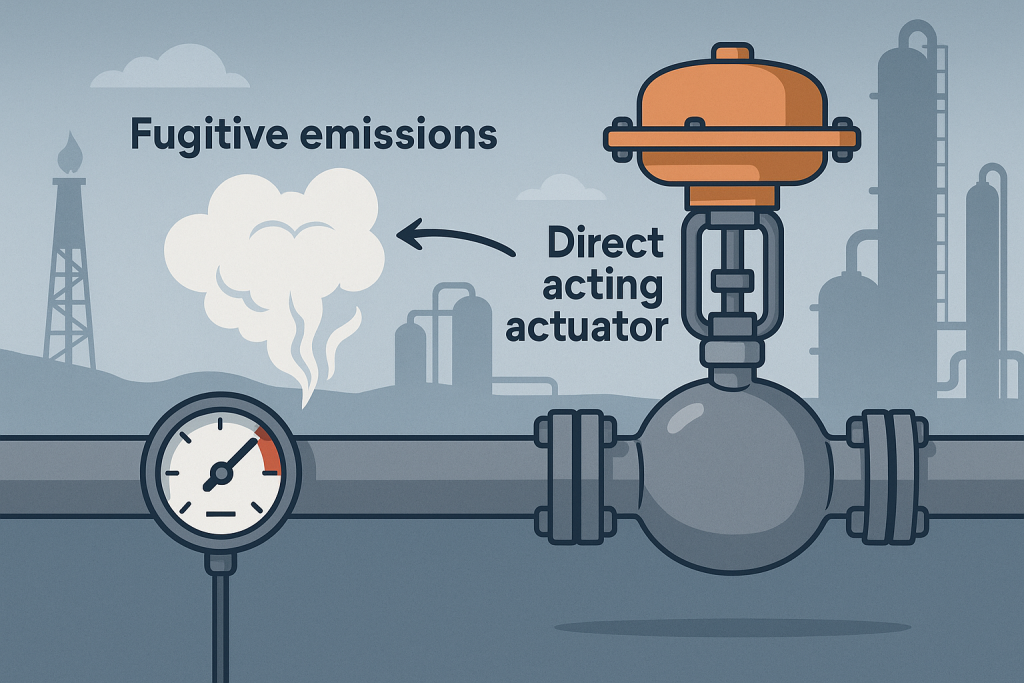
Why Fugitive Emissions Are Your Plant’s Silent Threat
Imagine a valuable product disappearing completely a constant threat of fire or explosion, and contributing to environmental degradation. That’s the reality of fugitive emissions. In refineries and processing plants, thousands of valves control the flow of flammable, toxic, or valuable substances. Despite sophisticated designs, the dynamic seals within these valves – primarily the stem packing and seat seals – are under constant stress from high pressures, fluctuating temperatures, corrosive media, and frequent operation.
These leaks aren’t just minor annoyances; they have profound consequences:
- Economic Losses: Lost product directly impacts the bottom line. Combined with the cost of leak detection and repair (LDAR) programs and potential fines for non-compliance with regulations like EPA standards, ISO 15848, or stringent local mandates, the financial drain is immense.
- Safety Hazards: Many hydrocarbons are highly flammable or toxic. Leaks create hazardous atmospheres, increasing the risk of fires, explosions, and personnel exposure to dangerous chemicals.
- Impacto medioambiental: Volatile Organic Compounds (VOCs) and Greenhouse Gases (GHGs) released as fugitive emissions contribute to air pollution and climate change, leading to increased regulatory scrutiny and public pressure.
While upgrading valve packing materials and implementing robust LDAR programs are essential, they address the symptom or the detection of leaks. To truly minimize fugitive emissions, we must focus on the components that enable the valve’s sealing function in the first place. This brings us to the critical role of the valve actuator.
How Valves Really Seal and Why it’s a Tough Job
At its core, a valve seals by creating a barrier to fluid flow. In most industrial valves, this involves two primary sealing points:
- The Seat Seal: Where the valve’s closing element (disc, bola, plug, gate) makes contact with the valve body or seat ring to stop flow.
- The Stem/Shaft Seal: The packing or sealing mechanism around the moving stem or shaft that prevents process fluid from escaping to the atmosphere. This is often the most problematic area for fugitive emissions due to the dynamic motion involved.
Maintaining these seals, especially the stem packing, is incredibly challenging in high-pressure hydrocarbon service. Factors like:
- High differential pressure trying to force media past the seals.
- Extreme temperatures causing expansion and contraction of materials.
- Corrosive properties of the media degrading sealing materials.
- Mechanical stress and wear from repeated valve operation.
- Vibration from connected piping or equipment.
All these factors conspire to challenge the integrity of the valve’s seals. The actuator, by providing the force and motion to operate the valve, directly influences how well these seals perform under pressure and over time.
Why Direct Acting Actuators Are Different (and Better for Sealing)
Valve actuators come in various designs, but they fundamentally differ in how they transmit power to the valve stem or shaft. Many utilize gearboxes, linkages, or complex mechanisms. Direct acting actuators, however, operate on a principle of applying force or torque directly in line with the valve’s motion, minimizing intermediate components.
Think of it like pushing a door. You can push it directly on its face (direct action) or use a series of levers and pulleys to achieve the same motion (indirect action). While levers might multiply force, they can also introduce play, friction, and potential points of misalignment.
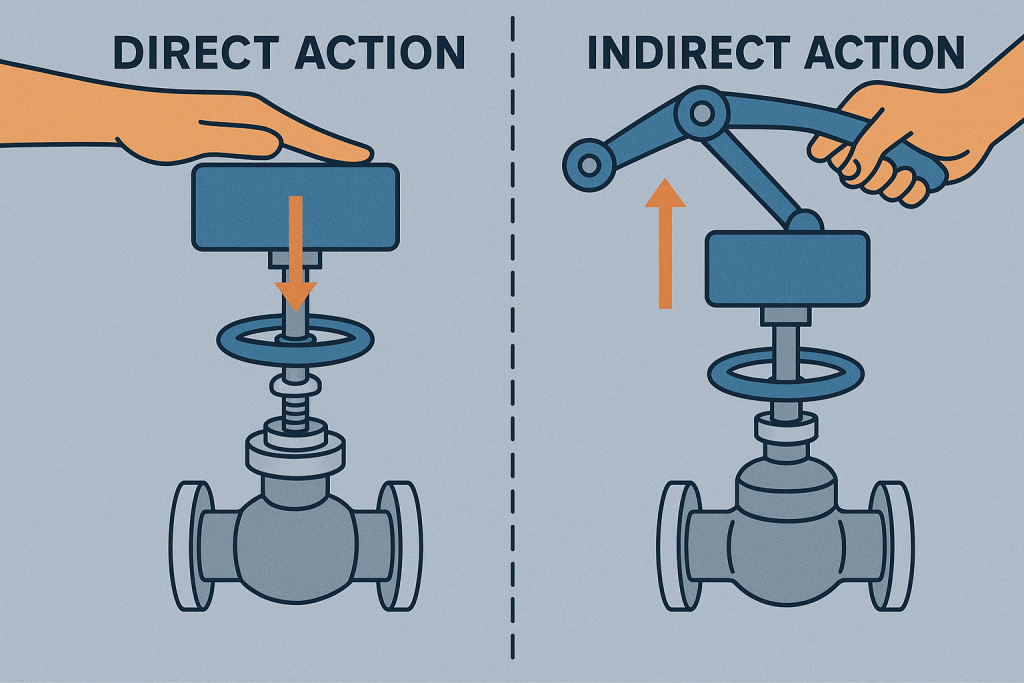
Here’s why this “direct” approach offers significant advantages specifically for enhancing valve sealing and combating fugitive emissions:
- Consistent and Predictable Force/Torque Application: In a direct acting actuator, the force (for linear motion like gate/globe valves) or torque (for rotary motion like ball/butterfly valves) generated by the power source (air pressure, electric motor) is applied directly to the stem or shaft. This provides a highly predictable and consistent output, ensuring the valve’s sealing elements receive the correct, reliable force needed for tight shutoff and proper packing compression. There’s less guesswork or variability compared to systems with multiple mechanical links.
- Improved Stem Alignment: By applying force directly along the axis of the valve stem, direct acting actuators inherently minimize side loading. Side loading can accelerate wear on stem guides and packing, creating preferential leak paths. Direct action promotes smoother stem movement and more even compression of the packing material.
- Reduced Hysteresis and Backlash: The fewer mechanical connections between the power source and the valve stem/shaft in a direct acting actuator, the less energy is lost to friction and deformation (hysteresis), and the less “play” there is in the system (backlash). This precision is crucial for control valves requiring fine positioning for flow regulation without leakage, and for block valves needing repeatable, tight seating.
- Simplified Design, Enhanced Reliability: Fewer moving parts typically mean less potential for mechanical failure. A simpler, more robust direct acting actuator design translates to higher reliability and less need for maintenance that could potentially disrupt the valve’s seal integrity.
These inherent advantages make direct acting actuators a preferred choice for critical valves where reliable, long-term sealing against fugitive emissions is paramount.
Types of Direct Acting Actuators for Emission Control
Direct acting actuators harness different power sources to generate motion. Understanding these types and their specific characteristics is key to selecting the best option for minimizing fugitive emissions.
Let’s look at the main players:
- Pneumatic Direct Acting Actuators: These use compressed air pressure acting on a diaphragm or piston to create linear (for rising stem valves) or rotary motion (often via rack and pinion or scotch yoke mechanisms for quarter-turn valves). They are known for their simplicity, speed, and inherent fail-safe capability (spring return). Historically, some pneumatic actuators vented a small amount of air (and potentially process gas if seals leaked) to the atmosphere with each stroke. However, modern designs, particularly low-bleed or no-bleed pneumatic direct acting actuators, significantly reduce or eliminate these operational emissions, making them viable for many low-e applications when instrument air is available.
- Electric Direct Acting Actuators: These use an electric motor to drive a gearing system or lead screw that directly applies linear or rotary force. A major advantage is zero emissions from the power source itself. Electric actuators provide great accuracy in positioning and have advanced diagnostic features, which enable remote checking of valve performance details that can show early signs of sealing problems.
- Electro-Hydraulic Direct Acting Actuators: These self-contained units feature an electric motor driving a hydraulic pump and cylinder integrated into the actuator housing. They provide high force/torque in a compact design, making them suitable for large or high-pressure valves. Like electric actuators, they offer zero external emissions from their operation.
Choosing the right type depends on the specific application requirements, including available power, required speed, torque/thrust needs, safety integrity levels (SIL), and the acceptable level of potential emissions from the actuator itself.
Table 1: Direct Acting Actuator Types and Fugitive Emission Considerations
| Actuator Type | Direct Action Principle | Power Source Emissions? | Sealing Force Consistency | Positioning Accuracy | Fail-Safe Capability | Suitability for High Pressure |
|---|---|---|---|---|---|---|
| Pneumatic (Modern) | Diaphragm/Piston (Linear/Rotary) | Low/Zero Emissions | Alta | Good to High | Inherent (Spring) | Bien |
| Eléctrico | Motor/Gearing (Linear/Rotary) | Zero Emissions | Alta | Muy alta | Requires UPS/Spring | Bien |
| Electro-Hydraulic | Motor/Hydraulic Cylinder | Zero Emissions | Muy alta | Alta | Inherent (Spring) | Excelente |
Selecting the Right Direct Acting Actuator for Leak-Tight Performance
Selecting a direct acting actuator for critical low-emission service in high-pressure hydrocarbon environments involves more than just matching torque or thrust to the valve requirement. A focused approach is needed to ensure the actuator actively contributes to minimizing fugitive emissions.
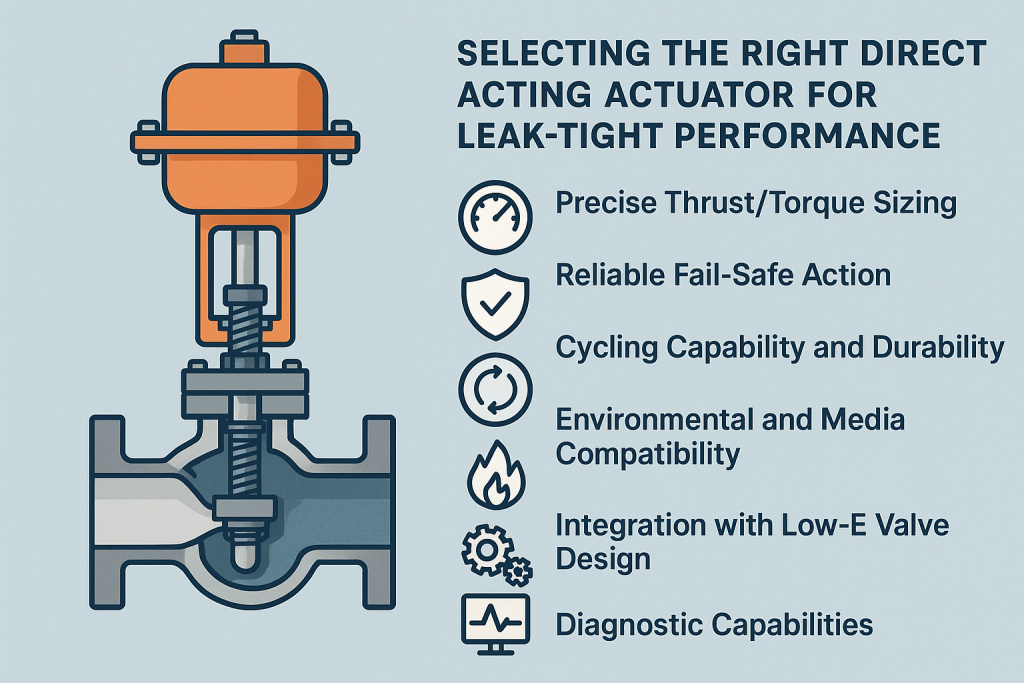
Here are key selection criteria to consider:
- Precise Thrust/Torque Sizing: Accurate calculation of the force or torque required not just to operate the valve, but to maintain sufficient seating load for tight shutoff and consistent compression of the stem packing against process pressure. Oversizing wastes energy, undersizing compromises sealing.
- Reliable Fail-Safe Action: For safety and emission containment during power or signal loss, the actuator’s fail-safe position (fail-close or fail-open, often achieved with integrated springs in direct acting designs) must be guaranteed to maintain a safe, sealed state.
- Cycling Capability and Durability: The actuator must be designed to withstand the required number of operating cycles over its lifespan without degradation that could lead to mechanical play or reduced force output, compromising the seal.
- Environmental and Media Compatibility: Actuator materials, seals, and enclosure ratings (e.g., NEMA, IP, hazardous area classifications like ATEX or IECEx) must withstand the corrosive atmosphere, temperature extremes, and potential exposure to process media.
- Integration with Low-E Valve Design: Ensure the actuator is compatible with the valve’s specific low-emission features, such as specialized packing systems or stem finishes. Proper mounting interfaces are crucial for maintaining alignment.
- Actuator-Source Emissions: While the focus is on valve leaks, consider emissions from the actuator itself. Opting for electric, electro-hydraulic, or low/zero-bleed pneumatic direct acting actuators minimizes this potential source.
- Diagnostic Capabilities: “Smart” direct acting actuators offer valuable data on operational parameters (torque profiles, partial stroke testing results, cycle history) that can provide early warnings of potential valve packing or sealing issues, enabling predictive maintenance before a leak occurs.
Table 2: Key Direct Acting Actuator Selection Criteria for Low-Emission Valves
| Criterios de selección | Importance for Emissions Control | How Direct Action Helps |
|---|---|---|
| Precise Sizing (Thrust/Torque) | Ensures sufficient, consistent force for tight seating & packing seal | Predictable output directly applied; easier to match actuator force to valve requirement. |
| Reliable Fail-Safe Action | Guarantees a safe, sealed position upon power/signal loss. | Spring-return designs are inherent to many direct acting types. |
| Durability & Cycling | Maintains performance over time; prevents wear that affects sealing. | Simpler mechanics can mean higher intrinsic reliability. |
| Environmental Compat. | Prevents degradation of actuator components affecting its function. | Selection based on robust design and materials. |
| Valve Design Integration | Ensures proper mating and force transmission to the valve seal. | Critical for maintaining stem alignment and packing integrity. |
| Actuator-Source Emissions | Eliminates or minimizes leaks from the actuator itself. | Modern electric/electro-hydraulic/low-bleed pneumatic options provide solutions. |
| Diagnostic Capabilities | Enables early detection of potential sealing issues. | Provides valuable performance data directly related to valve operation. |
Maintaining the Seal, Minimizing the Leaks
Even the best direct acting actuator won’t ensure a leak-tight valve if not properly installed and maintained. Correct practices are vital to realize the full potential of these devices in minimizing fugitive emissions.
- Precision Installation: Proper mounting and alignment of the actuator to the valve are non-negotiable. Misalignment can introduce side loads on the valve stem, negating one of the key benefits of a direct acting actuator and accelerating packing wear. Following manufacturer specifications meticulously is crucial.
- Calibration Matters: For control valves, accurate calibration ensures that the actuator positions the valve precisely, providing the correct seating force when closed and smooth, repeatable modulation when open, minimizing leakage during operation.
- Targeted Maintenance: Routine maintenance should focus on the actuator components that directly impact valve sealing – checking couplings, ensuring smooth operation, inspecting actuator seals for external leaks (if applicable), and verifying that the fail-safe function operates correctly.
- Harnessing Diagnostics: For smart actuators, actively monitoring diagnostic data can provide invaluable insights. Changes in torque or thrust profiles during cycling might indicate increased friction from worn packing or early signs of seating issues, allowing for proactive maintenance before a detectable leak occurs.
Direct Acting Actuators in Action
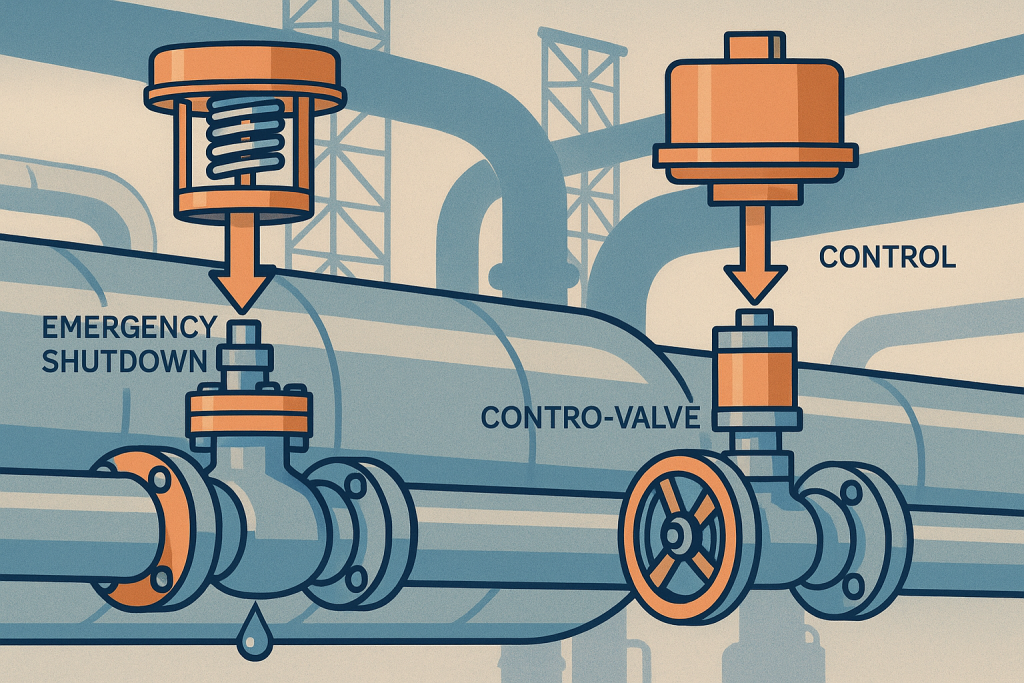
In high-pressure hydrocarbon service, the reliable sealing provided by properly selected and maintained direct acting actuators is not theoretical – it’s essential for daily operations and safety. Think of critical emergency shutdown (ESD) valves on a pipeline or reactor: when they need to close instantly and seal bubble-tight, the predictable, direct force of a robust direct acting actuator (often pneumatic with spring return or electro-hydraulic) is trusted to get the job done and contain hazardous media. Similarly, in hydroprocessing units handling hydrogen at high temperatures and pressures, control valves rely on the precise and consistent positioning of a direct acting actuator to regulate flow accurately while preventing fugitive emissions through the stem.
Final Thought
Fugitive emissions remain a persistent and costly problem in the aceite, gas, and petrochemical industries. While advancements in valve design and packing materials are crucial, one cannot overstate the valve actuator’s role in enabling and maintaining a reliable seal.
Direct acting actuators, with their inherent advantages in consistent force application, improved alignment, and reduced play, are fundamental to achieving leak-tight valve performance, particularly in challenging high-pressure hydrocarbon environments. By understanding the specific benefits of different direct acting actuator types, carefully considering key selection criteria focused on emission control, and prioritizing correct installation and maintenance, plant operators and engineers can significantly minimize fugitive emissions.
Specifying the right direct acting actuator fugitive emissions solution is more than a technical decision; it’s a strategic investment in enhancing safety, ensuring environmental compliance, and improving the overall operational and financial performance of your plant. These actuators are not just automated muscle; they are critical guardians of valve integrity, playing an essential role in sealing the future of responsible hydrocarbon processing.


 English
 Arabic
 Russian
 French
 Spanish