
Should You Choose PTFE Lined Valves For Harsh Chemicals?
Your plant faces a constant battle against corrosive chemicals, leading to frequent valve failures and costly downtime. You need a reliable, cost-effective solution for these challenging environments.
PTFE lined valves provide excellent protection against various aggressive chemicals at moderate temperatures. Their polytetrafluoroethylene (PTFE) lining creates an inert barrier inside the valve body, preventing fluid contact with metal components. This extends valve lifespan and maintains process purity effectively.

This specialized lining technology goes beyond simple protection; it is a fundamental shift in how valves withstand chemical attack in many industrial settings. Understanding its properties will help you safeguard your critical infrastructure. Emily has seen firsthand how a well-chosen PTFE lined valve can transform a problematic process, a sentiment Hassan echoes, emphasizing its value in chemical processing.
What is PTFE and Why is it Used in Valve Linings?
Corrosive fluids threaten your metal valves, leading to swift degradation and leaks. You need to know what PTFE is and how it can effectively shield your valuable industrial valves from such devastating chemical attacks.
PTFE stands for Polytetrafluoroethylene, a synthetic fluoropolymer. It is used in valve linings because it is chemically inert, meaning it resists nearly all aggressive chemicals. This creates a non-reactive barrier inside the valve, protecting the metal body and ensuring process purity and long valve life.
According to a estudiar, in chemically intensive waste streams, PTFE components show over 99% removal efficiency for several ions while retaining structure at elevated temperatures, showing that chemical attack and temperature have limited impact on PTFE morphology relative to alternatives like PVDF.
The Remarkable Properties of PTFE
When we talk about PTFE lined valves, the magic begins with Polytetrafluoroethylene, or PTFE. This material is a polymeric compound. It is made up of carbon and fluorine atoms. The strong carbon-fluorine bonds are the secret to PTFE’s exceptional chemical resistance. These bonds make PTFE very stable and unreactive. This means that highly corrosive chemicals, like strong acids, bases, and solvents, cannot break down or react with the PTFE lining. Emily often mentions how PTFE has become synonymous with “chemical protection” in the valve industry.
The PTFE lining in a valve acts as a barrier. It separates the fluid flowing through the pipeline from the metal components of the valve body and trim. This prevents corrosion of the valve itself. Without this lining, many valve materials would quickly degrade, leading to leaks, process contamination, and valve failure. Hassan emphasizes that in chemical processing, preventing even minor leaks is critical for both safety and product quality.
Another important property of PTFE is its extremely low coefficient of friction. This means it is very “slippery.” This non-stick surface helps prevent the buildup of residues inside the valve. It also ensures smooth operation of parts that move against the lining, like a valve disc or ball. This non-stick feature is crucial for maintaining flow control valve efficiency and reducing pressure drop.
Furthermore, PTFE possesses good thermal stability up to certain temperatures, making it suitable for moderate temperature applications. It can handle continuous operating temperatures up to approximately 200°C (392°F). However, above this temperature, PTFE can begin to soften and experience cold flow, which means it can deform under constant pressure. This is a key consideration for selecting where to use PTFE lined valves. Its combination of chemical inertness, non-stick properties, and thermal stability makes it an ideal material for lining industrial valves in a wide array of aggressive media applications.
| PTFE Property | Benefit for Valve Linings | Impact on Your Operations for Valve Lifespan |
|---|---|---|
| Inercia química | Resists almost all corrosive fluids. | Prevents valve corrosion, maintains process purity. |
| Non-Stick Surface | Reduces residue buildup, smooth operation. | Improves flow control, reduces maintenance needs. |
| Thermal Stability | Operates continuously up to 200°C (392°F). | Suitable for moderate temperature chemical processing. |
| Low Friction | Minimizes wear on moving parts. | Extends valve lifespan, reduces actuator load. |
| Electrical Insulation | Prevents galvanic corrosion with dissimilar metals. | Enhances system integrity, prevents unexpected failures. |
Where Are PTFE Lined Valves Most Effectively Used?
You have a range of aggressive chemicals and need effective fluid control. The question is, where do PTFE lined valves truly prove their worth in industrial settings? Which applications gain the most from their unique properties?
PTFE lined valves are most effectively used in chemical plants, pharmaceutical manufacturing, and wastewater treatment. They excel in handling corrosive acids, caustic solutions, and solvents at moderate temperatures. Their chemical inertness ensures process purity and prevents valve degradation in these demanding environments.
Maximizing PTFE’s Potential in Critical Processes
Understanding “where are PTFE lined valves most effectively used?” helps you pinpoint critical areas in your plant where they can provide maximum value. Hassan, our Chief Engineer, often advises his teams to think beyond just the chemical itself. He also considers the operating conditions. Emily sees PTFE lined valves as foundational tools for many industries struggling with corrosion.
One of the primary sectors where PTFE lined valves are indispensable is Chemical Processing Plants. These facilities constantly handle a vast array of aggressive media, including concentrated hydrochloric acid, sulfuric acid, nitric acid, and various solvents. Traditional metal valves quickly succumb to corrosion in such environments. PTFE lined valves, such as PTFE lined ball valves or PTFE lined butterfly valves, provide the necessary chemical resistance to ensure safe and reliable fluid transfer and flow control. They prevent dangerous leaks and protect expensive process equipment downstream. They are workhorses for chemical transfer, reactor isolation, and process line control.
Fabricación farmacéutica also relies heavily on PTFE lined valves. In this industry, process purity is paramount. Any contamination can compromise product quality and patient safety. PTFE’s chemical inertness means it will not leach contaminants into sensitive pharmaceutical products. Its non-stick surface also makes it ideal for handling viscous or sticky media and facilitates easy CIP (clean-in-place) procedures. PTFE lined valves are commonly used in API (Active Pharmaceutical Ingredient) production, purified water systems, and solvent recovery processes.
Furthermore, PTFE lined valves are found in Wastewater Treatment Plants y Fume Scrubbing Systems. Wastewater often contains various corrosive chemicals, and scrubber systems handle highly aggressive gasses and liquids used to neutralize industrial emissions. PTFE lined valves provide robust protection against these harsh conditions, ensuring the long-term integrity of the treatment and scrubbing processes. Their ability to resist a broad spectrum of chemicals prevents system failures.
Emily often highlights that PTFE lined valves are particularly effective where cost-effectiveness needs to meet corrosion resistance. While PFA lined valves offer higher temperature ranges, if your operating temperature is below 200°C (392°F), PTFE often provides an excellent solution at a more attractive price point. This makes them a smart choice for a wide range of applications from general chemical service to acid transfer.
| Application Area | Specific Use Cases | Key Benefit of PTFE Lined Valves | Expected Outcome for Your Plant |
|---|---|---|---|
| Chemical Plants | Acid/caustic transfer, solvent handling, reactor feeds | Corrosion protection, leak prevention | Reduced downtime, enhanced safety, longer equipment life. |
| Productos farmacéuticos | API production, purified water, solvent recovery | Process purity, non-leaching, CIP compatibility | Product integrity, regulatory compliance, reduced batch contamination. |
| Tratamiento de aguas residuales | Chemical dosing lines, corrosive effluent handling | Resistance to harsh wastewater, reliable isolation | System longevity, environmental protection, consistent treatment. |
| Fume Scrubbing Systems | Circulating aggressive scrubbing liquids | Protection against acidic/alkaline fumes | Extended scrubber life, effective emission control. |
| Electroplating Industry | Handling plating solutions, rinse water | Resistance to metal-etching chemicals | Sustained process quality, reduced equipment repair. |
What Are the Key Limitations of PTFE Lined Valves?
You rely on PTFE lined valves for corrosion resistance, but every material has its limits. Understanding these limitations is critical. It helps you prevent unexpected failures, costly replacements, and ensure reliable fluid control in your plant operations.
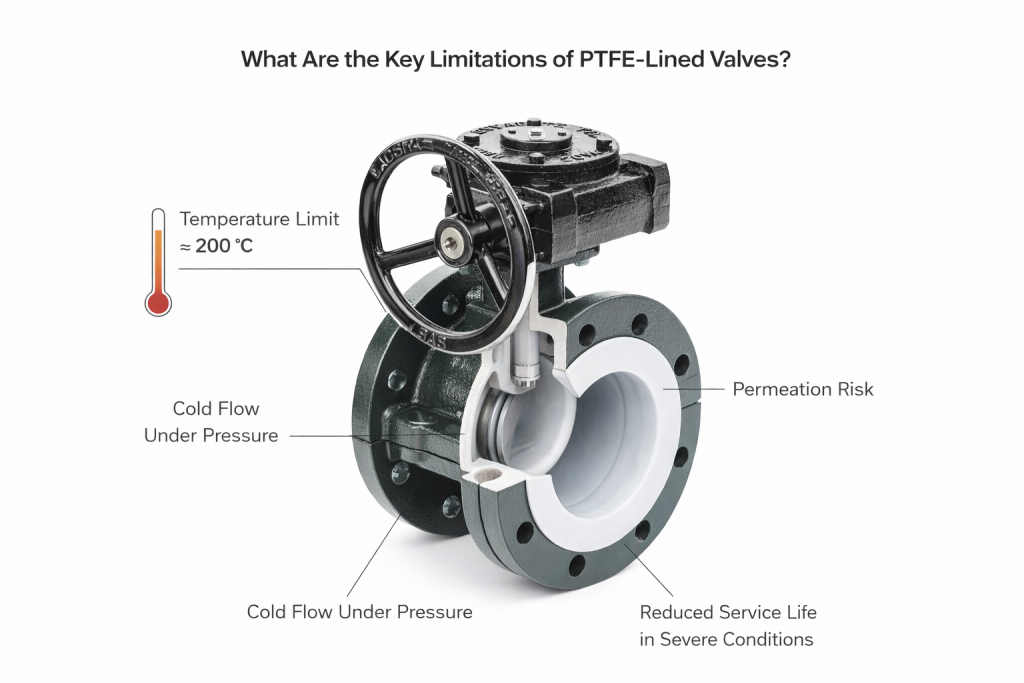
The key limitations of PTFE lined valves include their temperature resistance, cold flow susceptibility, and permeation characteristics. They are generally limited to moderate temperatures (up to 200°C) and can deform under sustained pressure (cold flow). This may lead to leakage or reduced valve lifespan in severe conditions.
Navigating the Boundaries of PTFE Performance
Even with PTFE’s impressive chemical resistance, it is vital to understand its boundaries. Hassan often advises, “No material is perfect for every application. Knowing PTFE’s limitations is just as important as knowing its strengths.” Emily agrees, noting that misuse often leads to the perception that the valve itself is faulty, rather than recognizing where the material falls short.
One of the most significant PTFE lined valve limitations is its Resistencia a la temperatura. While PTFE performs well up to around 200°C (392°F), exceeding this limit will cause the material to soften significantly. When PTFE softens, it loses its structural integrity. This can lead to deformation of the lining, especially under system pressure. This deformation can compromise the valve’s sealing capability, potentially causing leakage and ultimately valve failure. For high temperature resistance applications above this range, other fluoropolymers like PFA or metal-seated valves become necessary.
Another critical factor is Cold Flow. PTFE has a tendency to deform slowly and permanently under continuous mechanical stress or pressure, even at room temperature. This phenomenon is known as cold flow. In PTFE lined valves, this can manifest as the lining material slowly yielding or extruding from under the valve seat, or around bolted connections. This cold flow can reduce the bubble-tight shutoff capability over time. It may require frequent re-tightening of bolts or eventual replacement of the liner. This limits PTFE’s effectiveness in applications with sustained high pressure or fluctuating pressures that stress the lining. This is why PTFE lined ball valves or plug valves need careful pressure and temperature matching for their seat designs.
Permeation is another consideration, particularly with gases or small molecular fluids. While PTFE is an excellent barrier, it is not entirely impermeable. Over time, certain gases or small organic molecules can slowly permeate through the PTFE lining. This can lead to a slight risk of fugitive emissions for highly hazardous or toxic media. It can also lead to the eventual degradation of the underlying metal body if the fluid is particularly aggressive. For applications requiring ultra-high purity or handling highly permeable gases, PFA might offer better permeation resistance due to its denser molecular structure.
Finally, while PTFE has excellent general chemical resistance, there are a few very specific chemicals it cannot handle. These include molten alkali metals (e.g., sodium, potassium) and elemental fluorine at high temperatures. These are highly specialized conditions, but they illustrate that PTFE is not universally resistant to all chemicals. Therefore, always verify PTFE’s compatibility with your specific process fluid, temperature, and pressure conditions using chemical compatibility charts. This careful selection ensures optimal valve performance and extended service life.
| Limitación | Descripción | Consequence for Your Plant | Recommended Mitigation / Alternative |
|---|---|---|---|
| Temperature Limit | Max. 200°C (392°F) continuous operating. | Softening, deformation, sealing failure. | Use PFA lined valves or metal-seated valves for higher temps. |
| Cold Flow | Permanent deformation under sustained pressure. | Leakage, reduced shutoff, lining extrusion. | Select valves with reinforced linings or use PFA for high-pressure. |
| Permeation | Gas or small molecule seepage through lining. | Fugitive emissions, substrate corrosion. | Consider PFA lining for highly permeable or toxic media. |
| Specific Chemicals | Incompatible with molten alkali metals, molten fluorine. | Rapid degradation, catastrophic failure. | Consult chemical compatibility charts precisely. |
| Abrasive Media | Soft PTFE can be damaged by particulates. | Lining erosion, valve failure. | Use ceramic-lined valves or hard-faced components for slurries. |
Conclusión
PTFE lined valves are your reliable, cost-effective defense against corrosion in chemical processing and pharmaceutical industries. Understand their temperature and pressure limits for optimal performance and extended valve lifespan.
Seeking dependable corrosion resistance?


 English
 Arabic
 Russian
 French
 Spanish