
Programmable Ball Valve vs. Solenoid Valve: Which Should You Use for Your Application?
In the world of automated fluid control, selecting the right valve is critical for efficiency, precision, and cost-effectiveness. Two of the most common types used for automated control are the programmable (motorized) ball valve and the solenoid valve. While both serve to regulate fluid flow, they achieve it through vastly different mechanisms, making each suitable for specific applications.
Understanding their fundamental differences is key to making an informed decision. This guide from BCST Valve will break down the features, advantages, and ideal applications for both programmable ball valves and solenoid valves, helping you choose the optimal solution for your system.
What is a Programmable Ball Valve?
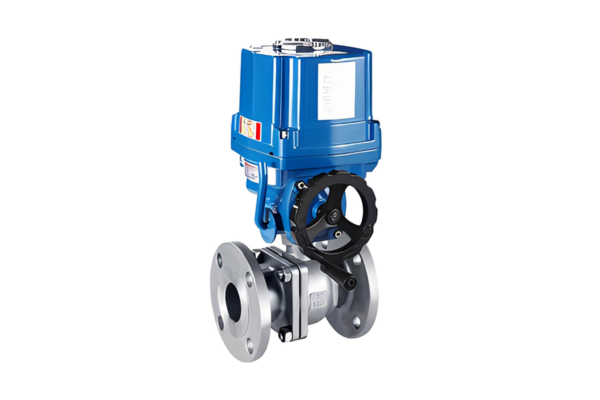
A programmable ball valve combines a standard ball valve (a quarter-turn valve that controls flow using a rotatable ball with a bore) with an electric actuator. The actuator contains a motor, gears, and control electronics that rotate the ball, allowing for precise control over the valve’s opening and closing.
- Operation: Electromechanical rotation of a ball.
- Control Type: Can provide both On/Off (fully open/closed) and modulating (proportional flow control, e.g., 0-100% open) capabilities.
- Velocidad: Typically slower in operation (seconds to tens of seconds) as the motor needs time to rotate the ball.
- Power Consumption: Only consumes power during the opening or closing cycle. Once in position (open, closed, or partially open), it holds its position without continuous power (non-failsafe types).
- Capabilities: Handles high pressures, temperatures, and viscous or dirty media well. Available in large sizes.
¿Qué es una electroválvula?
A solenoid valve is an electromechanically operated valve that uses an electric current to generate a magnetic field, which in turn moves a plunger to open or close the valve orifice. They are typically direct-acting or pilot-operated.
- Operation: Electromagnetic movement of a plunger.
- Control Type: Primarily designed for rapid On/Off switching. Proportional solenoid valves exist but are more complex and costly for larger flows.
- Velocidad: Very fast actuation (milliseconds to fractions of a second), ideal for quick response times.
- Power Consumption: Generally requires continuous power to remain in its actuated (open or closed) position, especially for normally closed (NC) or normally open (NO) types. This can lead to heat generation.
- Capabilities: Best suited for clean fluids and gases, lower to medium pressures, and smaller pipe sizes. More susceptible to blockage from debris.

Direct Comparison: Programmable Ball Valve vs. Solenoid Valve
| Característica | Programmable Ball Valve | Válvula solenoide |
|---|---|---|
| Actuación | Electric motor (electromechanical) | Electromagnet (electromagnetic) |
| Tipo de control | On/Off & Modulating (Proportional) | Primarily On/Off (some proportional) |
| Actuation Speed | Slow (seconds to tens of seconds) | Very Fast (milliseconds) |
| Power Consumption | Only during actuation; holds position without power | Continuous power often required to hold position |
| Pressure/Temp | High pressure & temperature capabilities | Lower to medium pressure & temperature |
| Compatibilidad de soportes | Versatile (clean, dirty, viscous, slurries, gases) | Best for clean fluids/gases; susceptible to debris |
| Pipe Size Range | Small to very large (up to several inches/DN) | Typically small (up to ~1 inch/DN25-DN50) |
| Cost (Initial) | Más alto | Baja |
| Mantenimiento | Generally low; robust design | Coil burnout possible with continuous power; susceptible to clogging |
When to Choose a Programmable Ball Valve
Programmable ball valves are the preferred choice for applications demanding:
- Precise Flow Control (Modulating): When you need to regulate flow rate, not just turn it fully on or off. Ideal for mixing, blending, and process control.
- High Pressure and Temperature: Their robust design and sealing capabilities make them suitable for challenging industrial environments.
- Viscous or Dirty Fluids: The full-port design and wiping action of the ball handle suspended solids and thicker media without clogging.
- Large Pipe Sizes: Economical and reliable for pipes 1 inch (DN25) and above.
- Eficiencia energética: Where holding a position for extended periods without consuming power is critical.
- Slow, Controlled Actuation: Preventing water hammer or sudden surges in flow.
When to Choose a Solenoid Valve
Solenoid valves are best suited for tasks requiring:
- Rapid On/Off Switching: Where quick response time is prioritized over precise flow regulation, such as emergency shut-off or precise dosing.
- Compact Size: Their small footprint makes them ideal for installations with limited space.
- Clean Fluids & Gases: Less tolerant of particulates that can clog the orifice or damage internal components.
- Lower Pressure & Temperature: Generally designed for less demanding fluid conditions.
- Lower Initial Cost: Often a more economical choice for simple automation tasks.
Key Deciding Factors for Your Application

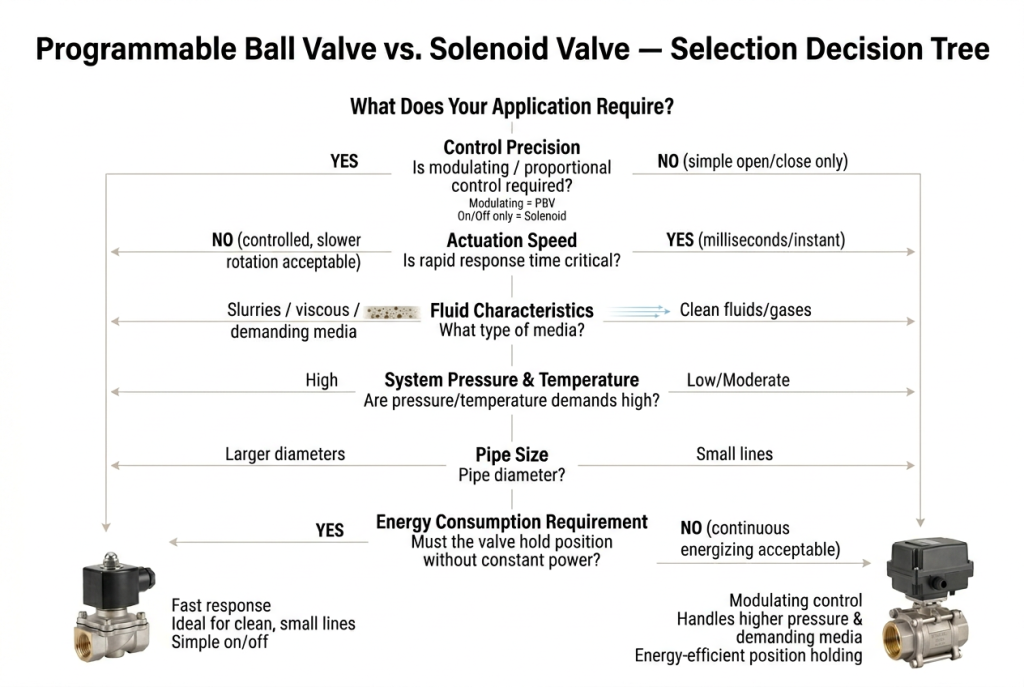
- Control Precision: Do you need modulating (programmable ball valve) or simple on/off (solenoid valve)?
- Velocidad de actuación: Is rapid response time critical (solenoid valve) or is a slower, controlled movement acceptable (programmable ball valve)?
- Fluid Characteristics: Are you handling clean fluids/gases (solenoid valve) or more demanding media like slurries or high-viscosity liquids (programmable ball valve)?
- System Pressure and Temperature: High demands point to programmable ball valves; lower demands might suit a solenoid.
- Pipe Size: Smaller lines often use solenoids; larger lines typically require programmable ball valves.
- Consumo de energía: Does the valve need to hold a position for long periods without constant power (programmable ball valve)?
For more detailed guidance on selecting the right valve, including specific technical parameters, refer to our Buyer’s Guide to Selecting a Programmable Ball Valve.
Conclusion: Tailoring the Valve to the Task
There’s no universally “better” valve type; the superior choice always aligns with the specific requirements of your application. Programmable ball valves offer versatility, precision, and robustness for heavy-duty, modulating, and large-scale applications. Solenoid valves, with their rapid response and compact nature, excel in fast-paced, smaller-scale, on/off scenarios.
By carefully evaluating the demands of your system against the distinct characteristics of each valve type, you can ensure optimal performance, reliability, and cost-efficiency. BCST Valve offers a wide range of both motorized ball valves and solenoid valves, engineered to meet diverse industrial and commercial needs.
Still unsure which valve is best for your project?


 English
 Arabic
 Russian
 French
 Spanish