
Top 5 Applications for Programmable Ball Valves: Revolutionizing Flow Control
Programmable ball valves represent a significant leap forward in automated fluid management. These intelligent devices, combining the robust mechanics of a ball valve with the precision of an electric actuator, offer unparalleled control, efficiency, and safety across a multitude of industries. Unlike their manual counterparts, programmable ball valves can execute complex flow operations based on schedules, sensor data, or remote commands, making them indispensable in modern automated systems.
At BCST Valve, we understand that understanding the technology is just the first step. Knowing where and how to apply it unlocks its true potential. If you’re new to the concept, delve into our pillar article: What Is a Programmable Ball Valve? The Ultimate Guide. In this guide, we’ll explore the top 5 applications where programmable ball valves are truly indispensable, driving efficiency, reducing waste, and enhancing operational precision.
1. Industrial Process Control & Automation
In manufacturing, chemical processing, food & beverage production, and pharmaceuticals, precise control over fluid flow is not just desirable—it’s critical for product quality, safety, and cost efficiency. Programmable ball valves play a pivotal role in automating complex processes.
- Batch Processing: Accurately adding measured quantities of ingredients, solvents, or catalysts to reaction vessels on a timed schedule or in response to weight/flow sensors.
- Fluid Diversion: Automatically routing liquids or gases between storage tanks, processing units, or waste streams to optimize production lines.
- Temperature & Pressure Regulation: Interfacing with sensors to maintain precise temperatures by controlling coolant or heating fluid flow, or managing pressure by opening/closing relief lines.
- CIP/SIP Systems: Automating Clean-In-Place (CIP) and Sterilize-In-Place (SIP) routines, ensuring hygienic processing without human error.
Their ability to integrate with PLCs (Programmable Logic Controllers) and DCS (Distributed Control Systems) allows for seamless, hands-free operation and real-time process optimization.
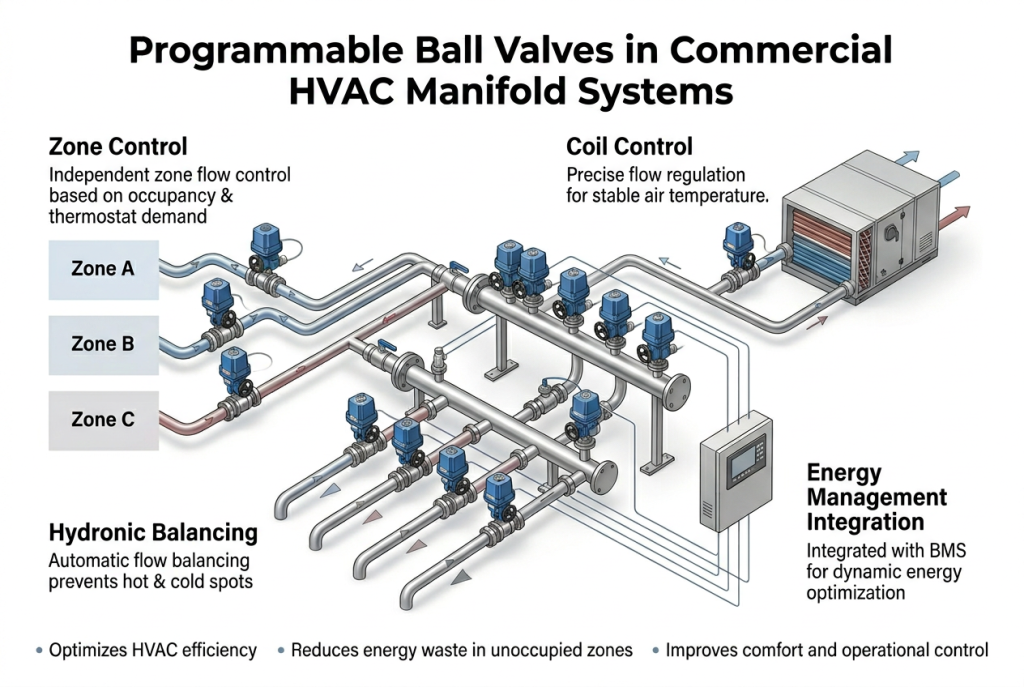
2. HVAC (Heating, Ventilation, and Air Conditioning) Systems
Energy consumption in large commercial and residential buildings is heavily influenced by HVAC efficiency. Programmable ball valves are essential components in optimizing these systems for comfort and cost savings.

- Zone Control: Directing hot or chilled water to specific zones or rooms based on occupancy schedules or individual thermostat settings, preventing energy waste in unoccupied areas.
- Coil Control: Precisely regulating water or refrigerant flow through heating and cooling coils to maintain desired air temperatures, rather than simple on/off.
- Hydronic Balancing: Automatically adjusting flow to ensure even distribution of heating/cooling fluid throughout the entire system, preventing “hot spots” or “cold spots.”
- Energy Management: Integrating with Building Management Systems (BMS) to optimize overall energy consumption by dynamically adjusting flow rates across the HVAC infrastructure.
3. Smart Irrigation & Agriculture
Water is a precious resource, and its efficient management is paramount in modern agriculture. Programmable ball valves are at the heart of smart irrigation systems, enabling significant water conservation and optimized crop yields.
- Automated Watering Schedules: Opening and closing valves for different irrigation zones based on pre-programmed time schedules.
- Sensor-Driven Irrigation: Responding to soil moisture sensors, weather station data (rain, humidity), or evapotranspiration rates to apply water only when and where it’s needed.
- Nutrient Delivery: Precisely controlling the flow of fertilizers and nutrients through irrigation lines (fertigation), ensuring optimal delivery to crops.
- Remote Management: Farmers can monitor and adjust irrigation systems from anywhere, responding to changing conditions without being physically present.
This precision reduces water waste, lowers energy costs for pumping, and promotes healthier plant growth.
4. Water & Wastewater Treatment Plants
The journey of water from source to tap, and then from wastewater back to nature, involves numerous stages of treatment, filtration, and chemical dosing. Programmable ball valves ensure these critical processes are executed with precision and reliability.
- Filtration Backwash Cycles: Automating the reversal of flow through filters to clean them, crucial for maintaining water quality and preventing system downtime.
- Dosificación química: Controlling the precise flow of coagulants, disinfectants (like chlorine), and pH adjusters, ensuring correct chemical balance and regulatory compliance.
- Reservoir & Tank Level Management: Automatically managing water inflow and outflow to maintain optimal levels in reservoirs, storage tanks, and clarifiers.
- Sludge Handling: Orchestrating the movement of sludge and byproducts through various treatment stages.
Their durable construction and ability to handle various media make them ideal for these demanding environments.
5. Building Management Systems (BMS) & Smart Homes
As buildings become smarter, programmable ball valves are integrating fluid control into broader automation frameworks, enhancing comfort, safety, and resource efficiency.
- Automated Leak Detection & Shut-off: Quickly closing the main water supply in response to detected leaks, preventing significant water damage and costly repairs.
- Water Recycling Systems: Automating the diversion of greywater for non-potable uses like toilet flushing or irrigation.
- Rainwater Harvesting: Controlling flow to redirect collected rainwater for usage or storage based on tank levels and demand.
- Energy Monitoring & Conservation: Integrating with smart thermostats and energy management platforms to optimize hot water distribution or shut off non-essential lines.
The Unifying Advantages: Why Programmable Valves Excel Across Applications
Across these diverse applications, the core advantages of programmable ball valves remain consistent:
- Precision Control: Exacting management of flow rates and volumes reduces waste and optimizes processes.
- Enhanced Efficiency: Automation reduces reliance on manual labor, minimizes human error, and ensures systems operate at peak performance.
- Cost Savings: Derived from reduced energy consumption, less material waste, quicker operations, and prevention of damage (e.g., from leaks).
- Improved Safety: Automated shut-offs in emergencies, remote operation in hazardous environments, and reliable system isolation.
- Data Integration: Provides valuable operational data that can be used for analysis, reporting, and further optimization.
Choosing the right automated valve is crucial. Understand the various types and their compatibility with your system in our guide: Buyer’s Guide to Selecting a Programmable Ball Valve.
Conclusion: The Future of Responsible Fluid Management
Programmable ball valves are more than just components; they are enablers of intelligent, sustainable, and highly efficient fluid management systems. Their ability to deliver precision, reliability, and automation across a wide spectrum of industries—from the factory floor to the home—underscores their vital role in shaping our automated future.
At BCST Valve, we are committed to engineering and manufacturing programmable ball valves that meet the highest standards of performance and integration. Let us help you empower your systems with the precision and intelligence they deserve.
Ready to optimize your operations with smart valve technology?


 English
 Arabic
 Russian
 French
 Spanish