
Before & After: The Reactor That Went from a 3-Month Valve Life to a 3-Year Valve Life
Before, the plant was in a state of reactive chaos. Every three months, the poly-silicon reactor had to be shut down to replace a critical failed valve, torpedoing production schedules and costing a fortune in lost output and maintenance.
After, the plant runs with confident predictability. A new, correctly specified severe service valve, built with robust midstream ball valve principles, has been operating without issue for over three years, turning a major liability into a reliable asset.

The “Before” State: A Cycle of Failure and Unpredictability
Imagine owning a car that you knew, with 100% certainty, would break down on the highway every three months. This was the reality for the plant. The existing valve was fundamentally mismatched for the service, failing repeatedly and threatening the facility’s profitability.

Dive Deeper: The Technical Anatomy of the Failure
The issue was a combination of two attack mechanisms that standard valves could not handle simultaneously:
- Abrasive Erosion: The fine, hard poly-silicon particles in the slurry would embed themselves into the standard Stellite 6 seats, scoring the ball and creating a permanent leak path. This constant grinding action destroyed the mirror finish essential for a tight seal.
- Erosion-Corrosion: At high temperatures, the seat materials would soften, accelerating wear. The abrasive particles would also scrape away any protective oxide layer on the base metal, exposing fresh metal to attack from corrosive gases. This synergy is incredibly destructive.
| Modo de fallo | “Before” Valve (Standard MSBV) | Resultado |
|---|---|---|
| Abrasive Slurry | Stellite 6 hard-faced seats | Particles embedded in the seat, scoring the ball, creating a leak path. |
| High Temperature | Seat material softens slightly | Accelerated rate of abrasive wear. |
| Overall | Mismatched technology | Predictable failure every 3 months. Costly downtime. |
The “After” State: Applying Midstream Reliability
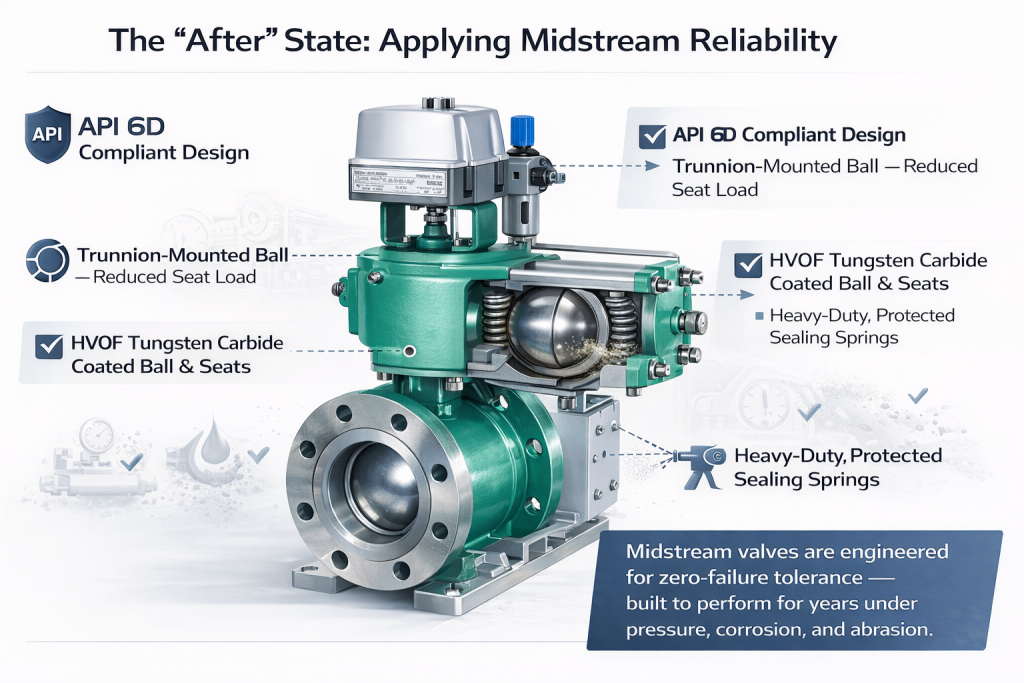
We looked to the midstream oil and gas sector, where midstream ball valves are designed to work flawlessly for years. These valves, often built to the API 6D standard, prioritize safety and long-term integrity. We selected a valve using this DNA: a trunnion-mounted design with HVOF Tungsten Carbide coatings.
Dive Deeper: The Engineering Behind 3-Year Reliability
Here’s the engineering that delivered the 3-year (and counting) valve life:
- HVOF Tungsten Carbide Coating: This was the game-changer. Tungsten Carbide is significantly harder than silicon particles. Instead of digging in, the particles now glance off the ultra-hard surface, causing no damage. The dense, non-porous coating also prevents corrosion.
- Trunnion-Mounted Design: The ball is mechanically anchored, reducing torque and providing a reliable seal independent of flow pressure. This is a core principle of high-performance midstream ball valves.
- Protected Spring Cavities: The new design shielded the seat springs from the abrasive slurry, ensuring they could always provide the necessary sealing force without clogging.
| Característica | “After” Valve (Midstream-Inspired) | Result for the Plant |
|---|---|---|
| Revestimiento | HVOF Tungsten Carbide | Eliminated abrasive wear; achieved bubble-tight seal. |
| Valve Design | Trunnion-mounted, API 6D principles | Lower torque, reliable sealing at all pressures. |
| Overall | Correct technology for severe service | Uninterrupted operation for 3+ years. Massive ROI. |
Conclusion: A Shift in Philosophy
This wasn’t just a valve replacement; it was a philosophy shift. By applying the robust, zero-failure design principles of high-end midstream ball valves to a downstream process problem, the plant transformed its most unreliable asset into one of its most dependable.
The lesson is clear: for your most critical applications, don’t just specify a valve—specify a solution built on a foundation of proven, severe-service engineering.


 English
 Arabic
 Russian
 French
 Spanish