
A shut-off valve handle that suddenly stiffens, a seat that starts leaking after one pressure event, or seals that seem to fail “for no reason” often point to the same hidden cause: rapid gas decompression. In high-pressure gas service, a fast pressure drop can cool the valve internally so quickly that sealing elements crack, distort, or lose performance before operators even understand what happened.
Quick answer: When compressed gas expands quickly through or inside a valve, the Joule-Thomson effect can drive a rapid temperature drop. In severe cases, that cooling combines with rapid gas decompression to damage elastomers, increase operating torque, create leakage, and shorten the service life of a high-pressure shut-off valve.
Why this failure mode is misunderstood
Many valve failures are blamed on poor quality, operator error, or “aggressive service” in a general sense. But in high-pressure gas applications, the real failure mechanism can be far more specific. A valve may be mechanically strong, correctly sized, and pressure-rated for the line, yet still struggle when the operating cycle includes sudden depressurization.
That happens because severe gas service is not only about pressure. It is also about how pressure changes. When gas expands rapidly, temperature can fall very fast. Seals and seats that seemed acceptable during steady-state design review may not tolerate that thermal shock. The result is a valve that works during commissioning, then begins to leak, drag, or stick after real operating cycles.
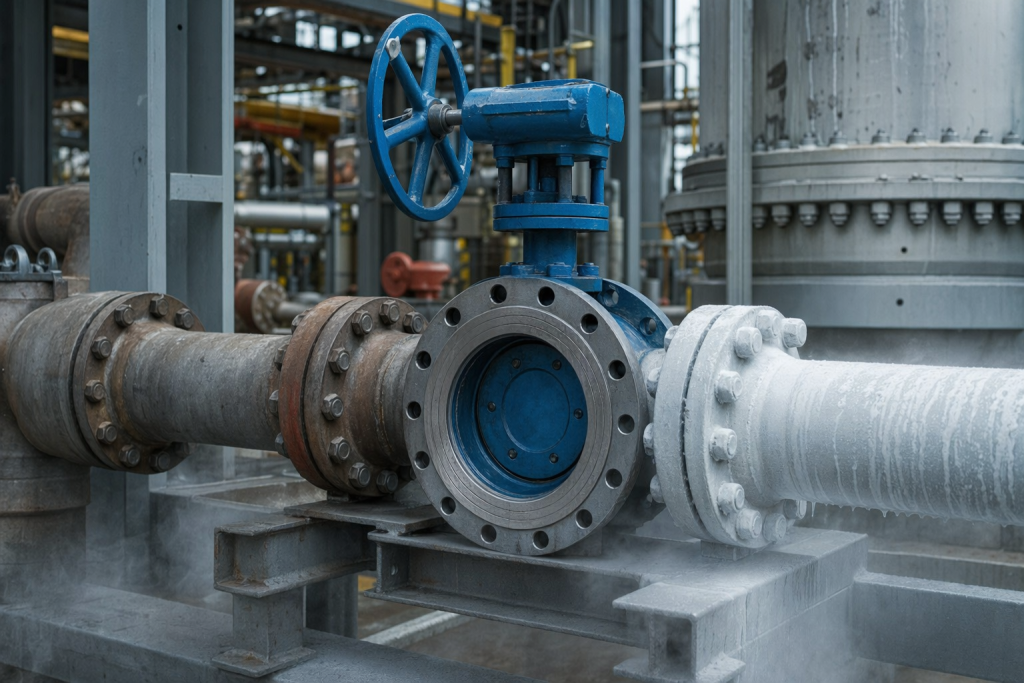
What is the Joule-Thomson effect in valve service?
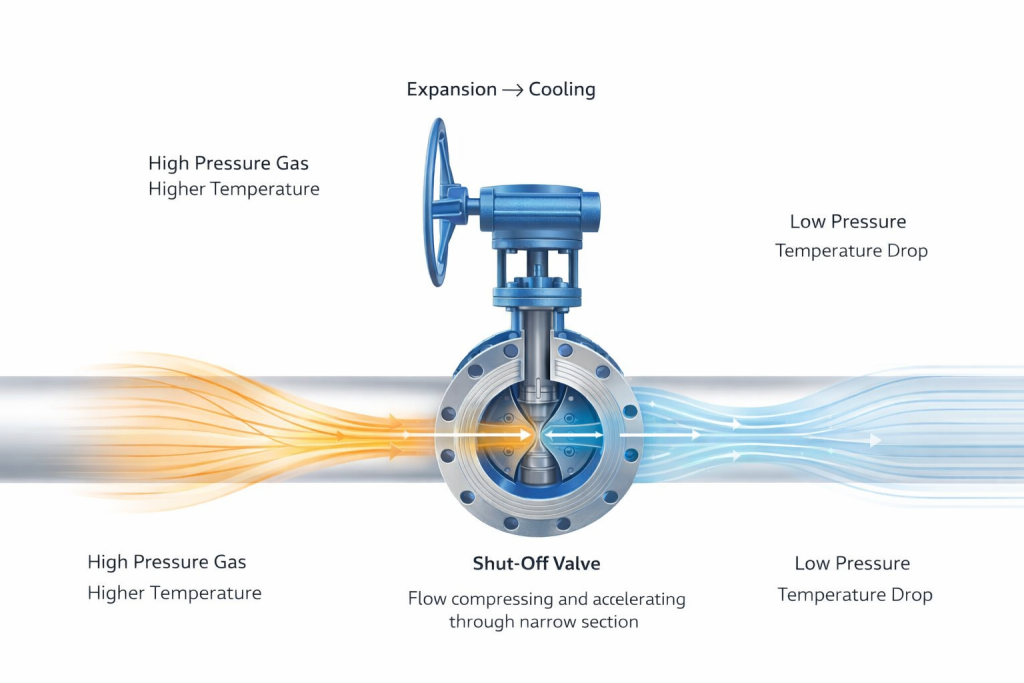
The Joule-Thomson effect describes the temperature change that occurs when a real gas expands without external heat input. In many industrial gases, a pressure drop across a restriction causes cooling. Inside a shut-off valve, that restriction may occur across the seat, trim, internal cavity, or other flow path during opening, throttling, or sudden isolation events.
In plain language, the gas behaves a little like a refrigerant. A high-pressure upstream condition can become a much colder downstream or internal condition in a very short time. If the valve design, seal material, or body alloy was not selected with that in mind, the valve may experience thermal stress well outside what its basic pressure rating suggests.
What is rapid gas decompression?
Rapid gas decompression, often shortened to RGD, occurs when gas absorbed into a seal material expands faster than the material can safely release it. Under high pressure, gas can diffuse into elastomeric or polymeric components. When the pressure is cut suddenly, that trapped gas tries to escape. If the material cannot accommodate the expansion, internal cracking, blistering, or rupture can occur.
This is one of the most important reasons why a valve can pass an initial shut-off test but then degrade in service. The leakage pathway is not always present at the beginning. It can be created by the decompression event itself.
That is also why leak verification and decompression resistance should be considered together. A valve chosen for severe gas duty should not only meet the right test expectations; it should also use the right materials and design philosophy. This links closely to our guide on
helium leak testing vs. bubble testing for hydrogen shut-off valves,
where the testing side of the problem is explained in detail.
Which gases are most associated with this problem?
Engineers commonly discuss this issue in relation to compressed gases such as CO₂, nitrogen, and hydrogen-related severe service conditions. The exact thermal response depends on gas properties, pressure range, valve geometry, and operating sequence. What matters in practice is not memorizing a single rule for every gas. It is recognizing that certain services can create sharp cooling and decompression stress during fast pressure changes.
If a valve will see repeated pressurization and depressurization, emergency isolation, fast blowdown, or severe cycling, it deserves closer review than a standard isolation duty application.
Common signs of thermal shock or decompression-related valve damage
Failure does not always appear as a dramatic break. In many plants, the warning signs begin subtly and are misread as normal wear. Engineers and maintenance teams should watch for:
- Increasing operating torque after a blowdown or fast cycling event
- Seat leakage that begins after a pressure upset rather than from gradual wear
- Stem stiffness or handle resistance following rapid opening or closing under gas pressure
- Seal cracking, blistering, or distortion discovered during maintenance
- Unexpectedly short service life in gas systems that cycle pressure aggressively
When several of these symptoms appear together, the root cause may be decompression stress rather than ordinary valve aging.
Why standard seal materials sometimes fail
Standard soft sealing materials are often selected for shut-off efficiency, chemical compatibility, or cost. But not every elastomer or polymer performs well under rapid decompression. Under pressure, gas may penetrate the material. Under sudden depressurization, the same material may not release the gas evenly or safely.
The internal damage is what makes this issue deceptive. The surface may look acceptable at first, yet microscopic cracking inside the seal can eventually become external leakage or loss of seating performance. That is why anti-RGD material selection matters in severe gas service. It is not a premium feature added for convenience. It is often part of the core reliability requirement.
| Design Area | Standard Approach | Severe Gas / RGD-Aware Approach |
|---|---|---|
| Seal material | General shut-off selection | Chosen for decompression resistance and low-temperature behavior |
| Leak testing | Routine verification | Matched to severe-gas shut-off requirement |
| Material review | Pressure rating focus | Pressure, temperature swing, and gas compatibility focus |
| Operating cycle review | Steady-state assumption | Fast cycling and blowdown scenarios included |
Why body material and alloy choice also matter
Seals are not the whole story. The body and trim also experience temperature change and mechanical stress. Standard carbon steel may be acceptable in many services, but low-temperature shock and severe gas duty often justify a closer look at alloy selection. Engineers should check whether the chosen body material supports the operating envelope, including temperature excursions during rapid depressurization.
That is one reason BCST Valve’s
stainless steel valve options
deserve attention in severe service selection. Material review should include not only corrosion resistance, but also low-temperature behavior, compatibility, and long-term shut-off stability.
How to reduce the risk of valve freezing and decompression damage
Engineers can reduce failure risk by treating the valve as part of a pressure-transition system rather than as a static component. Good practice usually includes:
- Review the operating sequence, not just the line pressure. Ask how quickly pressure is applied and removed.
- Select seals for decompression resistance. General-purpose sealing may not be enough.
- Check low-temperature suitability of body and trim materials.
- Use an appropriate leak verification philosophy. For severe gas duty, sensitive testing may be important.
- Consider actuator or operating torque implications. Cooling and material contraction can affect operability.
- Match the valve to the installation reality. If it is a replacement job, dimensional fit matters too.
That final point becomes critical in older plants. If the line is part of an aging skid, the technically correct valve must still fit the existing footprint. Our guide to
retrofitting high-pressure shut-off valves in legacy skids
explains how dimensional compatibility affects downtime, labor, and replacement cost.
When a valve problem is really an application problem
One of the most useful lessons in severe service engineering is that some “bad valve” cases are actually “bad application matching” cases. A valve may be built correctly, pressure-rated correctly, and tested correctly for a different duty. It still fails because the real service involved fast gas expansion, low-temperature shock, or repeated decompression cycles that were never emphasized during selection.
That is why the best specification process combines pressure class, leak requirement, media type, temperature behavior, and operating cycle into one decision. A high-pressure shut-off valve should be evaluated as a service solution, not as a catalog line item alone.
PREGUNTAS FRECUENTES
Why does a shut-off valve freeze during depressurization?
Fast gas expansion can cause a sharp temperature drop. In some services, that cooling is enough to affect seals, torque, and shut-off performance.
What is rapid gas decompression in valves?
It is damage caused when gas absorbed into a seal expands too quickly during sudden pressure release, creating cracks, blistering, or structural breakdown in the material.
Can standard O-rings fail in high-pressure gas service?
Yes. If the application involves severe gas cycling or rapid depressurization, standard sealing materials may not provide enough decompression resistance.
Need a valve for severe gas service or rapid pressure cycling?
Send BCST Valve your gas type, inlet pressure, temperature range, shut-off requirement, and end connection details. We can help review valve options for high-pressure isolation under demanding service conditions.


 English
 Arabic
 Russian
 French
 Spanish