
How Spring-Loaded Ball Valves Work: A Complete Guide to Mechanisms & Designs
The term “spring-loaded” in the context of industrial valves can sometimes lead to confusion, as it applies to two distinct—yet equally critical—aspects of valve design and operation. For engineers, technicians, and anyone involved in specifying or maintaining fluid control systems, understanding these nuances is essential for ensuring both optimal performance and uncompromising safety.
This comprehensive guide aims to clarify exactly how spring-loaded ball valves work. We will differentiate between the internal mechanism of spring-loaded seats, which significantly enhances sealing capabilities, and the external function of spring-return actuators, which provide critical fail-safe automation. By the end, you’ll have a clear understanding of both technologies and their crucial roles in various applications.
Let’s dive into the core mechanisms that make these valves indispensable in modern industrial processes.
Part 1: The Core Mechanism — Spring-Loaded Seats in Ball Valves
At its heart, the most common interpretation of a “spring-loaded ball valve” refers to the design of its internal seating mechanism. In these valves, compression springs are strategically placed behind the valve seats, applying a constant, pre-set force that pushes the seats against the ball.
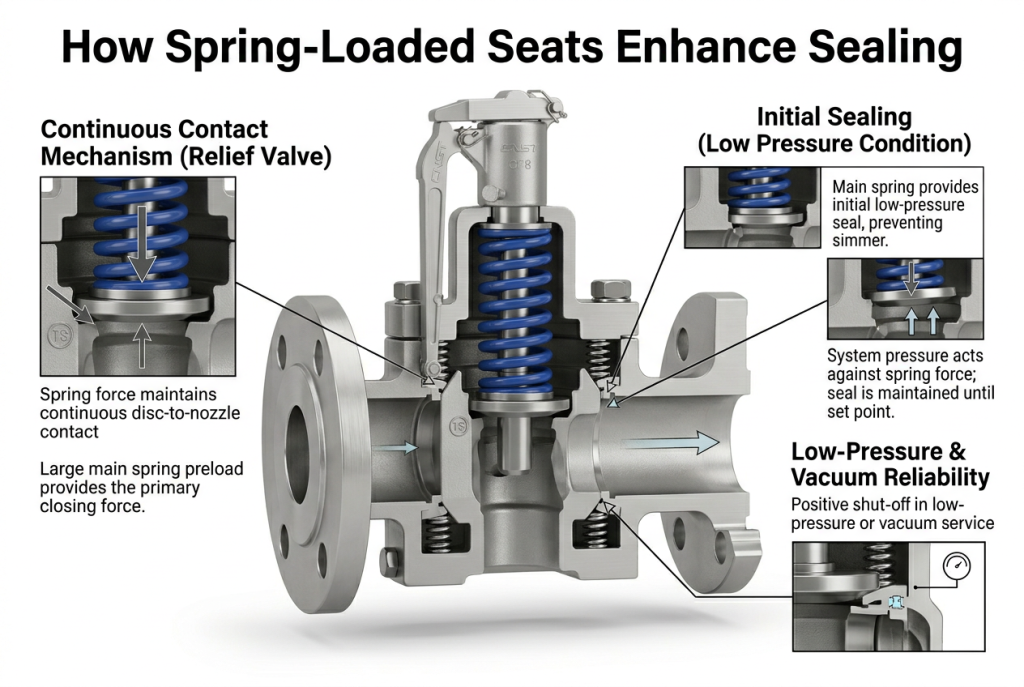
How Spring-Loaded Seats Enhance Sealing
The primary role of these internal springs is to provide an initial, low-pressure seal, even when there’s minimal or no differential pressure from the process fluid. This is particularly vital in applications involving low pressures, vacuum, or when the process is just starting up.
- Continuous Contact: Springs ensure that the seats maintain continuous, firm contact with the spherical surface of the ball, creating a tight seal regardless of line pressure fluctuations.
- Dual Sealing Action: In many designs (especially trunnion-mounted valves), the springs work in conjunction with line pressure. At low pressures, the springs provide the sealing force. At higher pressures, the line pressure itself pushes the upstream seat against the ball, further energizing the seal. This creates a highly reliable, bubble-tight shut-off.
- Low-Pressure & Vacuum Service: For applications where line pressure is insufficient to create an effective seal on its own, spring-loaded seats are indispensable, allowing these valves to maintain positive shut-off in vacuum or near-vacuum conditions.

Part 2: Another Type of “Spring-Loaded” — Spring-Return Actuators
Beyond the internal sealing of the valve itself, the term “spring-loaded” also refers to a safety feature integrated into automated valves: the spring-return actuator. This is an external device mounted on top of the valve, responsible for moving the ball to its open or closed position.
What is a Spring-Return Actuator?
A spring-return actuator (often pneumatic or hydraulic) uses an external energy source (like compressed air) to move the valve in one direction, while a powerful internal spring provides the force for the return stroke in case of energy loss. This design is crucial for fail-safe operations.
- Fail-Open: The actuator uses air/power to close the valve. If air/power fails, the spring automatically pushes the valve open.
- Fail-Close: The actuator uses air/power to open the valve. If air/power fails, the spring automatically pushes the valve closed.

Why Spring-Loaded Seats are Essential for Reliable Valve Performance
Focusing back on the internal spring-loaded seat mechanism, its importance cannot be overstated in achieving consistent, long-term valve reliability across a range of operating conditions. These seats are a key differentiator for high-performance ball valves.
Maintaining Seal at Low Pressure & Vacuum
One of the most significant advantages of spring-loaded seats is their ability to provide a tight seal even when pipeline pressure is very low or absent. In vacuum applications, the springs actively push the seats against the ball, preventing ingress of atmospheric air or leakage of process fluids to the vacuum side. Without this spring assistance, many ball valves would not be able to maintain a reliable seal in these conditions.
Compensating for Wear, Thermal Expansion, and Contamination
Over time, valve seats can experience wear from friction during operation or from particulate matter in the fluid. Temperature fluctuations can also cause materials to expand and contract. Spring-loaded seats dynamically compensate for these changes:
- Wear Compensation: As the seat material slowly wears, the springs continuously push the seats forward, maintaining contact and extending the effective sealing life of the valve.
- Thermal Expansion: In instances of differential thermal expansion between the ball and seats, the springs can absorb slight movements, ensuring the seal remains intact.
- Minor Contamination: The spring force helps the seats push through minor build-up of process media or contamination, maintaining a cleaner sealing surface.
Spring-Loaded Seats in PBV Trunnion-Mounted Ball Valves: The Ultimate Synergy
In high-performance industrial applications, particularly those involving high pressures and critical isolation, the trunnion-mounted ball valve design is a benchmark. And within this design, spring-loaded seats play an absolutely essential role, creating a powerful synergy.
PBV Trunnion-Mounted Ball Valves feature a fixed ball that is mechanically supported by trunnions, meaning the ball itself does not move or “float” into the seat. Instead, it’s the spring-loaded seats that move to create the tight seal. This allows for:
- Reliable Sealing at Any Pressure: The springs provide initial sealing at low pressures, while higher line pressure then assists by pushing the upstream seat more firmly against the ball. This ensures a consistent, verifiable seal across the entire pressure spectrum.
- Reduced Operating Torque: Since the ball is fixed, less force is required to compress the seats to achieve a seal compared to a floating ball valve relying solely on pressure to push the ball into the seat. This leads to much lower operating torque and smaller, more economical actuators.
- Double Block and Bleed (DBB) Capability: Spring-loaded seats are fundamental to achieving Double Block and Bleed (DBB) functionality in trunnion valves. Both the upstream and downstream seats are independently pressurized (by spring force and/or line pressure) against the ball, allowing verification of isolation via a bleed port in the body cavity.
Conclusión
The phrase “spring-loaded” in the context of ball valves encompasses two vital yet distinct concepts: the internal spring-loaded seats that ensure superior sealing performance across varying pressures and compensate for wear and thermal effects, and the external spring-return actuators that provide crucial fail-safe automation for operational safety.
Both mechanisms are integral to the reliability and safe operation of modern industrial valves. By understanding their individual functions, engineers and operators can make more informed decisions about valve selection, installation, and maintenance, ultimately contributing to more secure and efficient fluid control systems.
Need help specifying a spring-loaded ball valve for your critical application?


 English
 Arabic
 Russian
 French
 Spanish