
Ever stared at a valve and felt a knot of doubt? A wrong guess about its position leads to serious system failures and safety hazards. That single moment of uncertainty in your pipeline is incredibly costly and dangerous.
The quickest way to know if a gate valve is open or closed is to look at its stem. For a rising stem valve, a stem that’s up and visible means it’s open. For a non-rising stem valve, you must check the position indicator on the valve’s handwheel.

I learned one of my first big lessons about industrial safety not in a classroom, but on our factory floor. My father showed me that a valve isn’t just a hunk of metal; it’s a critical control point. It decides the safety and efficiency of an entire process. Thinking a gate valve is open or closed when it’s the opposite isn’t a minor slip-up—it’s a crisis. This lesson sticks with me, especially when I work with people like Hassan, a chief engineer designing massive refineries. For him, valve status is the bedrock of process control. Let’s walk through how to build this skill so you’ll never have to guess again.
How to Identify If a Válvula de compuerta is Open or Closed
That moment of hesitation… staring at a gate valve, unsure of its state. We’ve all been there. It’s a simple point of confusion that brings an entire operation to a standstill.
The fastest way to know if a gate valve is open or closed is by its stem. If it’s a rising stem model, a raised stem means open, and a lowered stem means closed. If it’s a non-rising stem valve, you have to check the indicator on the handwheel.
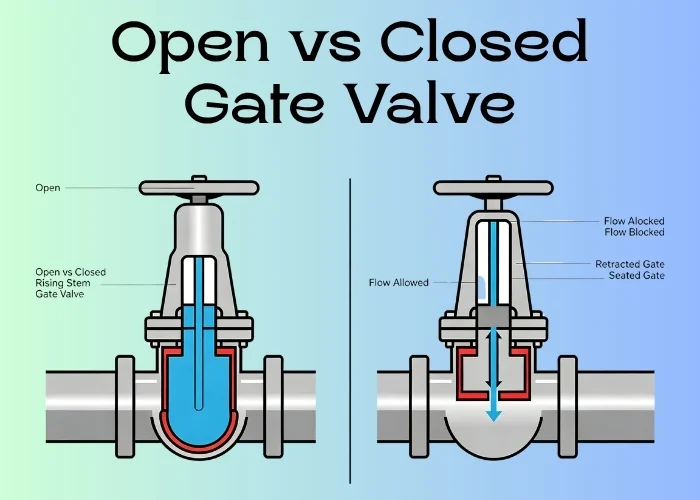
Being able to tell if a gate valve is open or closed at a glance is a fundamental skill on any job site. The trick is knowing which type of valve you’re looking at. The two main designs, rising stem and non-rising stem, give you different clues.
Understanding Rising Stem Valves
These are the easiest to read. Rising stem valves, also called Outside Screw and Yoke (OS&Y), have a brilliantly simple design. When you turn the handwheel, the whole stem assembly moves up or down. If you see a long, exposed, and greasy stem sticking out of the top, the path is open. If the stem is down, nearly flush with the handwheel, the path is closed.
I can still picture my father pointing to a big OS&Y valve in our factory and telling me, “Emily, look. The stem is up, so the fluid is flowing. It’s that simple.” This visual confirmation is a massive safety feature. You can tell its position from across the room, which is why it’s so popular. A raised stem means the gate valve is open. A lowered stem means the gate valve is closed. No ambiguity.
Identifying Non-Rising Stem Valve Positions
Here is where it gets a little trickier. With a non-rising stem valve, the stem turns, but it doesn’t move up or down externally. This makes them perfect for tight spots with low clearance, like in the hull of a ship or in underground service. But it also means you lose that immediate visual cue.
So how can you tell if this type of gate valve is open or closed? You have to trust the position indicator. This is a small needle or pointer built into the top of the handwheel that moves to point at “OPEN” or “SHUT” markings. It is vital to keep these indicators clean and readable. Without one, you’re just guessing, and guessing is not an option in this business.
| Tipo de válvula | Identification Method | Ventajas clave |
|---|---|---|
| Rising Stem | Visual check of stem height (Up = Open, Down = Closed) | Position is obvious from a distance. |
| Non-Rising Stem | Read the position indicator on the handwheel/body. | Compact design for tight spaces. |
Gate Valve Opening and Closing Procedure
The temptation is always there—just crank the valve open and get things moving. But doing it wrong wrecks the valve’s seat and sends a damaging shockwave through your pipes.
To operate a gate valve correctly, you have to turn the handwheel slowly and steadily. When closing, turn it until it’s snug, then back it off a quarter-turn. This single step prevents seizure and protects the valve, ensuring you operate the gate valve open or closed for years.
Turning a valve looks simple. But there’s a professional way to do it and a way that leads to breakdowns. A gate valve is not a faucet; it’s designed to be fully open or fully closed, nothing in between. I’ve seen brand-new valves get destroyed by improper operation. A little patience at the handwheel saves a world of trouble later.
Step-by-Step Opening Procedure
Opening one of these too fast sends a shockwave called “water hammer” through the line. It’s powerful enough to burst pipes and damage other equipment. To do it right, take your time.
- Check It Out First: Give the valve a quick look. Make sure the stem threads aren’t caked with dirt. A little grease on the threads makes everything turn much smoother.
- Turn Slowly to Avoid a Shock: Turn the handwheel counter-clockwise. Go slow. You want the pressure to equalize gently across the valve, not slam into the system.
- Use Your Senses: As it opens, listen for the flow starting. Feel for any grinding or weird resistance. If something feels wrong, it is. Stop and check.
- Open It All the Way: Keep turning until the handwheel stops on its own. Now the gate is completely out of the flow path. Don’t try to force it any further. The valve is fully open.
Step-by-Step Closing Procedure
Closing a valve properly is all about getting a tight seal without damaging anything.
- Go Slow and Steady: Turn the handwheel clockwise. Again, a slow, controlled pace is key. This protects the valve’s internals from the pressure.
- Feel for the Seat: Keep turning until you feel the gate become snug against its seat. Don’t put your whole body into it. Absolutely never use a wrench or a “cheater bar” to get more leverage. That is a fast way to snap a stem. The gate valve is closed.
- The Pro Tip: Quarter-Turn Back: This is the one tip that saves so much trouble. After the valve is shut tight, turn the handwheel back the other way (counter-clockwise) about a quarter of a turn. This doesn’t open the valve. It just relieves the stress on the stem, preventing it from getting stuck from heat changes. Hassan, the chief engineer, drills this into his teams. A stuck valve means a shutdown, and that costs money.
| Do’s | Don’ts |
|---|---|
| ✅ Operate slowly and steadily. | ❌ Don’t open or close the valve rapidly. |
| ✅ Open fully until the handwheel stops. | ❌ Don’t use a wrench or “cheater bar” on the handwheel. |
| ✅ Clean and lubricate the stem threads. | ❌ Don’t leave the valve in a partially open position. |
| ✅ Back off a quarter-turn after closing. | ❌ Don’t ignore unusual sounds or resistance during operation. |
Importance of Gate Valve Position in Industrial Systems
A gate valve left in the wrong position feels like a small oversight. In reality, it triggers process failures, stops production cold, and creates a major safety incident.
A gate valve’s position—fully open or fully closed—is non-negotiable for system safety and efficiency. Leaving one partially open causes intense wear and tear that leads to failure. Getting the position right protects equipment, prevents accidents, and keeps the process running smoothly. Knowing if a gate valve is open or closed isn’t just good practice; it’s essential.
Think of your plant’s piping like a system of roads and highways. The valves are the gates and barriers. Their position controls everything. The status of a single gate valve, open or closed, impacts the entire line. One mistake causes a chain reaction that affects safety, product quality, and your bottom line. It’s a heavy responsibility.
Preventing Equipment Damage and Process Failure
Gate valves are made for one job: on/off service. Using them to “throttle” or regulate flow by leaving them halfway open is a terrible idea. When a gate valve is open only partially, the fluid blasts through that small opening at high speed. It’s like a tiny jet of water cutting through rock over time. That is what happens to your valve’s internals. It erodes the gate and seats until the valve no longer seals tightly. That means leaks. In a refinery like the ones Hassan designs, a single leaking válvula de compuerta contaminates an entire batch of product, a multi-million-dollar mistake.
Ensuring System Safety
This is where valve position becomes a matter of life and death. Many valves are used to isolate equipment for maintenance. Picture a team working on a pump. The upstream isolation gate valve is closed to keep them safe. If someone mistakenly opens that valve, or if it was never fully closed in the first place, that team is exposed to high-pressure, hazardous material. On the flip side, if the isolation gate valve is closed on a pressure relief line, a tank over-pressurizes and ruptures. In these moments, being 100% sure if a gate valve is open or closed is everything.
Maintaining Operational Efficiency
Correct valve position is also about money. A gate valve that isn’t fully open creates drag in the system, making pumps work harder and burn more electricity just to keep up. That adds up fast. A valve that isn’t fully closed allows for product leakage and cross-contamination, hurting your final yield and quality. When operators know the exact status of every gate valve, open or closed, they can run the plant at peak efficiency, just as it was designed.
This obsession with reliability and clear operation is baked into the DNA of my family’s company, Válvula BCST. We believe a valve should never be a point of weakness or confusion. If you’re looking for valves where there’s no guesswork involved, I hope you’ll see what we have to offer. Visit us at https://bcstvalve.com/ for valves built for true peace of mind.
Frequently Asked Questions (FAQs)
Q: Can you use a gate valve to regulate flow?
A: No. Gate valves are designed for on/off service. Using them for throttling causes rapid wear on the gate and seats, leading to leaks and premature failure.
Q: What happens if you overtighten a gate valve when closing it?
A: Overtightening damages the valve’s seat and stem, preventing it from sealing properly in the future. It also causes the gate to become stuck, making it extremely difficult to open.
Q: Why do you back off the handwheel after closing a gate valve?
A: This quarter-turn back-off releases tension on the stem and packing without opening the valve. It prevents the components from seizing due to thermal expansion, making the valve easier to open next time.
Final Thought
Knowing if a gate valve is open or closed is a core skill that defines a safe, efficient, and reliable operation. It’s about protecting your people, your process, and your equipment. When you need valves that remove the guesswork and deliver on performance, trust BCST for quality you can always count on.



 English
 Arabic
 Russian
 French
 Spanish