

That “Protective” Galvanized Coating Is Now Flaking into Your Pumps, Filters, and Nozzles
The promise of a galvanized ball valve is clear: superior corrosion resistance for demanding environments. The zinc coating is intended to be a robust shield, protecting the underlying steel from rust and extending the valve’s lifespan. However, in certain applications, this very “protection” can become a silent saboteur, slowly but surely degrading from the inside and releasing caustic fragments into your critical systems. This internal coating failure, known as zinc flaking or delamination, is a hidden hazard that can lead to catastrophic downstream consequences.
This article exposes the dark side of a seemingly durable solution. We’ll explore why the galvanized coating on your ball valves can delaminate, how these zinc flakes can wreak havoc on expensive downstream equipment like pumps, filters, and sensitive nozzles, and what steps you can take to prevent such costly failures. For a broader understanding of galvanized valves, see our article: Galvanized Ball Valve: The Robust Choice for Corrosion-Prone Applications.
Understanding this critical failure mode is essential for plant engineers, maintenance managers, and reliability experts focused on maintaining system integrity and preventing unscheduled downtime caused by unexpected contaminants.
What is Zinc Flaking (Delamination) in Galvanized Valves?
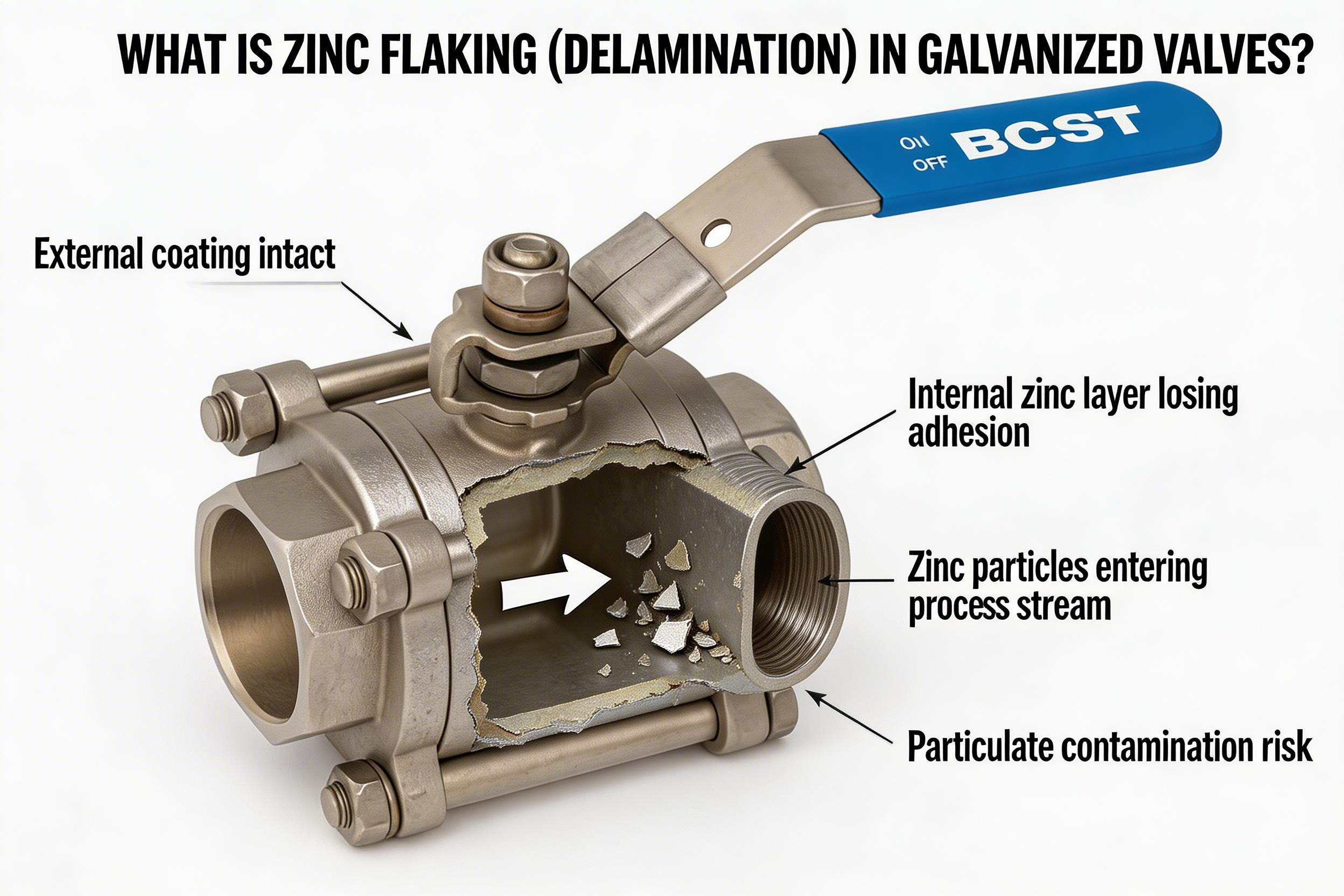
Zinc flaking, or delamination, refers to the detachment and shedding of the zinc coating from the internal surfaces of a galvanized ball valve. While the external galvanized layer often remains intact, the internal coating, subjected to fluid flow, temperature fluctuations, and chemical interactions, can lose its adhesion to the base steel. This results in small, irregular pieces of zinc breaking off and entering the process stream.
Initially, these flakes might be small and seem innocuous. However, they can accumulate, forming a significant source of particulate contamination that moves downstream, silently damaging every component in its path.
Why Does Galvanized Coating Flake Off Internally?
Several factors can accelerate the internal delamination of a galvanized coating:
- High Temperatures: Prolonged exposure to elevated fluid temperatures can cause the zinc-iron alloy layers to become brittle and eventually crack or de-bond from the steel substrate. This is particularly problematic in steam or hot water systems.
- Ciclado térmico: Repeated heating and cooling cycles create expansion and contraction stresses between the differently expanding zinc coating and the steel valve body, leading to fatigue and eventual delamination.
- Abrasive Media Flow: Fluids containing suspended solids, slurries, or even high-velocity clean fluids can exert an abrasive force on the coating, eroding it over time and initiating flaking.
- Incompatible Chemical Exposure: While generally corrosion-resistant, zinc reacts poorly with certain chemicals, especially highly acidic (pH < 6) or highly alkaline (pH > 12) solutions, which can aggressively attack and dissolve the coating.
- Poor Galvanization Quality: Inadequate surface preparation prior to galvanizing, uneven coating thickness, or insufficient metallurgical bonding can all lead to premature flaking.
- Erosion-Corrosion: A combined effect where mechanical erosion of the coating exposes the underlying steel, which then corrodes rapidly, further undermining the surrounding coating.
The Catastrophic Downstream Consequences of Zinc Flakes
When the zinc flakes escape the galvanized ball valve and enter the process stream, they don’t just disappear; they become harmful solid contaminants. The impact on downstream equipment can range from operational inefficiencies to catastrophic failures:
- Pump Damage: Zinc flakes are abrasive. When ingested by pumps, they can cause rapid wear to impellers, casings, and mechanical seals, leading to reduced pump efficiency, increased vibration, and premature failure. The cost to repair or replace a single pump damaged by this debris can easily exceed the cost of the entire valve installation, directly impacting the true cost of ownership for a “cheap” galvanized ball valve.
- Clogged Filters and Strainers: These are often the first line of defense, but they can become quickly overwhelmed by a continuous supply of zinc flakes. Clogged filters lead to increased pressure drop, reduced flow, frequent maintenance, and potential bypass of contaminated fluid.
- Nozzle Blockage: In spray systems, cooling towers, or processing lines, small orifices in nozzles are extremely vulnerable to clogging by zinc flakes. This results in uneven fluid distribution, impaired process efficiency, and even complete system shutdown.
- Instrument and Sensor Malfunction: Delicate instrumentation, such as flow meters, pressure transducers, and analytical sensors, can be fouled, damaged, or rendered inaccurate by particulate contamination, leading to unreliable data and incorrect process control.
- Process Contamination: In industries like food and beverage, pharmaceuticals, or semiconductor manufacturing, the introduction of foreign particles (zinc flakes) results in product contamination, batch rejection, and significant financial losses.
- System Blockages: In extreme cases, a large volume of flakes can accumulate in low-flow areas, elbows, or pipe restrictions, leading to partial or complete pipeline blockages.

Identifying the Problem: Signs and Symptoms of Flaking
Detecting internal flaking from a galvanized ball valve can be challenging as the valve body itself might look fine externally. However, downstream symptoms can be clear indicators:
- Frequent Filter/Strainer Clogging: An unexplained increase in the frequency of filter cleaning or replacement.
- Reduced Flow/Pressure: Unaccounted-for pressure drops across the system or reduced flow rates.
- Pump Vibrations or Noise: Changes in pump performance, indicating impeller wear or cavitation from debris.
- Visible Particulate in Process Fluid: If clear fluids are used, you might visually observe suspended particles.
- Instrument Drift or Failure: Inconsistent or inaccurate readings from flow meters or sensors.
- Unusual Wear Patterns: During routine inspection of other components, finding premature wear that suggests abrasive particles.
Preventing Internal Galvanized Coating Failure
The best defense against zinc flaking is proactive material selection and proper application. Consider these strategies:
- Accurate Application Assessment: Always perform a thorough evaluation of the fluid characteristics (pH, temperature cycles, solids content), flow velocity, and operational temperatures. Avoid galvanized ball valves in applications prone to the identified risk factors.
- Specify High-Quality Galvanization: If a galvanized ball valve is deemed suitable, ensure it meets stringent galvanization standards (e.g., ASTM A123/A123M) from reputable manufacturers like BCST Valve.
- Consider Alternatives: For applications with high temperatures, aggressive chemicals, or abrasive media, consider superior material options:
- Válvulas de bola de acero inoxidable: Offering inherent corrosion resistance without a coating, suitable for a wider range of temperatures and mild corrosives.
- Lined Valves: For highly corrosive or abrasive media, plastic-lined (e.g., PVDF, PFA) ball valves provide excellent chemical resistance and a smooth, non-flaking surface.
- Nickel Alloy Valves: For extreme temperatures and highly aggressive chemicals where even stainless steel may fall short.
- Routine System Monitoring: Implement a robust preventative maintenance program that includes regular checks of filters, pumps, and instrumentation for signs of contamination or wear.
While this article focuses on internal coating failure, another form of electrochemical decay, galvanic corrosion, can destroy the valve from the outside-in when connected to dissimilar metals like copper, further highlighting the complexities of corrosion in piping systems.
Conclusión
The internal flaking of a galvanized coating in ball valves is a serious, often overlooked, failure mode that can lead to significant and expensive damage to critical downstream equipment. While galvanization offers excellent external corrosion protection, its suitability for conveying fluids internally, especially hot, abrasive, or chemically reactive ones, must be rigorously evaluated.
At BCST Valve, we advocate for solutions driven by comprehensive application understanding, not just initial cost. Our expertise ensures you select the right ball valve material for your specific process, safeguarding your pumps, filters, and overall system integrity from hidden dangers like zinc flaking. Don’t let a seemingly protective coating become a destructive force within your system.
Protect your systems from internal coating failure. Talk to a BCST Valve expert today.


 English
 Arabic
 Russian
 French
 Spanish