
French Valve vs Schrader Valve: Choosing the Right Bike Tire Valve
For every cyclist, understanding the nuances of bike valve types is as fundamental as knowing how to change a tire. The two most common types you’ll encounter are the French valve (more commonly known as Presta) and the Schrader valve. While both serve the same basic purpose – to hold air in your tires – their design, function, and ideal applications differ significantly.
Elegir bien bicycle valve, or simply understanding which one you have, impacts everything from pump compatibility to pressure retention and even wheel aesthetics. This guide will walk you through the key distinctions in the French valve vs Schrader valve debate, helping you make informed decisions for your next ride.
Understanding the Schrader Valve: The Familiar Favorite
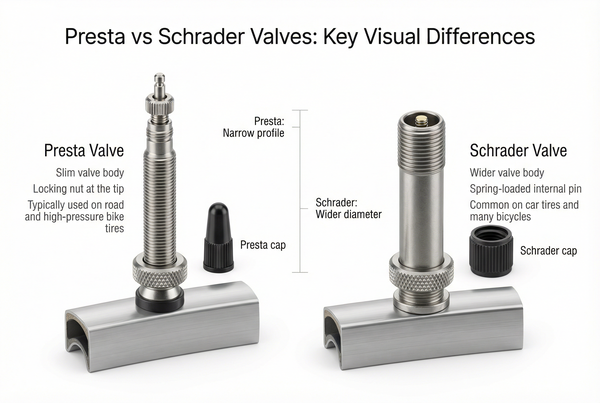
En Schrader valve is likely what you picture when you think of a bike tire valve. It’s the same type found on car tires, making it incredibly common and easy to use. Characterized by its wider stem and external threaded body, the Schrader valve is robust and durable.
A Schrader bike valve stem types features a spring-loaded core. When inflating, the pump’s nozzle presses this pin down, opening the valve and allowing air to enter. Once inflation stops, the spring, aided by the internal tire pressure, pushes the pin back up to seal the valve. This design makes it very accessible; almost any gas station air pump or standard bicycle pump can inflate a Schrader valve.
Decoding the French Valve (Presta): The Cyclist’s Choice
So, what is presta? The french valve, more technically known as the Presta valve, is slimmer and typically found on road bikes, higher-end mountain bikes, and many modern bicycles. If you’ve ever wondered what does a presta valve look like, imagine a slender, unschooled stem with a small knurled nut at the top.
To use a bicycle presta valve,
you first unscrew the threaded nut at the top of the valve stem. This “unlocks” the valve. Then, a specialized Presta-compatible pump head is attached. Unlike the Schrader, the Presta valve doesn’t have a spring; instead, the air pressure inside the tube holds the valve closed. When you pump, the incoming air pressure pushes down the inner stem, allowing air to flow. When you stop, the internal tire pressure pushes the stem back up, sealing the valve. After inflation, you must screw the knurled nut back down to secure the seal. A what does a presta valve pump look like is specific, often featuring a smaller chuck diameter or a dual head to accommodate both valve types.
French Valve vs Schrader Valve: A Head-to-Head Comparison
To really highlight the differences between presta vs schrader valve, let’s look at their characteristics side-by-side.
| Característica | Schrader Valve | French Valve (Presta) |
|---|---|---|
| Diameter | Wider (approx. 8mm) | Narrower (approx. 6mm) |
| Length | Standard lengths | Available in various lengths for deep-dish rims |
| Mecanismo de sellado | Spring-loaded pin, internal pressure-assisted | Locknut, internal pressure-assisted |
| Inflation | Press pump head on, push air | Unscrew locknut, press pump head on, push air, re-tighten locknut |
| Pump Compatibility | Standard (auto, bicycle) | Presta-specific or dual-head pump (or use schrader valve adapter) |
| Durabilidad | Very robust, resistant to casual damage | Easier to bend/break if not careful (plastic cap is key) |
| Pressure Control | Good for all pressures | Excellent for high pressures, easier fine-tuning |
Ultimately, the choice between presta and schrader valves comes down to the bike’s design and the cyclist’s needs.
Why Different Valve Types for Bicycles?
The existence of different types of bike tire valves isn’t arbitrary. Each valve design offers specific advantages that cater to various cycling disciplines and equipment specifications:
- Narrower Rims & High Pressure (Presta): Presta valves are ideally suited for the narrower rims commonly found on road bikes. A smaller valve hole means a stronger rim, which is crucial for handling the very high pressures (often 80-120 PSI) typical for road cycling. The secure locknut mechanism of a presta bike valve is also considered more effective at retaining extremely high pressures without leakage.
- Durability & Compatibility (Schrader): Schrader valves, with their larger and more robust design, are commonly found on mountain bikes, hybrid bikes, and kids’ bikes. They are less prone to accidental bending or damage, an advantage on rough terrain. Their wide compatibility with standard air pumps makes them convenient for many riders.
- Fine Pressure Adjustment (Presta): Due to their simpler opening mechanism once the locknut is released, Presta valves can offer a more precise and controlled release of air, allowing for finer pressure adjustments, which is particularly valued by competitive cyclists.
Understanding these distinctions helps clarify why bicycle tyre valve types vary and how each serves its specific niche in the cycling valve types landscape.
Inflation and Maintenance: Presta vs. Schrader
Inflating your tires correctly is crucial for performance and safety. How you inflate depends largely on your bike tire valve type.
Inflating a Schrader Valve:
Simply remove the cap, firmly press the pump nozzle onto the bicycle valve, and inflate. Any standard automotive air pump or bicycle pump with a Schrader head will work. Ensure the pump head creates a tight seal to prevent air leakage. When you’re done, remove the pump and replace the cap.
Inflating a Presta Valve:
- Unscrew the small threaded nut at the top of the presta bike valve stem counter-clockwise.
- Briefly press down on the exposed pin to “break” the seal and ensure air can flow.
- Attach a Presta-specific pump head (or a dual-head pump). Many pump heads will have a lever to lock onto the stem.
- Pump to the desired pressure.
- Remove the pump head, and most importantly, screw the threaded nut back down clockwise until snug. This relocks the valve and prevents air loss.
If you only have a Schrader pump but a Presta valve, a simple and inexpensive Schrader valve adapter can be screwed onto the Presta valve to make it compatible with a Schrader pump. This is a handy accessory for a cyclist on the go, making any pump capable of handling your bike tire presta valve.
Choosing the Right Valve for Your Ride
The best valve type for you depends on your bike and riding style. If your bike already has one type of valve, you’ll generally stick with it unless you’re replacing inner tubes and want to convert (assuming your rims can accommodate the wider Schrader hole). Understanding bicycle valve types helps.
- For Road Cyclists: Presta valves (or french valve bike) are almost universally preferred due to slender rims and high-pressure requirements. The variety of presta valve types in different lengths also accommodates deep-dish aerodynamic rims.
- For Mountain Bikes/Hybrids: Both Schrader and Presta are common. Schrader offers robustness, while Presta allows for narrower rim designs and easier tubeless setup in some cases.
- For Casual Riders/Kids’ Bikes: Schrader valves are practical due to their widespread compatibility and durability.
Familiarize yourself with the different bike tire valves and their features to ensure you always have the right tools for tire maintenance.
FAQ — Your Burning Questions on Bicycle Valves Answered
Q1: What are the main differences between Presta and Schrader valves?
The main differences between presta vs schrader are their diameter (Presta is narrower), sealing mechanism (Presta uses a locknut, Schrader a spring-loaded pin), and the equipment needed for inflation. Presta is generally preferred for high-pressure road tires and narrow rims, while Schrader is robust and more universally compatible.
Q2: What should I know about bike valve stems?
Bike valve stems vary by type (Schrader or Presta) and length. Presta stems come in various lengths to fit different rim depths, from shallow to deep-dish. Schrader stems are typically standard length. Both need to be inspected for cracks or bends, as damage can lead to air leaks.
Q3: Can I use a Schrader pump on a Presta valve?
Yes, but you will need a schrader valve adapter. This small adapter screws onto the Presta valve, effectively making its outer dimensions compatible with a standard Schrader pump head. Many modern bike pumps are also designed with dual heads to fit both valve types without an adapter.
Q4: What should I look for in bicycle tyre valve types when buying inner tubes?
When buying inner tubes, always match the valve type (Presta or Schrader) to the holes in your bike’s rims. Also, pay attention to the valve stem length, especially for Presta valves, to ensure it’s long enough to extend through your rim for easy pumping, especially with aerodynamic deep-dish rims.
Q5: What are the general tire valve types bicycle riders typically encounter?
The vast majority of bicycle riders will encounter either Presta valves (often called french valves) or Schrader valves. A third, less common type, is the Woods (or Dunlop) valve, occasionally seen on older or European bicycles, but these are rare in new bikes.
Conclusión
The debate of French valve vs Schrader valve isn’t about one being inherently better, but rather about suitability for specific contexts. The Schrader valve offers robust familiarity and broad compatibility, making it perfect for everyday and family bikes. The Presta valve caters to performance-oriented cyclists with its narrower profile, lighter weight, and superior high-pressure retention, especially important for sensitive bike tire valve sistemas.
Conocer el different types of bike tire valves and how to handle them ensures a smoother, safer, and more enjoyable cycling experience. Always match your pump to your valve, or keep a Schrader valve adapter handy, and you’ll be ready for anything the road (or trail) throws your way!


 English
 Arabic
 Russian
 French
 Spanish