
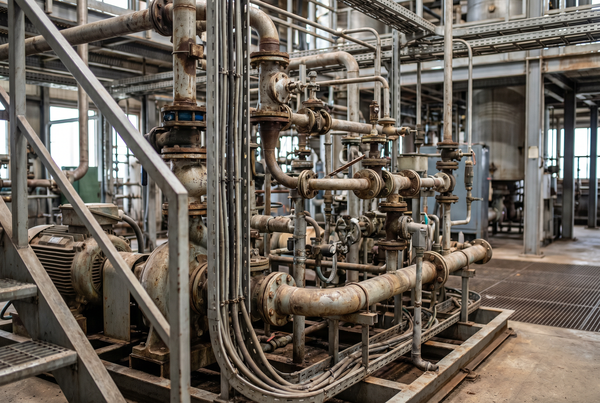
The challenge is familiar: a legacy chemical processing facility, an aging process skid, and a tangled web of piping, instruments, and traditional straight-through valves. This isn’t just an aesthetic issue; header congestion in existing B2B facilities directly translates to compromised safety, hazardous maintenance, and prolonged downtime.
The Legacy Burden: Header Congestion & Compromised Maintenance
When plant layouts are decades old, expansions and modifications often introduce an unmanageable density of equipment. This header congestion chemical plant scenario creates acute operational pain points:
- Limited Maintenance Access: Technicians struggle to reach critical components, prolonging routine inspections and increasing exposure to hazardous media.
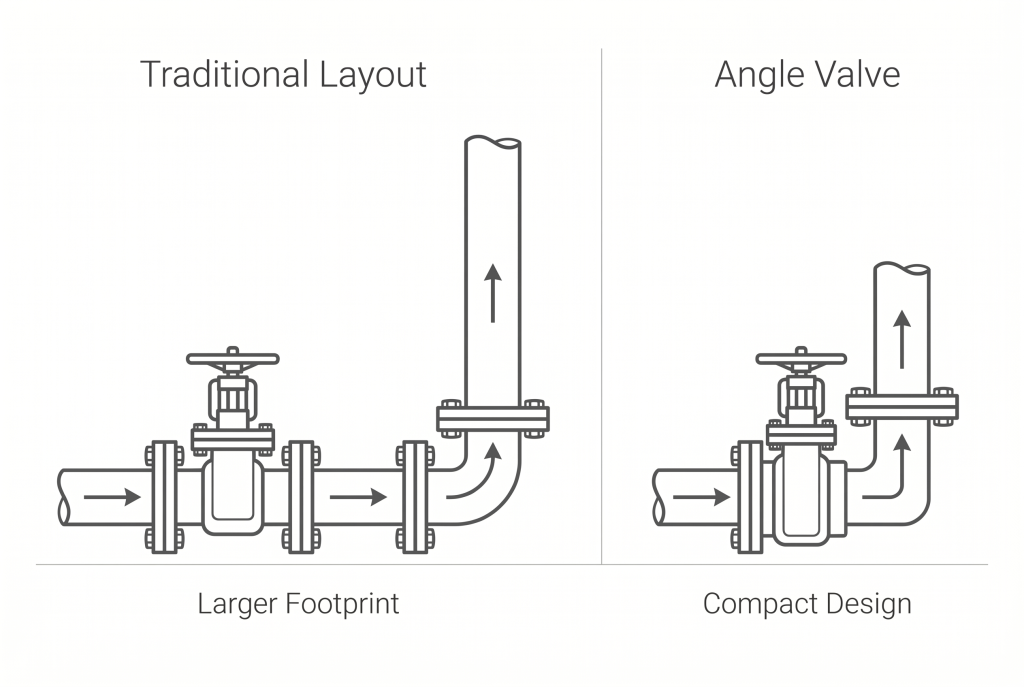
- Increased Leak Paths: Traditional straight-through valves often require additional 90-degree elbows, adding two flange connections per turn and doubling potential leak points.
- Operational Inefficiencies: Complex piping configurations lead to higher pressure drops and energy consumption.
- Riesgos para la seguridad: Emergency shutdowns and repairs become more dangerous in confined spaces, impacting personnel safety.
Standard valve retrofit chemical plant solutions often fail because off-the-shelf components don’t fit the precise dimensional constraints or service requirements of existing legacy chemical skids.
High-Pressure Angle Valves: A Compact Solution for Tight Spaces
A estudiar says, The high-pressure angle valve offers a fundamentally different design advantage for process skid optimization. Its inherent 90-degree body configuration effectively combines the function of a straight-through valve and a pipe elbow into a single, compact unit.
How Angle Valves Decongest Headers
- Reduced Footprint: By integrating the turn, angle valves significantly shorten the overall assembly length, freeing up critical overhead or lateral space.
- Fewer Leak Points: Eliminating a traditional elbow means eliminating two gasketed flange connections. This directly reduces the likelihood of fugitive emissions, especially crucial for aggressive media in high pressure chemical valve applications.
- Improved Flow Dynamics: While providing a 90-degree turn, the internal geometry of a well-designed angle valve can minimize severe turbulence, offering better flow paths than a sharp-cornered elbow directly followed by a valve.
The Retrofit Imperative: Why Customization Matters for Legacy Infrastructure
A successful legacy chemical skids valve retrofit isn’t about shoehorning standard components; it’s about bespoke engineering. Every existing skid presents unique dimensional interfaces, pipe schedules, and material histories.
Addressing Integration Challenges
BCST Valve specializes in custom solutions that align perfectly with your existing infrastructure:
- Precise Face-to-Face Dimensions: Matching existing valve footprints, even non-standard ones, to avoid costly re-piping.
- Compatibilidad con bridas: Fabricating flanges to specific ANSI, DIN, or JIS standards, including custom drilling patterns or raised face dimensions.
- Weld End Preparation: Precisely machined butt-weld ends to match existing pipe schedules and wall thicknesses for seamless integration.
- Actuator Orientation: Configuring actuators for optimal maintenance access valves in confined spaces.
The Buying Guide: Specifying Custom High-Pressure Angle Valves for Chemical Processing
Selecting the right custom high-pressure angle valve for chemical processing involves meticulous attention to operational parameters and material resilience.
1. Pressure Ratings & Classifications
For chemical industry headers, pressure classes are often at the higher end, demanding robust body designs:
| Pressure Class (ASME B16.34) | Typical MAWP (ANSI) | Common Application |
|---|---|---|
| Class 1500 | ~3705 psi | High-pressure steam, feed water |
| Class 2500 | ~6170 psi | Severe service, critical chemical reactors |
| Class 4500 | ~11110 psi | Ultra-high-pressure processes |
2. Material Selection for Aggressive Media
The fluid properties dictate the metallurgy. For high pressure chemical valve applications involving corrosive, erosive, or high-temperature media, standard carbon or 304 stainless steel is often insufficient.
| Material | Primary Benefit | Typical Applications (Chemical) |
|---|---|---|
| Duplex Stainless Steel (e.g., F51) | High strength, good chloride stress corrosion resistance | Seawater, brackish water, some organic acids |
| Super Duplex SS (e.g., F55) | Superior pitting and crevice corrosion resistance | Highly corrosive chlorides, sulfuric acid |
| Hastelloy (e.g., C276) | Exceptional resistance to a wide range of chemicals (oxidizing/reducing) | Chlorine, sulfuric, nitric, phosphoric acids |
| Monel (e.g., K-500) | Excellent resistance to hydrofluoric acid, strong alkalis | HF acid plants, caustic service |
| Inconel (e.g., 625) | High strength at elevated temperatures, corrosion fatigue resistance | High-temperature corrosive gases, sour gas |
3. End Connections & Actuation
Customization extends to how the valve integrates with the piping and how it’s controlled:
- Butt-Weld/Socket-Weld Ends: Preferred for high-pressure chemical valve applications where minimum leak paths and permanent connections are paramount.
- Flanged Ends: RTJ (Ring Type Joint) flanges are common for severe service, offering superior sealing reliability over raised face designs.
- Accionamiento: Whether manual handwheels or automated pneumatic/electric actuators, integrating them within the existing dimensional envelope is key.
BCST Valve: Your Partner in Custom Retrofit Solutions
At BCST Valve, we understand that you’re not just buying a valve; you’re investing in a solution to a complex operational problem. Our approach to custom valve manifold solutions for legacy chemical skids is built on:
- Engineering Expertise: Detailed analysis of your current infrastructure, process conditions, and maintenance pain points.
- Custom Fabrication: Precision manufacturing of high-pressure angle valves unique dimensions, materials, and end connections.
- Integration Support: Collaborative design process to ensure seamless fit and optimal performance within your existing system.
We provide comprehensive valve dimensional drawing customization services, ensuring that the proposed compact valve solutions will fit your specific requirements before manufacturing begins.
Conclusion: Solving Critical Space Challenges with Precision Engineering
Header congestion in legacy chemical skids is a persistent operational challenge, costing facilities in downtime, maintenance efforts, and safety risks. Off-the-shelf valves are rarely the answer. By leveraging custom high-pressure angle valve retrofits, facilities can drastically improve their maintenance access valves, significantly reduce leak points valve count, and optimize overall plant layout without the prohibitive cost of full system replacement.
BCST Valve stands as your solution provider, not just a seller. Our expertise in designing and manufacturing specialized valves for complex integration problems ensures that your specific space constraints industrial valves are met with engineered precision.
Ready to Decongest Your Chemical Skid and Enhance Operational Efficiency?
Don’t settle for off-the-shelf. Let BCST Valve design a custom solution that fits your exact challenges.


 English
 Arabic
 Russian
 French
 Spanish