
Why Your Control Valve Hunts at 5–15% Open: Low-Flow Instability, Oversizing, and Seat Geometry in Gas Service
At 10% open, the control valve should be stabilizing the process. Instead, the loop oscillates, the positioner keeps correcting, and the line never settles. In many gas-service systems, that behavior is not primarily a tuning problem, but often a symptom of an underlying valve-sizing issue. This common-yet-frustrating phenomenon, often termed control valve hunting at low opening, plagues process engineers and maintenance teams with inconsistent control and wasted energy.
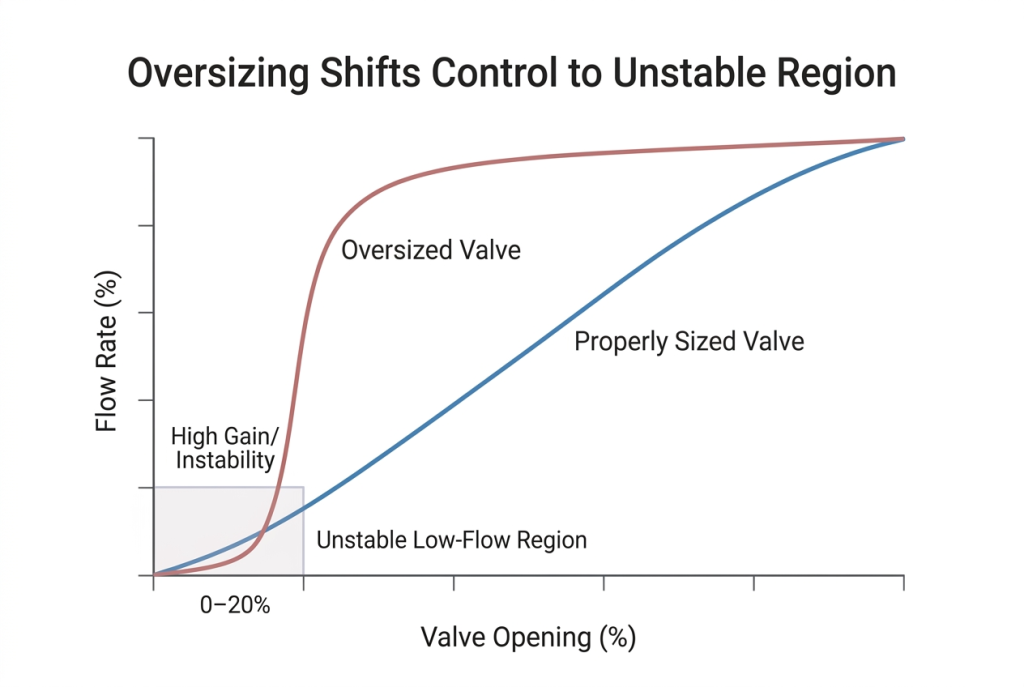
Quick Answer: A control valve that hunts at low opening is often oversized for its real operating range. At low lift (e.g., 5–15% open), an oversized control valve may lose control authority, exaggerate gain changes, and create unstable responses, especially in gas service where density changes exacerbate the issue.

What “Hunting” Actually Looks Like in the Field (and Why it’s a Problem)
From an operator’s perspective, “hunting” manifests as persistent, unwanted oscillations of the process variable around its setpoint. The control valve’s stem position continuously moves, trying to stabilize the loop, but never quite succeeds.
The Feedback Loop of Instability
When an oversized control valve low flow instability occurs, the controller, sensing a deviation from the setpoint, commands the valve to adjust. However, due to the valve’s poor resolution at minimal opening, it overshoots or undershoots the required flow. The controller then overcorrects, initiating a perpetual cycle of adjustments and deviations. This constant activity can quickly wear out actuators and positioners, and in gas service, leading to significant energy losses.
Symptoms include:
- Continuous oscillation of flow, pressure, or temperature readings.
- Rapid, small movements of the valve stem, especially if the valve is unstable at 10% open or less.
- Excessive wear on the valve’s trim, packing, and actuator due to constant movement.
- Increased energy consumption (e.g., compressed air for pneumatic actuators, or wasted steam if thermal processes are unstable).
Why Oversized Valves Lose Control Authority at Low Lift
The core reason for low-flow instability is often valve oversizing. When a valve’s maximum flow capacity (Cv) is significantly greater than the actual maximum flow required, the valve is forced to operate at a very small percentage of its total travel.
The Cv Curve Mismatch
Most control valves are designed based on standardized flow coefficient (Cv) calculations to provide a smooth, predictable flow characteristic (equal-percentage, linear, etc.) over a wide operating range, typically from 20% to 80% of their travel. When forced into the 5–15% open range, however, this characteristic can become highly non-linear and even erratic. The valve’s effective gain (change in flow for a given change in stem position) can become extremely sensitive or flat, making it nearly impossible for the control loop to maintain stability. This effect is particularly pronounced in control valve low flow gas service due to the compressibility of gases.
Laminar vs. Turbulent Flow at Low Lift
At very low flow rates through a minimally open valve, the flow regime can transition between laminar and turbulent. This transition is inherently unstable and unpredictable. The fluid may “choke” or “vent” inconsistently, especially around the gas control valve seat geometry. This behavior significantly complicates control, leading to rapid pressure fluctuations that are interpreted by the positioner as necessary adjustments, fueling the hunting cycle.
Equal-Percentage vs. Linear Trim in Low-Flow Duty
The internal trim characteristic plays a crucial role in a valve’s low-flow stability. Two primary types, equal-percentage and linear, react differently to changes in valve opening.
Understanding Trim Characteristics for Low Flow
| Trim Type | Cv vs. Travel | Low-Flow Behavior | Optimal Use Case |
|---|---|---|---|
| Equal-Percentage | Cv changes by equal percentage for equal travel change | Relatively stable, wider usable range at low Cv | Good for wide rangeability, pressure drop changes |
| Lineal | Cv changes linearly with travel | Becomes very sensitive at low travel, prone to hunting | Constant pressure drop systems, on/off control |
For systems prone to control valve hunting at low opening, an equal-percentage trim often offers better stability at minimal flow, as it provides finer resolution at lower Cv values. However, even an equal-percentage trim cannot fully compensate for severe oversizing or deeply problematic gas control valve seat geometry.
How Actuator/Positioner Tuning Makes the Problem Worse or Better
While the primary culprit is often oversizing, the actuator and positioner can either exacerbate or partially mitigate the problem.
Impact of Deadband and Hysteresis
An oversized valve already struggles for precise control at low lift. If the valve’s actuator-positioner assembly also has significant deadband and hysteresis, the problem becomes exponentially worse. The positioner must “hunt” more aggressively to overcome frictional forces and inherent mechanical slack, further fueling the oscillations.
The Role of Positioner Gain
Incorrect positioner tuning, particularly high proportional gain, can make an oversized control valve unstable at 10% open or less. If the positioner responds too aggressively to small errors, it can amplify the inherent instability of the valve at low flow, turning small oscillations into wild swings.
When to Resize, When to Change Trim, and When to Replace the Valve
Addressing control valve hunting at low opening requires a systematic approach:
- Review Valve Sizing: Recalculate the required Cv for both normal and minimum operating conditions. If the valve is consistently operating below 20% open, it’s likely oversized.
- Action: Consider a smaller valve or a valve with a much lower inherent Cv range.
- Trim Modification Options: If the valve body is otherwise suitable and a complete replacement is challenging, investigate internal trim changes.
- Action: Change from linear to equal-percentage trim, or specify a “reduced trim” that effectively lowers the valve’s maximum Cv within the existing body.
- Actuator/Positioner Tuning & Upgrade: Fine-tune positioner gain settings.
- Action: Upgrade to a high-precision digital positioner with advanced control algorithms that can better handle control valve low flow instability.
- Complete Valve Replacement: If the valve is severely oversized, operating close to its shut-off point at minimum flow, or consistently causing issues in a critical gas control valve seat geometry application, replacement with a correctly sized valve or multi-stage trim (if noise or cavitation are also factors) is often the most economic long-term solution.
FAQ on Low-Flow Control Valve Instability
What causes a control valve to hunt at low flow?
Primarily, an oversized valve where too much flow capacity causes it to operate at very low opening percentages. At these restricted positions, control authority is poor due to non-linear flow characteristics, leading to constant overcorrection by the controller.
How can you identify valve oversizing without opening the pipe?
Monitor the valve’s typical operating position. If it consistently operates below 20-30% open at its maximum required flow, it’s likely oversized. Process data showing persistent hunting/oscillation at low flow rates also points to oversizing.
Is equal-percentage trim always better for low-flow stability?
Equal-percentage trim generally offers more stable control at lower percentages of valve travel compared to linear trim, making it a better choice for processes with wide flow variations or where the valve operates frequently at low flow. However, it’s not a complete fix for a severely oversized valve. However, it’s not a complete fix for a severely oversized valve. Professional system designs should always be cross-referenced with the ISA-75 series of control valve standards to ensure the valve body and trim are appropriate for the required flow range.
Conclusion: Solving Low-Flow Instability for Stable Process Control
The frustrating cycle of control valve hunting at low opening is a clear indicator of inherent process instability, often rooted in an oversized control valve. Understanding the nuances of low-flow instability, the impact of gas control valve seat geometry, and the subtle differences between trim characteristics empowers engineers to diagnose and correct these issues beyond simple retuning.
BCST Valve specializes in engineering precision control valves designed for stable operation across the entire flow range, even in demanding gas service. Our expertise in valve sizing, advanced trim designs, and high-performance positioners ensures that your process operates with optimal stability, efficiency, and reliability, eliminating the “hidden tax” of constant hunting.
Struggling with Control Valve Hunting at Low Flow?
Ensure stable operation for your critical gas service applications. Speak with a BCST valve specialist today.


 English
 Arabic
 Russian
 French
 Spanish