
The “Human Projectile” Risk: Why Standard Bleeders Fail in High-Pressure Gas Service
Unveiling the critical design flaws that turn a common bleeder valve into a deadly hazard.
Picture this: a technician is isolating an instrument line, applying a wrench to a bleeder valve in a high-pressure gas system. Suddenly, with a deafening bang, the valve stem—a metal rod under immense pressure—ejects from the valve body, flying like a bullet. This isn’t science fiction; it’s a very real industrial danger known as the “human projectile” risk, a catastrophic outcome rooted in fundamental **design flaws** of standard bleeder valves when exposed to highly pressurized gas or fluid service.
Key Insight: In high-pressure gas service, a bleeder valve’s internal design, particularly its stem retention mechanism, is not just a technical detail—it’s the difference between routine maintenance and a life-threatening incident. This catastrophic design failure is one of the most severe examples of the Hidden Pressure Traps that can exist in process instrumentation.
While many in the industry treat bleeder valves as generic components, our experience tells us that in critical applications, bespoke design features are non-negotiable. This article will expose why standard bleeder valve designs falter under pressure, the mechanics of stem blowout, and what specific design choices guarantee against this deadly “human projectile” risk.
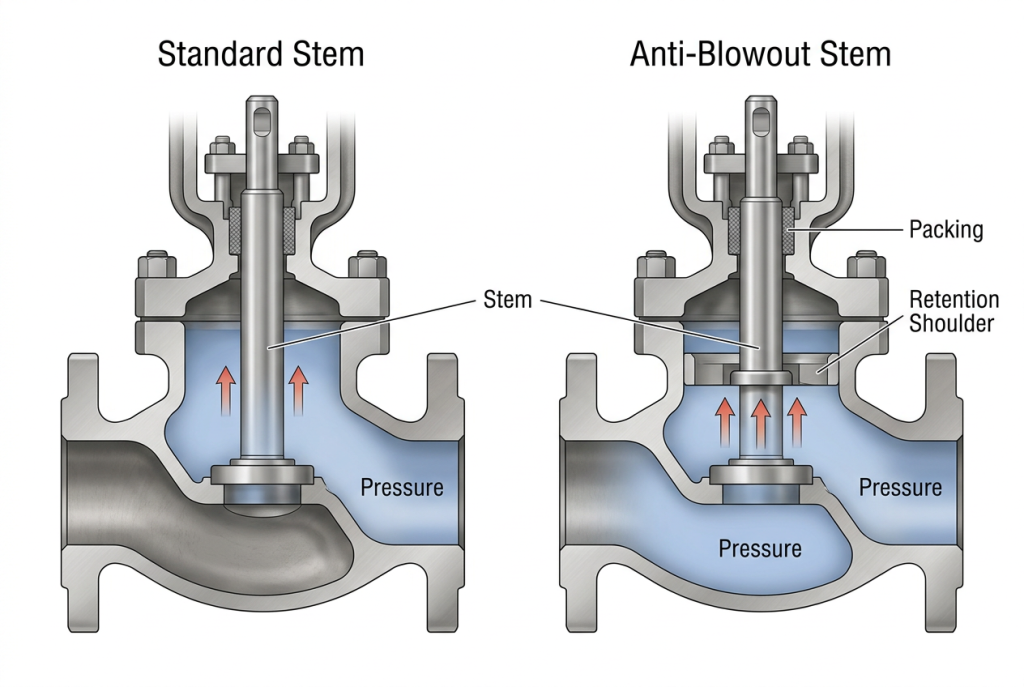
The Mechanics of Stem Blowout: What Goes Wrong?
The primary function of a valve stem is to translate rotational motion (from the handle or actuator) into linear motion, controlling the flow. In standard valve designs, the stem is often inserted from the top, with external threading and packing preventing leakage. The critical flaw in high-pressure scenarios lies in its retention method.
Standard Stem Design Limitations
In many conventional bleeder valves, the stem is designed to be “back-seated” – meaning it has a shoulder that seats against the stem packing from the inside. While this provides a secondary seal, its primary retention against internal pressure often relies on the external threads and the bonnet assembly. If these threads gall, strip, or if the packing assembly itself fails or loosens under dynamic pressure, the stem can be forcibly ejected.
Consider a system operating at 6,000 PSI. A stem with a 0.25-inch diameter will have approximately 294 lbs of force constantly pushing against its retention mechanism. Any compromise to that mechanism can result in catastrophic failure.
Forces at Play in High-Pressure Gas Service
High-pressure gas presents unique challenges:
- Compressibility: Gas stores significantly more potential energy than liquid at the same pressure, leading to more violent releases.
- Rapid Expansion: A small leak can quickly become a large, destructive force as gas expands instantly.
- Ciclado térmico: Temperature fluctuations can cause expansion and contraction of materials, stressing connections and seals.
The Solution: Anti-Blowout & Non-Rotating Stem Designs
The industry’s answer to the “human projectile” risk lies in fundamentally redesigning the stem retention mechanism. This moves away from relying solely on external threads and packing and integrates the safety feature directly into the valve’s core structure.
1. Anti-Blowout Stem (ABS) Design
An anti-blowout stem is designed with an internal shoulder that is larger than the bore of the gland nut. This means the stem is installed from *inside* the valve body. Even if the external threading and packing gland were to completely fail, the internal shoulder physically prevents the stem from being ejected by internal line pressure.
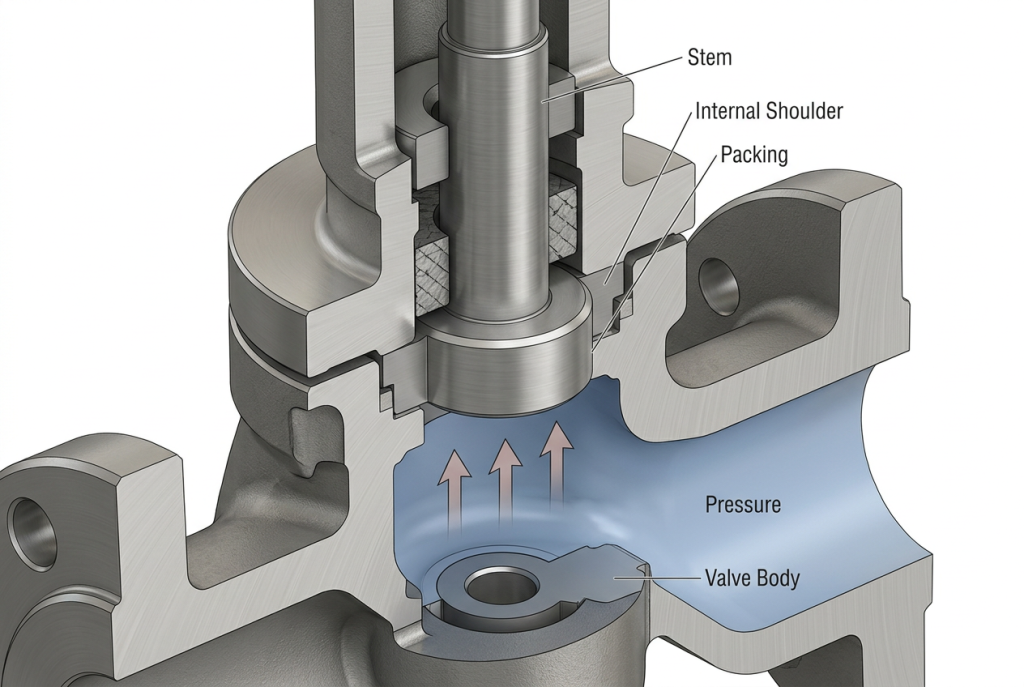
2. Non-Rotating Stem (NRS) Design
Beyond preventing blowout, a non-rotating stem further enhances safety and longevity. In NRS designs, the stem itself does not rotate; instead, it moves linearly when the handle turns. This prevents galling between the stem and the packing, allowing for smoother operation and significantly extending packing life, minimizing external leakage risks.
| Característica | Standard Bleeders | Anti-Blowout & Non-Rotating |
|---|---|---|
| Stem Retention | External threads/packing gland | Internal shoulder (inherently safe) |
| Stem Movement | Rotates and moves axially | Axial only (non-rotating) |
| Blowout Risk | High in high-pressure service | Virtually eliminated |
| Packing Life | Shorter (due to rotation friction) | Extended (reduced friction) |
| Safety Rating | Lower for critical applications | Highest (industry best practice) |
While a robust mechanical design is critical, it is meaningless if the wrong material is chosen. In certain environments, material failure is the greater risk, as seen in The ‘NACE’ Oversight for sour gas service.
Don’t Gamble on Valve Design: The Cost of Complacency
Choosing a bleeder valve based solely on cost or superficial specifications is a gamble with human lives and operational integrity. The investment in anti-blowout and non-rotating stem designs is not merely an upgrade; it’s a fundamental requirement where high-pressure gas is present.
Beyond the potential for severe LTI and fatalities, stem blowouts can lead to:
- Catastrophic Release of Hazardous Media: Resulting in fires, explosions, or toxic gas clouds.
- Significant Downtime and Production Loss: Due to emergency shutdowns and extensive investigations.
- Reputational Damage and Regulatory Penalties: Long-term consequences that far outweigh the initial cost savings on cheaper valves.
Conclusion: Prioritizing Safety Through Superior Design
The “human projectile” risk is a stark reminder that in engineering, compromise on safety-critical design is unacceptable. The consequences of a standard bleeder valve failing in high-pressure gas service are simply too severe to ignore. By understanding the inherent vulnerabilities and making informed specification choices for anti-blowout and non-rotating stem designs, plant managers, engineers, and safety professionals can proactively eliminate this deadly hazard.
At [Your Brand Name], we engineer bleeder valves that don’t just meet industry standards, they set them. Our commitment to robust design ensures that every valve is a safeguard, not a potential hazard. Choose safety. Choose reliability. Choose designs that protect your most valuable assets: your people.
Secure your operations with unparalleled design safety.


 English
 Arabic
 Russian
 French
 Spanish