
In commercial buildings and industrial process cooling, the problem of chilled water low ΔT syndrome is a silent, insidious drain on energy budgets. At its core, low delta T means your chilled water plant (chillers, pumps) is working harder than necessary, consuming excessive electricity, all while delivering inadequate cooling to loads. Often, the culprit hides within the very components designed to regulate flow: the 3 way valve, particularly in part-load conditions.
This guide delves into a specific, high-friction troubleshooting topic for facility engineers, HVAC designers, and controls contractors: precisely why 3 way valve causes low delta t (ΔT) syndrome in chilled-water loops. We’ll explore the often-overlooked mechanism of chilled water bypass, the implications of improper sizing, and common piping configurations that contribute to this inefficiency, helping you diagnose and rectify this costly problem long before it impacts your annual energy bill.
Quick Answer: A 3 way valve often causes low ΔT syndrome in chilled-water loops by allowing excessive chilled water bypass directly from the supply to the return line, especially during part-load conditions. This reduces the temperature differential (ΔT) across coils, forcing chillers to run inefficiently to meet cooling demand.
1. What is Low ΔT Syndrome in Chilled Water Loops?
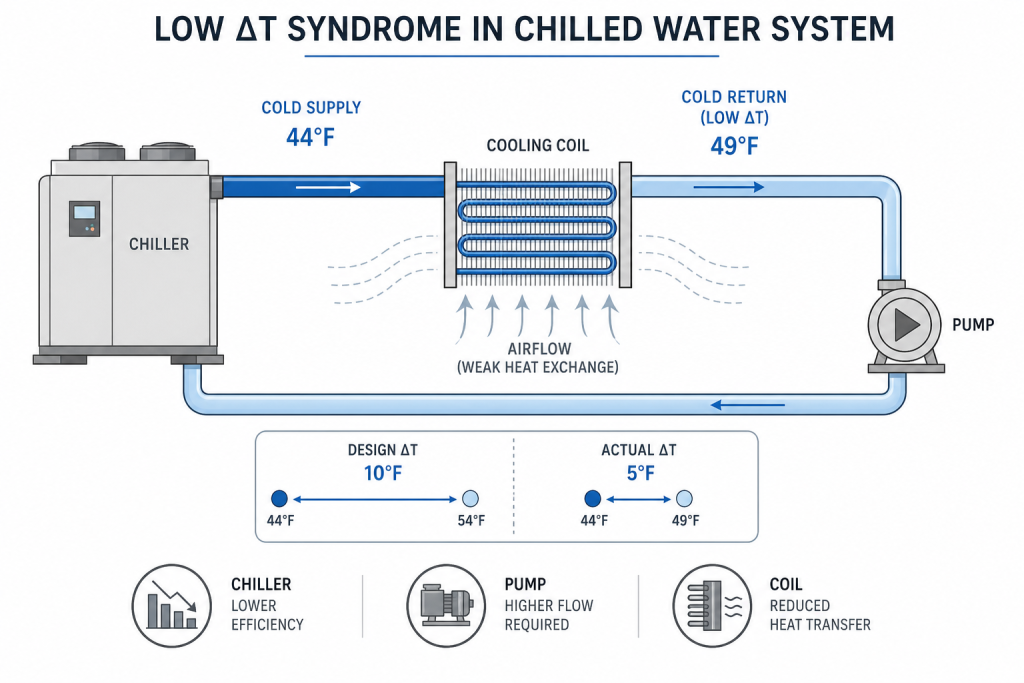
Low ΔT syndrome refers to a condition in chilled water systems where the actual temperature difference between the supply (cold) and return (warmer) water is significantly less than the design ΔT (e.g., a design of 10°F but actual is 5°F). This means the water isn’t picking up enough heat from the cooling coils, thus returning colder than it should to the chiller. This is a crucial indicator of HVAC low delta t and overall system inefficiency.
Why Low ΔT is a Big Problem
- Reduced Chiller Efficiency: Chillers are designed to operate efficiently with a specific return water temperature. Colder return water reduces their capacity and forces them to work harder, increasing energy consumption to achieve the same cooling load.
- Increased Pumping Energy: To compensate for the reduced heat transfer per gallon, system pumps often must circulate more water, leading to higher pumping energy usage.
- Inadequate Cooling: Despite the increased energy input, the system may still struggle to meet cooling demands in zones due to insufficient heat removal at the coils.
2. How 3-Way Valves Directly Cause Low ΔT
While a 3 way valve is a versatile component, its common application in chilled-water coils during part-load conditions is a primary contributor to low ΔT syndrome. The core issue lies in its inherent design for mixing or diverting flow, which can inadvertently lead to wasted cooling capacity.
The Chilled Water Bypass Problem
In a typical 3-way valve setup for a chilled water coil, the supply chilled water enters one port, the return water leaves another, and an auxiliary port allows for bypass. As the cooling load on the coil decreases (e.g., during milder weather), the valve modulates to reduce flow through the coil. To maintain constant flow in the main chilled water distribution loop (a common strategy in constant-flow systems), the valve simultaneously bypasses some of the cold supply water directly into the return line, completely circumventing the coil.
Este 3 way valve chilled water bypass problem means:
- Colder water returns to the chiller than necessary, reducing chiller efficiency.
- Cooling energy is wasted as chilled water goes directly back without absorbing heat.
- The temperature differential across the coils drops below design, creating the definitive low ΔT syndrome.
3. The Chilled Water Bypass Mechanism Explained
The bypass mechanism of a 3-way valve is often employed to simplify pumping or maintain minimum coil velocity, but its impact on ΔT can be severe. Understanding the interaction between the supply, return, and bypass ports is key to understanding why 3 way valve causes low delta t.
Flow Dynamics During Part-Load
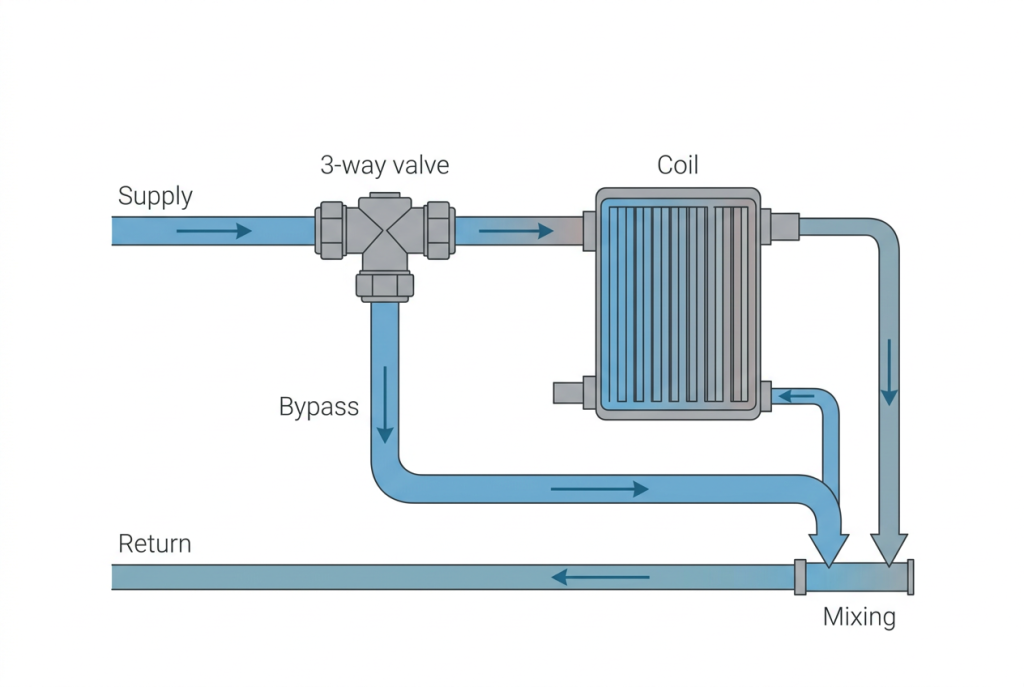
When a typical 3-way *diverting* valve is used in a chilled water loop, it takes flow from a common inlet and splits it between two outlets (one to the coil, one to bypass). However, it’s often more accurately thought of as a *mixing* valve in a secondary loop diverting unused chilled water:
- High Load: Valve directs most (or all) chilled water through the coil. Maximum heat transfer.
- Part Load: As cooling demand drops, the valve begins to close off the flow path to the coil. Simultaneously, it opens the bypass port, directing cool supply water directly into the return line. This creates an immediate dilution of the warmer return water, thus reducing the ΔT.
- Common Porting Mistake: Incorrectly piping 3-way mixing and diverting valves can exacerbate this. (Related: 3 Way Mixing Valve vs Diverting Valve: Why Wrong Porting Ruins System Performance).
4. Sizing & Application Mismatches: Beyond Just ΔT
Beyond the inherent bypass function, improper valve sizing and application choices worsen the 3 way valve low delta t problem.
The Influence of Valve Cv on Performance
If a 3-way valve is oversized (i.e., its Cv is too high for the coil’s required flow), it will operate at a very low percentage of opening when directing flow through the coil. In this low-lift range, control authority is poor, leading to imprecise modulation and more unintended bypass, worsening chilled water low ΔT syndrome. Accurate Cv matching is vital.
Constant vs. Variable Flow Systems
The decision to use a 3-way valve is often tied to constant-flow distribution systems. While necessary for some legacy systems, modern variable-primary flow (VPF) and variable-secondary flow (VSF) systems generally benefit from 2-way control valves, which eliminate internal bypass and allow for reduced pump speed at part load, enhancing overall system efficiency.
5. Diagnosis & Solution Options: Fixing the Low ΔT Problem
Rectifying chilled water low ΔT syndrome requires a systematic approach, often focusing on the system’s control valves.
Key Steps to Achieve Design ΔT
- Verify Valve Sizing: Perform accurate Cv calculations for all coils and ensure the 3-way valves are correctly sized for the specific coil flow, not just pipe size. Even better, consider a specialized 3 way valve retrofit if existing infrastructure prevents simple replacement.
- Piping Configuration Audit: Confirm that 3-way valves are piped correctly (e.g., in mixing vs. diverting applications, if utilized for that) and that unnecessary bypass circuits are eliminated or tightly controlled.
- Upgrade to 2-Way Valves: For systems capable of variable flow, replacing 3-way bypass valves with 2-way control valves is often the most effective solution. This eliminates unintended coil bypass, allowing flow to be actively reduced at part load.
- Balance the System: Ensure proper hydraulic balancing across all coils and air handlers, so each load receives its designed flow rate.
FAQ on 3-Way Valves and Low ΔT
Is low ΔT always caused by 3-way valves?
No, while 3-way valves in bypass configurations are a major contributor, low ΔT can also be caused by dirty coils, air in the system, improper pump settings, or incorrect temperature sensor placement. However, it is a very common root cause to investigate.
What is the ideal ΔT for chilled water systems?
The ideal ΔT is typically determined by the system’s design specifications, often in the range of 10-14°F (5.5-7.8°C). A consistent deviation below this design value indicates inefficiency.
Can I use a 3-way valve for mixing without causing low ΔT?
Yes, a 3-way valve used as a mixing valve (e.g., blending hot and cold water for a desired supply temperature) typically does not cause low ΔT syndrome, as it is actively delivering blended water to a load rather than bypassing. The issue arises when it’s used to reduce flow to a coil by bypassing back to the return.
Conclusion: Reclaim Efficiency in Your Chilled-Water Loops
The pervasive problem of low ΔT syndrome in chilled-water loops often finds its root cause in the misapplication or improper sizing of 3 way valves. By understanding the critical mechanism of chilled water bypass, facility engineers and HVAC professionals can halt the drain on energy resources and restore their systems to peak efficiency. Moving beyond an inefficient 3 way valve chilled water bypass problem means smarter energy consumption.
BCST Valve provides expertly engineered solutions for optimal chilled water control, from high-performance 2-way valves to precisely sized 3-way valves for appropriate applications. We empower engineers to diagnose and resolve HVAC low delta t issues, ensuring efficient, reliable cooling for any facility. Partner with us to achieve your design ΔT and significantly reduce operational costs.
Struggling with Low ΔT in Your Chilled Water System?
Optimize your control valves. Let BCST Valve help you diagnose and resolve inefficiency for good.


 English
 Arabic
 Russian
 French
 Spanish