
Choosing the wrong valve for a pipeline is a mistake I’ve seen happen, and it’s a costly one. An error in selection leads to dangerous backflow or sudden shutdowns, bringing a whole section of your plant to a standstill. It’s a headache you don’t need.
When you’re looking at a check valve vs a gate valve, the difference is simple. A check valve is your automatic safety guard, stopping fluid from flowing backward. A gate valve is your manual on/off switch, used to completely block or open a line. One is for automatic protection, the other for deliberate control.
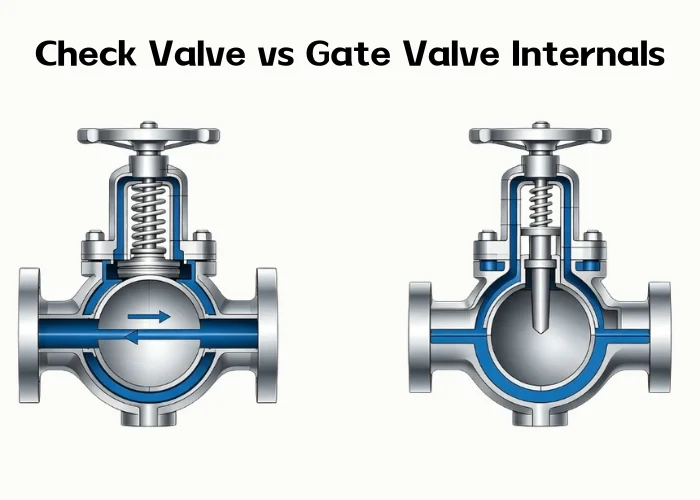
I know this choice is a heavy one, especially with project deadlines breathing down your neck. I grew up in this world; my father started his valve factory when I was young, and I spent years on the factory floor before ever selling a single valve. I will use that experience to make this decision easier for you. Let’s walk through what each valve does, so you will choose with confidence.
The Function and Mechanism of a Check Valve
When fluid flows the wrong way in your pipes, it isn’t just a minor issue; it destroys expensive pumps and compressors in seconds. This is not a situation where you can afford to wait for someone to react. You need an automatic fix.
That’s where the check valve comes in. Think of it as a one-way street for your fluids. Sometimes called a non-return valve, its only job is to let fluid move forward and slam the door shut if it tries to come back. The best part? It does this all on its own, powered by the flow of the fluid itself.
Dive Deeper: Understanding Check Valve Mechanisms
The way a check valve works is pure genius in its simplicity. It’s all about pressure. When the forward flow is strong enough, it pushes a disc or ball out of the way, opening the valve. The moment that flow stops or tries to reverse, the backpressure and gravity force the mechanism shut, creating a tight seal. No person, no computer, no external power source is needed. It’s a self-policing device.
Now, not all check valves are the same. Let me walk you through the three main types I see in the field.
Swing Check Valve
This is the most common kind. Imagine a cat flap in a door—that’s a swing check. It has a disc (we call it a flapper) on a hinge. Flow pushes it open, and when the flow stops, the flapper swings shut. They’re great because they don’t get in the way of the flow much, but in high-speed lines, they slam shut. This action sends a damaging shockwave (water hammer) through your pipes.
Lift Check Valve
With a lift check, a small piston or disc lifts straight up off its seat to let fluid pass. When the flow reverses, gravity and the pressure push it right back down. These are tougher than swing checks and are perfect for high-pressure systems with gas or steam, but they create more resistance for the fluid to push against.
Ball Check Valve
Just like the name says, this one uses a ball. Forward pressure pushes the ball out of its seat, opening a path. When the pressure drops, the ball rolls back into the seat, blocking the flow. These excel with thick, sludgy fluids because the rolling motion keeps the mechanism clean and free of gunk.
To make it easier, here’s a quick comparison:
| Feature | Swing Check Valve | Lift Check Valve | Ball Check Valve |
|---|---|---|---|
| Mechanism | Hinged disc (flapper) | Piston or disc lifts vertically | Free-floating or spring-loaded ball |
| Best For | Low-velocity liquids, full flow | High-pressure gas, steam, liquids | Viscous fluids, slurries |
| Orientation | Works in horizontal or vertical lines | Best for horizontal lines | Works in any orientation |
| Pressure Drop | Very low | Moderate | Moderate to high |
Selecting the right check valve depends on what’s flowing through your pipes, at what speed, and in what direction.
A Gate Valve Provides On/Off Isolation
When you need to shut down one part of a line for maintenance without stopping everything else, using the wrong valve causes leaks and unwanted pressure drops that affect your whole process. For this job, you need something that gives you a perfect seal.
This is a job for a gate valve. Its purpose is straightforward: it is a light switch for your pipeline—either completely on or completely off. It works by lifting a solid gate straight out of the flow path. There’s no in-between. Its purpose is simply to start or stop the flow entirely.
Dive Deeper: The Role and Types of Gate Valves
The best analogy for a gate valve is a canal lock gate. When you raise the gate, the water has a totally clear, straight path. When you lower it, the path is completely blocked. This is why engineers love gate valves for main lines. When they’re fully open, they create a very low pressure drop, meaning your pumps don’t have to work as hard.
But here’s a word of warning I always give to new engineers: never use a gate valve to dial down the flow. This is called throttling, and it’s a big mistake with this valve type. Leaving the gate partially open creates a high-speed jet of fluid that chews away at the gate and seat, causing it to vibrate and wear out fast. When you finally need it to seal completely, it won’t.
You will run into two main designs:
Rising Stem (OS&Y) Gate Valve
OS&Y means “Outside Stem and Yoke.” As you turn the wheel, the stem rises out of the valve. It’s a fantastic visual indicator—if the stem is up, the valve is open; if it’s down, it’s closed. From 50 feet away, an operator sees the valve’s status. The only drawback is they need a lot of headroom.
Non-Rising Stem (NRS) Gate Valve
With an NRS valve, you turn the stem, but it does not move up or down. The gate itself travels along the threaded stem inside the valve body. These are great for tight spaces or buried underground. The trade-off is that you cannot tell if it’s open or closed just by looking at it.
The Key Differences Between a Check Valve and a Gate Valve
Getting these two confused isn’t a small mistake; it’s a mistake that leads to major system failures and safety hazards. Making sure everyone on your team knows the difference is one of the fundamentals of plant safety.
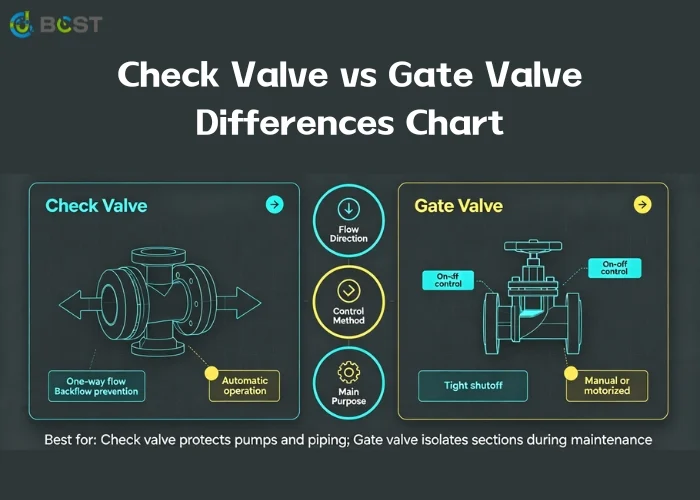
So, what’s the bottom line on check valve vs gate valve? It all comes down to one thing: automatic protection versus deliberate control. One acts on its own to protect your system, while the other waits for a command to isolate it.
Dive Deeper: A Head-to-Head Comparison
It’s never a question of which valve is “better.” It’s always about which is the right tool for the task at hand. I was discussing this with Hassan, a sharp chief engineer from Nigeria I work with on big refinery projects. He put it perfectly. He said, “Emily, using a gate valve where you need a check valve is like trying to use a light switch to stop a car from rolling downhill. It’s the wrong tool with the wrong function.” That has stuck with me for years.
Let’s put them side-by-side to make it crystal clear:
| Feature | Check Valve | Gate Valve |
|---|---|---|
| Primary Function | Prevents reverse flow (backflow) | Isolates flow (on/off service) |
| Operation | Automatic (flow-activated) | Manual or Actuated (requires external force) |
| Flow Control | Cannot be used for control | Should not be used for control (throttling) |
| Typical Use | Safety, equipment protection | Maintenance isolation, shutdown |
| P&ID Symbol | A sideways “>” with a vertical line | Two triangles pointing at each other at the tips |
| Pressure Drop | Varies from low to high (by type) | Very low (when fully open) |
| Failure Mode | Gets stuck open or closed | Stem breaks, seat leaks from wear |
Those P&ID symbols are especially important. On a plant blueprint, they are the universal language that tells an engineer or operator the purpose of every valve at a glance. The symbol for a check valve clearly shows one-way flow, while the gate valve symbol shows a clear barrier. Learning to read these is day-one stuff for a reason—it’s critical for safety. This clear distinction between a check valve vs a gate valve is something every professional in this field must know.
Real-World Applications of Check Valves and Gate Valves
Theory is great, but where do these valves actually live in a real plant? Seeing them in context makes their different roles obvious. A check valve is a silent guardian, while a gate valve is an operational workhorse.
You use check valves to protect your expensive equipment from the physics of fluid flow. You use gate valves to give you, the operator, the power to control your process for maintenance and shutdowns.
Dive Deeper: Real-World Scenarios
I’ve walked through hundreds of facilities, and you see the same smart design patterns everywhere. Once you see it, the check valve vs gate valve application difference becomes second nature.
Common Applications for Check Valves
You’ll find these quiet heroes in a few key spots:
- Pump Discharge: This is the #1 spot. When a pump shuts off, a check valve right after it stops the fluid from rushing backward and spinning the pump in reverse, which destroys it.
- Boiler Feedwater Lines: High-pressure steam from a boiler must not be allowed to push back into the lower-pressure water supply lines. A series of heavy-duty check valves prevents this catastrophic failure.
- Connecting Multiple Sources: When you have several pumps feeding one big pipe, each pump line requires a check valve. This stops the strongest pump from overpowering the others and sending fluid back down their lines.
Common Applications for Gate Valves
These are the valves that operators interact with daily to run the plant:
- Pipeline Isolation: In a refinery, Hassan will place massive gate valves on main process arteries. This allows an entire unit to be safely shut down for work without taking the whole refinery offline.
- Equipment Maintenance: A filter that needs a new cartridge will have a gate valve on the pipe going in and the pipe coming out. Close both, and you can safely work on the filter while the rest of the system keeps running.
- Tank Farms: Each giant storage tank has a gate valve on its main lines, giving operators total control over which tanks are receiving product and which are sending it out.
The standard, effective setup is a pump with a gate valve before it (for isolation), a check valve after it (for protection), and another gate valve downstream. This combination gives you full control and complete safety.
Watching my father build his company, BCST Valve, from the ground up taught me that this business isn’t just about selling parts; it’s about providing reliability. The cost of a valve failure is always higher than the cost of a quality valve. For applications this critical, you can’t take chances. That’s why I’m confident when I recommend our valves. We’ve helped engineers like Hassan build safer, more efficient plants for years.
Frequently Asked Questions
Can I use a gate valve instead of a check valve?
Absolutely not. A gate valve needs someone or something to close it. It cannot react instantly to stop backflow like a check valve does. Relying on it for that is a major safety risk.
Which valve has a higher pressure drop, a check valve or a gate valve?
A check valve has a higher pressure drop because its internal mechanism is in the flow path. A fully open gate valve is like an open piece of pipe, so it has a very low pressure drop.
Are check valves and gate valves expensive?
The price depends on the size, material, and pressure rating. But trust me, the cost of a quality valve is nothing compared to the cost of equipment damage or a full plant shutdown from using the wrong one.
Final Thought
In the end, the choice between a check valve vs gate valve isn’t complicated because they have completely different jobs. A check valve is your automatic safety net. A gate valve is your manual on/off switch. Using the right one protects your people, your equipment, and your bottom line.


 English
 Arabic
 Russian
 French
 Spanish