
Why Is Upgrading to Modern Butterfly Control Valves the Fastest Path to Plant Efficiency Gains?
Your plant leaks profit through outdated valves, causing process instability and high costs. A strategic upgrade to modern butterfly control valves can slash waste and boost your plant’s performance.
Upgrading to modern high-performance or triple-offset butterfly control valves provides superior control, eliminates leaks, and extends service life. This directly translates to increased throughput, reduced energy consumption, better product quality, and a safer, more reliable operation for your facility.
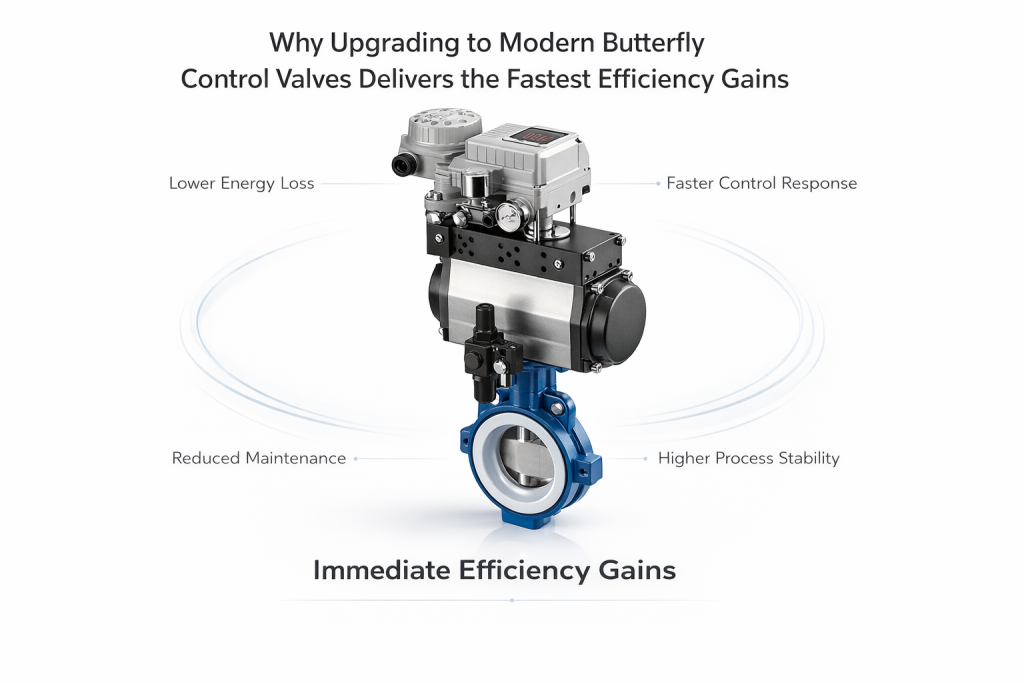
You’ve likely seen the recurring maintenance orders and felt the frustration of a control loop that just won’t stay stable. Emily, who has worked with dozens of clients on valve modernization projects, has seen plants achieve remarkable gains simply by focusing on valve upgrades first. Our Chief Engineer, Hassan, puts it bluntly: “Your first step should be to evaluate your most critical valves. The ROI from upgrading just a handful of key butterfly control valve units often paves the way for wider plant improvements. But achieving that ROI depends entirely on execution. That’s why following a successful step-by-step process for butterfly control valve replacement is non-negotiable to minimize downtime and secure those gains.” To unlock these benefits, you first need to understand what makes modern valves so much more effective than the older models currently holding your plant back.
How Do Modern Butterfly Valve Designs Eliminate Common Failures?
Your old concentric valves constantly wear out, leak, and cause process upsets. This friction-based design is a root cause of high maintenance costs and poor control in your plant.
Modern high-performance and triple-offset butterfly valve types use advanced offset geometry to minimize or completely eliminate friction between the disc and seat. This design principle drastically reduces wear, ensures a long-lasting tight seal, and provides the stable, precise control needed for demanding applications.
Moving Beyond Friction, Towards Precision
The question, “How do modern butterfly valve designs eliminate common failures?” gets right to the core of valve engineering. Friction is the primary enemy of any control valve. It causes a phenomenon known as “stiction” (static friction), where the actuator has to build up extra force just to get the disc to move. This leads to jerky, imprecise movements and process oscillations that can ruin product quality. Hassan always teaches our junior engineers that overcoming friction is the first step to achieving superior control. The evolution of butterfly valve types is a direct response to this challenge.
The Problem with Traditional Concentric Valves
Traditional concentric butterfly valves rely on a simple disc rotating into a soft (rubber or polymer) seat. While fine for basic on/off service in clean, low-pressure applications, they struggle badly in control loops. The constant rubbing of the disc against the seat during throttling causes rapid wear and degradation of the sealing element. This leads to leaks, frequent butterfly control valve replacement, process variability from poor control, and energy waste. They are simply not built for the rigors of precise modulation, abrasive fluids, or high temperatures.
The High-Performance (Double-Offset) Solution
The high-performance butterfly valve introduces a “double-offset” geometry, a major leap forward. By offsetting the stem behind the disc and slightly to one side, the design creates a camming action. The disc lifts away from the seat almost immediately upon opening. This design innovation accomplishes two things: it drastically minimizes friction and wear, which extends the valve’s service life, and it allows for the use of more robust seat materials like PTFE or even metal. This makes it the go-to choice for most throttling and control applications today, offering a great balance of performance and value.
The Triple-Offset Valve (TOV) for Critical Service
It adds a third angular offset to the disc and seat, creating a unique cone-in-cone geometry. This means the disc and seat never rub against each other during the entire valve stroke. The only contact happens at the precise moment of final closure, where it creates a torque-seated, gas-tight, zero-leakage metal seal. This design is inherently fire-safe and can handle extreme temperatures and pressures, making it essential for critical services like high-pressure steam, hydrocarbons, or hazardous chemicals where failure is not an option. ASME study shows optimized butterfly valve design reduces torque fluctuations for better efficiency: “This study provides a theoretical basis for the design and optimization of butterfly valves… The effects of shaft diameters on the value and the fluctuation of valve disk torque were studied, and the physical reason was discussed.” This research confirms how advanced offset geometries minimize dynamic forces, enabling lower actuator energy use and faster gains in plant stability and throughput.
| Valve Type | Working Principle | Best For | Key Limitation |
|---|---|---|---|
| Concentric | Disc rotates into soft seat | Low-pressure on/off, clean liquids | High seat wear, poor for control |
| High-Performance | Double-offset camming action | Throttling control, higher pressures | Not zero-leakage with metal seats |
| Triple-Offset | Cone-in-cone, non-rubbing design | Critical service, zero-leakage, high temps | Higher initial investment |
Why Is the Actuator Package as Critical as the Valve Itself?
You selected a great valve, but your process control is still sloppy. An undersized or poorly chosen actuator package will completely undermine your investment, leaving performance on the table.
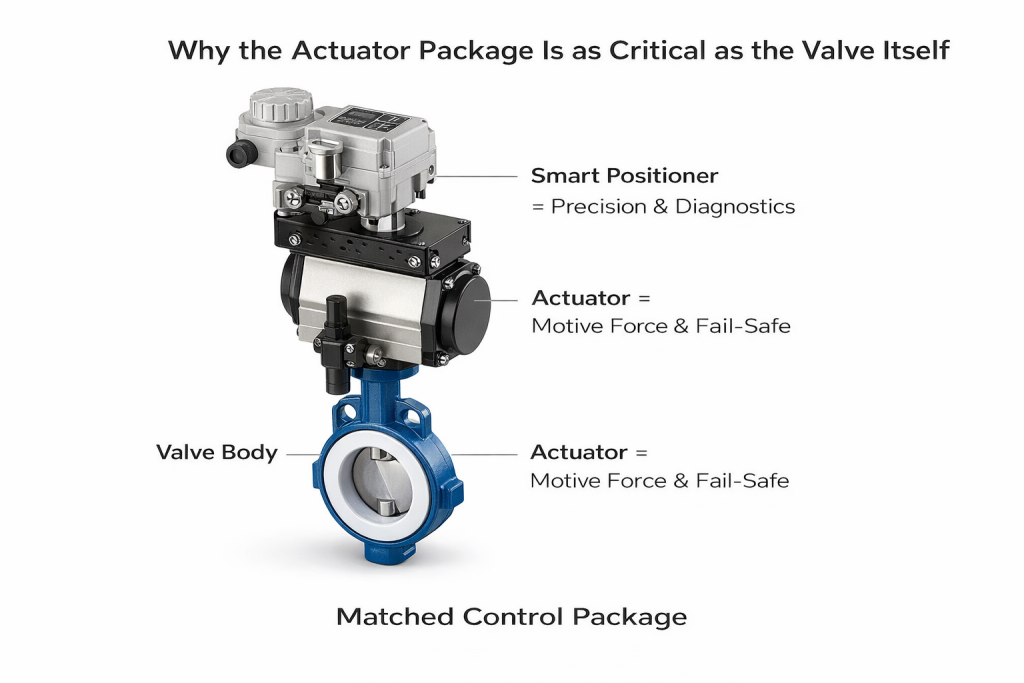
The butterfly valve with actuator and positioner forms a complete control package. The actuator provides the motive force and fail-safe action, while a smart positioner delivers the precision and diagnostic intelligence. Properly matching these components to the valve and application is essential for achieving optimal performance.
Building a Complete Control Instrument
When you ask, “Why is the actuator package as critical as the valve itself?”, you are recognizing a fundamental truth of process control. A great valve is only half of the solution. The actuator and positioner assembly is the other half. Hassan always emphasizes that the butterfly valve with actuator must be treated as a single, integrated instrument. If the “muscle” (actuator) or the “brain” (positioner) is mismatched to the valve, the entire system’s performance will suffer, regardless of how advanced the valve technology is.
Sizing for Torque: More Than Just Open and Close
The actuator’s primary job is to generate enough torque (rotational force) to operate the valve under all conditions. This isn’t just one number; engineers must consider several torque requirements:
- Breakaway Torque: The force needed to overcome static friction and unseat the valve from the fully closed position. This is often the highest torque value.
- Running Torque: The force needed to move the disc through its stroke.
- Seating Torque: The force required to push the disc into the seat to achieve the desired shutoff classification (e.g., bubble-tight).
- Dynamic Torque: The force exerted on the disc by the flowing fluid, which can either try to open or close the valve.
An undersized actuator will fail to close the valve tightly, leading to leaks, or it may get stuck during operation. An oversized actuator is wasteful, slower, and can damage valve components.
The Smart Positioner: The Brains of the Operation
A positioner is non-negotiable for any throttling butterfly control valve. It translates the electronic control signal (typically 4-20mA) from your PLC or DCS into the precise physical valve position needed to maintain a process setpoint. Today’s digital or “smart” positioners are powerful micro-processing devices. They not only provide exceptional accuracy but also run constant diagnostics on the valve assembly. They can detect and alert you to issues like low air supply, high friction from a worn-out packing, or slow response times long before these problems cause a process upset or a shutdown. This predictive maintenance capability is one of the biggest ROIs of a modern control valve package.
Fail-Safe Philosophy: What Happens When Power Is Lost?
A critical consideration for any actuated valve is its “fail-safe” position. What should the valve do if it loses its control signal or power source (e.g., compressed air)?
- Fail-Close: The valve automatically closes. This is common for systems where you need to stop the flow of a chemical or fuel for safety. This is achieved with a spring-return pneumatic actuator.
- Fail-Open: The valve automatically opens. This might be used for a cooling water line to prevent a reactor from overheating.
- Fail-in-Place: The valve stays in its last position.
Choosing the correct fail-safe strategy is a critical safety and operational decision that is determined by the actuator selection.
Conclusion
Upgrading your critical butterfly control valves is not just a maintenance task—it is one of the highest-ROI investments you can make to improve your plant’s efficiency, reliability, and profitability. By investing in modern designs and fully integrated actuator packages, you can eliminate common failures, achieve superior process control, reduce operational costs, and build a more robust and responsive industrial facility.
Ready to unlock peak plant performance?


 English
 Arabic
 Russian
 French
 Spanish