
Choosing Your Miniature Ball Valve: A Guide to Materials, Connections & Ratings
Miniature ball valves are compact powerhouses, crucial for precise fluid control in tight spaces. While their small size is a universal appeal, selecting the *right* miniature ball valve for your specific application is paramount. A seemingly minor misstep in material choice, connection type, or rating can lead to premature failure, costly leaks, or even safety hazards.
This comprehensive guide from BCST Valve will walk you through the critical considerations: valve body and seat materials, connection types, and the essential pressure and temperature ratings to ensure your miniature ball valve performs reliably and safely, matching your system’s exact demands.
From plumbing to instrumentation, understanding these factors is the key to maximizing both efficiency and longevity. For a general introduction, refer to our pillar content: What Is a Miniature Ball Valve? A Complete Guide.
1. Material Selection: Body & Seat
The materials chosen for both the valve body and its internal seats are foundational to its performance and lifespan, directly influencing its compatibility with the media and resistance to environmental factors.
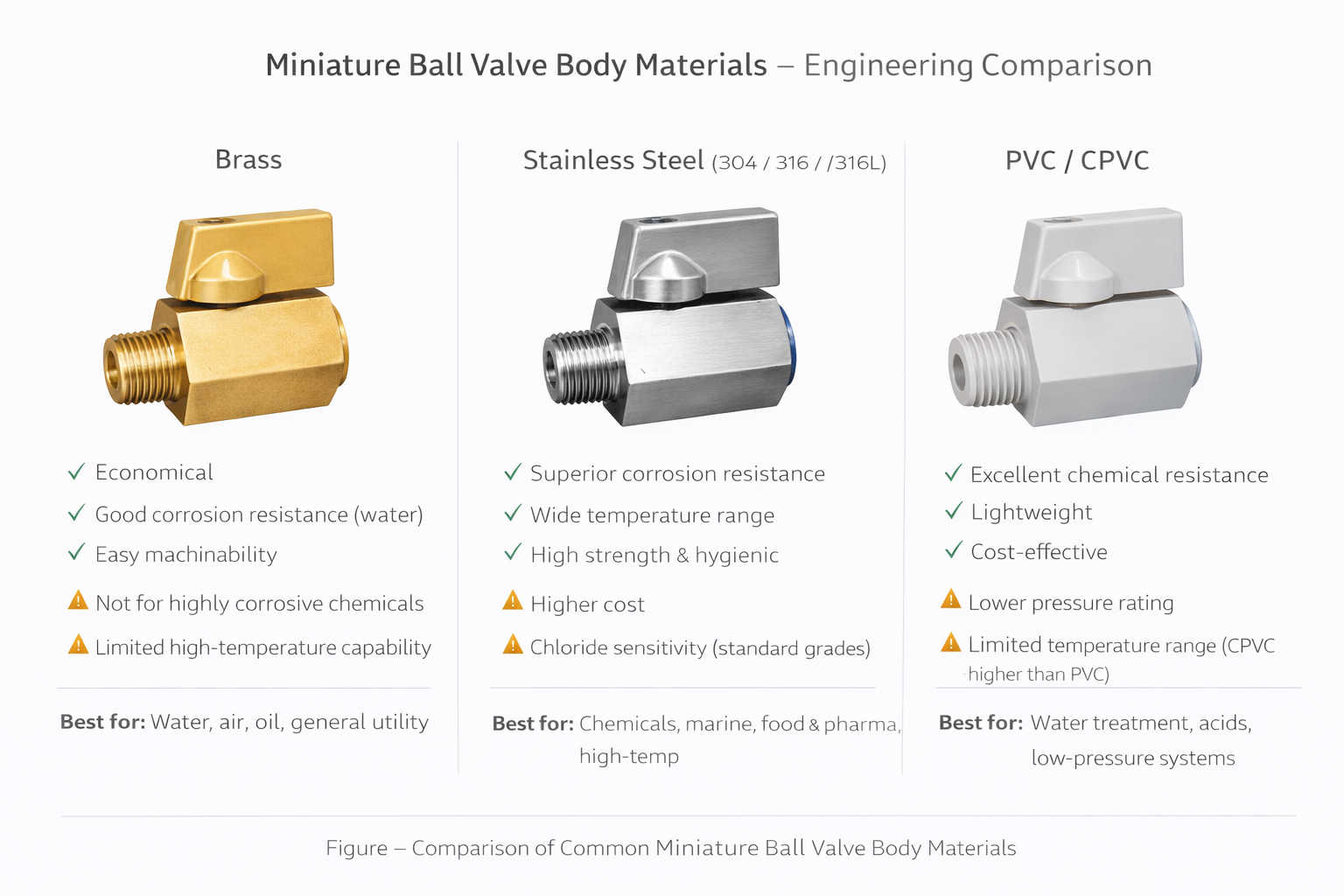
Valve Body Materials:
- Brass:
- Pros: Economical, good strength, excellent corrosion resistance to water, good machinability.
- Cons: Not suitable for highly corrosive chemicals, high temperatures, or media sensitive to lead (ensure lead-free for potable water).
- Best For: Water (potable & non-potable), air, oil, low-pressure plumbing, general utility.
- Stainless Steel (304/316/316L):
- Pros: Superior corrosion resistance (especially 316/316L), wide temperature range, high strength, hygienic properties.
- Cons: Higher cost, less suitable for highly aggressive chlorides without specialized alloys.
- Best For: Chemicals, food & beverage, pharmaceuticals, marine, high-temperature applications, corrosive environments.
- PVC (Polyvinyl Chloride) / CPVC (Chlorinated Polyvinyl Chloride):
- Pros: Excellent chemical resistance to many acids, alkalis, and salts; lightweight; cost-effective.
- Cons: Limited pressure and temperature ratings compared to metals. CPVC has higher temp limits than PVC.
- Best For: Water treatment, aggressive chemicals, low-pressure applications, specific industrial processes.
Seat Materials:
The seat material is crucial for the sealing integrity and bubble-tight shutoff. It also heavily influences the valve’s temperature range.
- PTFE (تفلون): Standard for soft-seated ball valves. Excellent chemical resistance, low friction, wide temperature range (-20°F to 400°F / -29°C to 204°C).
- RPTFE (Reinforced PTFE): PTFE mixed with fillers (e.g., glass, carbon) for increased strength, wear resistance, and higher pressure/temperature capabilities.
- Delrin (Acetal): Good strength and stiffness, suitable for high-pressure gas applications at moderate temperatures.
- PEEK (Polyetheretherketone): For very high temperatures (up to 500°F / 260°C) and demanding chemical applications, offers excellent mechanical strength.
- Metal Seats: Used for extreme temperatures and abrasive media, but don’t offer bubble-tight shutoff without specialized design. (Less common for standard miniature ball valves).
2. End Connection Types
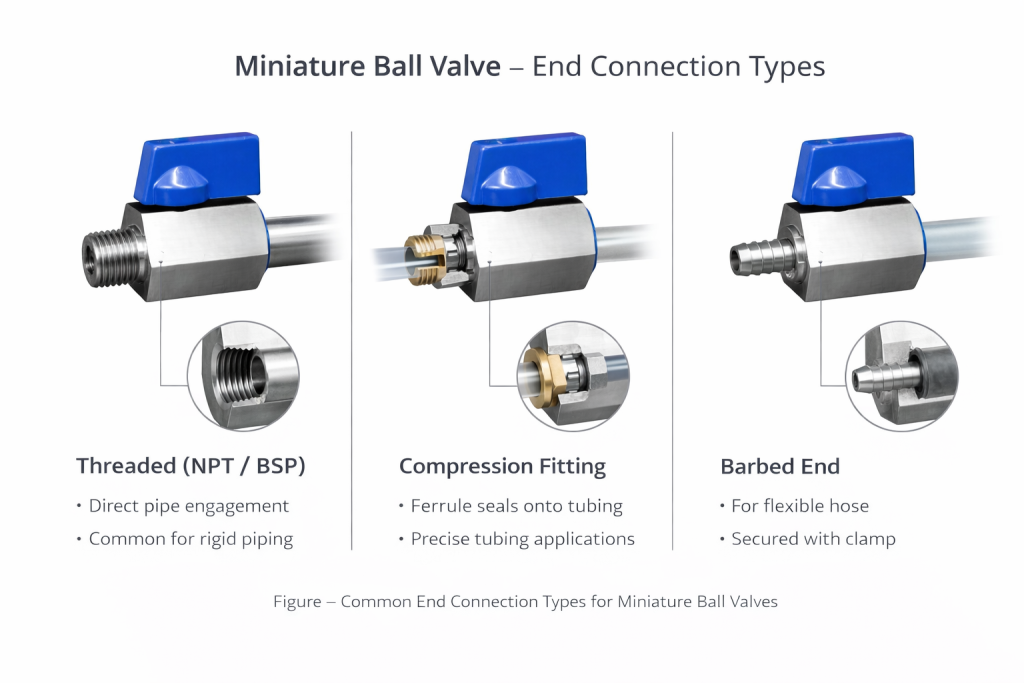
The connection type ensures proper integration of the miniature ball valve into your piping or tubing system. Compatibility and ease of installation are key factors.

- Threaded Connections (NPT, BSP, G):
- Description: The most common type, providing a robust, repeatable connection. Available in various standards: NPT (National Pipe Taper) in North America, BSP (British Standard Pipe Parallel or Taper) in Europe and Asia, and G-thread (parallel, like BSPP).
- Best For: Permanent or semi-permanent installations in rigid piping systems.
- Compression Fittings:
- Description: Utilize a ferrule (sleeve) that is compressed onto the tubing as a nut is tightened, creating a leak-tight seal. No welding or threading required on the tubing itself.
- Best For: Instrumentation lines, hydraulic/pneumatic tubing, systems requiring easy assembly/disassembly without special tools (e.g., lab setups, analytical equipment).
- Barbed Connections:
- Description: Feature a series of ridges (barbs) that grip the inside of a flexible hose. A hose clamp is typically used for a secure connection.
- Best For: Low-pressure applications using flexible tubing (e.g., garden hoses, small chemical transfer, laboratory setups).
- Push-to-Connect / Quick-Connect:
- Description: Designed for rapid connection and disconnection of plastic or soft metal tubing. The tubing is simply pushed into the fitting for a seal.
- Best For: Pneumatic systems, RO water filters, beverage dispensing, applications requiring frequent changes or quick assembly. Usually limited to lower pressures.
3. Pressure & Temperature Ratings
Understanding and adhering to the published pressure and temperature ratings is non-negotiable for safe and reliable valve operation. These ratings specify the maximum conditions the valve can safely withstand.
Pressure Ratings:
Expressed in various units (PSI, Bar, MPa) or classifications (PN, Class). It’s crucial to match the valve’s rating to your system’s maximum operating pressure, with a healthy safety margin.
- Static vs. Dynamic Pressure: Consider both the normal operating pressure and any potential pressure surges or spikes the system might experience.
- De-rating Curves: Most soft-seated valves have a pressure-temperature (P/T) de-rating curve. This means that as operating temperature increases, the maximum allowable operating pressure decreases due to the softening of seat materials. Always consult this curve from the manufacturer.
- Common Standards: Look for ratings like ANSI Class (e.g., Class 1500), PN (Nominal Pressure, e.g., PN63 = 63 Bar), or direct PSI/Bar ratings.
Temperature Ratings:
The valve must be able to withstand the minimum and maximum temperatures of the process media and the ambient environment. This is primarily influenced by the body and seat materials.
- Minimum Temperature: Ensures materials don’t become brittle or seals don’t shrink, leading to leaks.
- Maximum Temperature: Prevents degradation, melting, or weakening of materials. Plastic valves, for instance, have significantly lower temperature limits than metal valves.
- Seat Material Impact: As mentioned, soft seats like PTFE limit the upper temperature range. For higher temperatures, RPTFE, PEEK, or even metal seats might be necessary.
| Factor | Key Considerations |
|---|---|
| ضغط التشغيل | Maximum system pressure, pressure surges, de-rating curves at temperature. |
| Operating Temperature | Process media min/max temp, ambient temp, seat material limitations. |
| Fluid Medium | Chemical compatibility with body, ball, stem, and all sealing materials. |
Additional Selection Factors
- Port Configuration: While most miniature ball valves are 2-way for simple on/off, 3-way (L-port or T-port) options exist for diverting or mixing applications.
- Full vs. Reduced Port: Full port matches the pipe’s inner diameter, offering minimal flow restriction and pressure drop. Reduced port has a smaller bore, leading to increased pressure drop but often a more compact and economical valve. Understand flow characteristics via Understanding Flow (Cv) in Miniature Ball Valves.
- Actuation: Most miniature ball valves are manual (lever handle). However, compact pneumatic or electric actuators are available for automation if required.
- Certifications: For specific industries (e.g., potable water, food contact), check for relevant certifications (e.g., NSF, FDA).
خاتمة
The seemingly straightforward task of choosing a miniature ball valve becomes a nuanced engineering decision when considering the interplay of materials, connection types, and critical ratings. By systematically evaluating your process media, operating conditions, and system requirements against these factors, you can confidently select a valve that delivers long-term reliability and peak performance.
At BCST Valve, we are dedicated to providing high-quality, precisely engineered miniature ball valves, alongside the expertise to help you make the right choice every time. Don’t compromise on the integrity of your fluid control system.
Ready to select the perfect miniature ball valve for your application?


 English
 Arabic
 Russian
 French
 Spanish