
The Complete Guide to Air Compressor Pressure Relief Valves: Your System’s Critical Lifeline
In any compressed air system, safety is paramount. The air receiver (tank) stores high-pressure energy, making it a potential hazard if overpressurized. This is where a seemingly simple component becomes your system’s critical lifeline: the air compressor pressure relief valve. Often overlooked until an incident occurs, this device is designed to prevent catastrophic failure, making its correct selection, installation, and maintenance non-negotiable.
This comprehensive guide will demystify the pressure relief valve, providing essential knowledge for technicians, engineers, and facility managers. We’ll answer the fundamental question: what is the pressure relief valve on an air compressor? We’ll deep-dive into the critical ASME “3-Rule” for pressure relief valves, explore different valve designs (pop-off vs. continuous flow), and discuss atmospheric versus piped-away discharge systems. Understanding these principles is key to ensuring compliance, operational safety, and the longevity of your compressed air infrastructure.
Quick Answer: An air compressor pressure relief valve is a mechanical safety device designed to automatically open when the pressure inside an air receiver exceeds a predetermined safe limit, thereby releasing excess pressure and preventing tank rupture or explosion. It is a passive, fail-safe mechanism.
1. What is the Pressure Relief Valve on an Air Compressor? (Definition & Function)
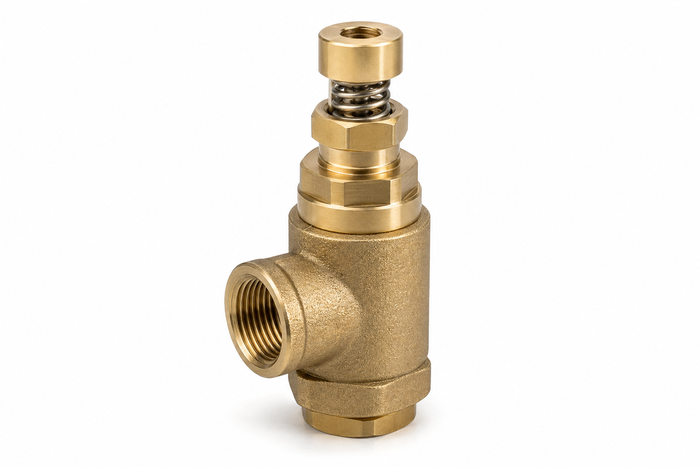
The pressure relief valve (PRV) on an air compressor system is a crucial mechanical safety device installed on the air receiver (storage tank). Its sole purpose is to act as a last line of defense against overpressurization, which could lead to severe equipment damage, injury, or even fatalities.
How it Protects Your Pressure Vessel
A PRV is pre-set to open at a specific pressure, known as the “set pressure.” This set pressure is typically slightly above the system’s normal operating pressure but below the maximum allowable working pressure (MAWP) of the air receiver. If primary controls (like the pressure switch or unloader valve) fail, causing the pressure in the tank to rise above the PRV’s set pressure, the valve will automatically spring open, rapidly discharging compressed air until the pressure drops back to a safe level. Once the pressure falls, the valve re-closes, often abruptly.
2. Understanding the “3 Rule” for Pressure Relief Valves (ASME Section VIII Compliance)
The “3 Rule” for pressure relief valves is a concise way to summarize critical ASME (American Society of Mechanical Engineers) Section VIII Division 1 guidelines for pressure vessel protection, specifically concerning the set pressure of relief devices relative to the vessel’s maximum allowable working pressure (MAWP).
Decoding the ASME Pressure Relief Valve “3 Rule”
For a single pressure relief valve or the highest set pressure of multiple relief valves protecting an unfired pressure vessel, ASME Section VIII, Division 1 dictates three crucial conditions:
- The set pressure of the relief valve must not exceed the MAWP (Maximum Allowable Working Pressure) of the vessel. This ensures the valve opens before the tank reaches its design stress limit.
- The accumulated pressure during the discharge of the relief valve must not exceed 110% of the MAWP. This accounts for the brief pressure spike that occurs as the valve opens and discharges, ensuring the vessel’s integrity even during a relief event.
- The difference between the set pressure and the MAWP must ensure adequate relieving capacity. While not explicitly a “number,” this implies that the valve must be properly sized to relieve pressure quickly enough to prevent exceeding the 110% accumulation limit.
This “3 Rule” forms the bedrock of pressure relief valve safety standards, ensuring that your air compressor system remains within safe operating limits, even in a failure scenario. These regulations require precise calibration and adherence to specified design parameters for the air compressor pressure relief valve itself.
For Featured Snippet: The “3 Rule” for pressure relief valves, as per ASME Section VIII, states that 1) the valve’s set pressure must not exceed the vessel’s MAWP, 2) accumulated pressure during discharge cannot exceed 110% of MAWP, and 3) the valve must have sufficient capacity to meet these limits. These are core ASME Section VIII compliance requirements for safe pressure vessel operation.
3. Pop-off vs. Continuous Flow: Choosing the Right Design
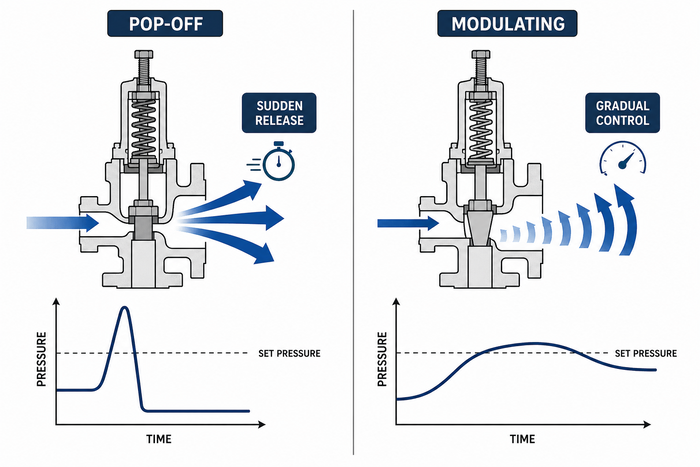
Pressure relief valves come in various designs, each suited for different applications and system dynamics. For air compressor pressure relief valve systems, two primary types are most common: pop-off and continuous flow.
Comparing Relief Valve Operating Styles
| Feature | Pop-off (API 520 / 526) | Modulating / Proportional |
|---|---|---|
| Opening Action | Rapid, full-opening once set pressure is exceeded. Sudden “pop.” | Gradual opening proportional to pressure increase. Minimizes pressure fluctuations. |
| Closing Action | Rapid, full re-closure once pressure drops below re-seating pressure. | Gradual re-closure as pressure decreases. |
| Primary Use | Common for air compressors and most pressure vessels. Best for rapid overpressure. | More common in steam boilers, process systems needing tighter pressure control. |
| Noise/Impact | Can be loud, creates a sudden pressure surge. | Quieter, less disruptive. |
For most standard air compressor pressure relief valve installations, the pop-off style is utilized due to its reliability and proven ability to provide immediate overpressure protection.
4. Atmospheric Discharge vs. Piped-Away Systems
The method of discharging the relieved air is another crucial consideration, especially regarding personnel safety and noise control.
Where Does the Air Go After Relief?
- Atmospheric Discharge: The simplest method, where the PRV vents directly into the surrounding atmosphere. This is common for smaller compressors in well-ventilated areas. However, the sudden, loud discharge can be a safety hazard (noise, air velocity) and may spray any entrained moisture/oil.
- Piped-Away System: The PRV’s outlet is connected to a vent pipe that channels the discharged air to a safe outdoor location, typically away from personnel and equipment. This reduces noise pollution and prevents expelled contaminants from entering the workspace. It’s often required for larger compressors, hazardous environments, or where noise abatement is critical. Proper sizing and support of the vent pipe are essential to prevent backpressure that could affect valve operation.
5. FAQ on Air Compressor Pressure Relief Valves
How often should an air compressor pressure relief valve be tested?
Regular testing is crucial. Many regulations (OSHA, ASME, local codes) recommend periodic testing, often annually, to ensure the valve opens at its set pressure and re-seats properly. This usually involves manually “popping” the valve. A comprehensive guide to this process can be found in a related article on pressure relief valve replacement and adjustment.
Can I adjust the set pressure of my air compressor relief valve?
No, generally not. Air compressor pressure relief valves are factory-set and sealed (often with a lead wire seal) to open at a specific pressure. Adjusting them without proper calibration equipment and certification is dangerous, voids the ASME stamp, and compromises system safety. Attempting to adjust these valves without authorization is a critical safety violation.
What is the difference between a pressure relief valve and a rupture disc?
A pressure relief valve is a re-closing device that opens to relieve overpressure and then closes when the pressure returns to normal. A rupture disc is a non-reclosing device that bursts open at a predetermined pressure and must be replaced after each activation. PRVs are typically preferred for air compressors due to their re-closing dynamic.
Conclusion: Upholding Safety with a Reliable Air Compressor Pressure Relief Valve
The air compressor pressure relief valve is far more than just a piece of hardware; it’s an engineered component critical to the safe operation of your entire compressed air system. Understanding what is the pressure relief valve on an air compressor, adhering to the ASME “3-Rule” for pressure relief valves, and ensuring its proper function are essential responsibilities for every operator and facility manager.
At BCST Valve, we specialize in high-quality, ASME-compliant pressure relief valves designed for the stringent demands of compressed air applications. Our commitment to precision engineering ensures your systems are protected, always meeting the highest pressure relief valve safety standards. Trust BCST to provide the reliable safety devices that your operations depend on.
Seeking ASME-Compliant Air Compressor Pressure Relief Valves?
Ensure the ultimate safety and compliance of your compressed air system with BCST Valve’s certified solutions.


 English
 Arabic
 Russian
 French
 Spanish