
A 3 way valve is a workhorse in HVAC and process control, designed to manage flow paths with versatility. Yet, despite their widespread use, a common misapplication causes significant system inefficiencies and operational headaches: installing a mixing valve where a diverting valve is needed, or vice-versa. This isn’t a mere academic distinction; wrong porting 3 way valve configurations can fundamentally ruin system performance, leading to erratic temperatures, wasted energy (e.g., low ΔT syndrome in chilled water loops), and ultimately, operational frustration.
This guide offers a practical comparison of 3 way mixing valve vs diverting valve applications, dissecting the precise flow dynamics of each. We’ll show you how to correctly identify valve types by their porting, illustrate the consequences of 3 way valve flow direction errors, and provide clear guidance on best applications. For installers, specifiers, and maintenance teams, understanding these critical differences is key to ensuring robust, efficient, and well-controlled fluid systems.
Quick Answer: A 3 way mixing valve combines two inlet flows into one outlet, while a 3 way diverting valve takes one inlet flow and splits it between two outlets. Using the wrong type or incorrect 3 way valve porting can lead to inefficient flow, poor temperature control, and hydraulic imbalance.
1. What is a 3 Way Valve? (A Brief Review)
At its core, a 3 way valve features three distinct ports and a single common flow path that connects to the other two. This allows for fluid to be routed in several ways, enabling complex control schemas with a single valve body. The key distinction lies in *how* these ports are used—for either mixing or diverting flows.

2. The 3 Way Mixing Valve: Combining Flows
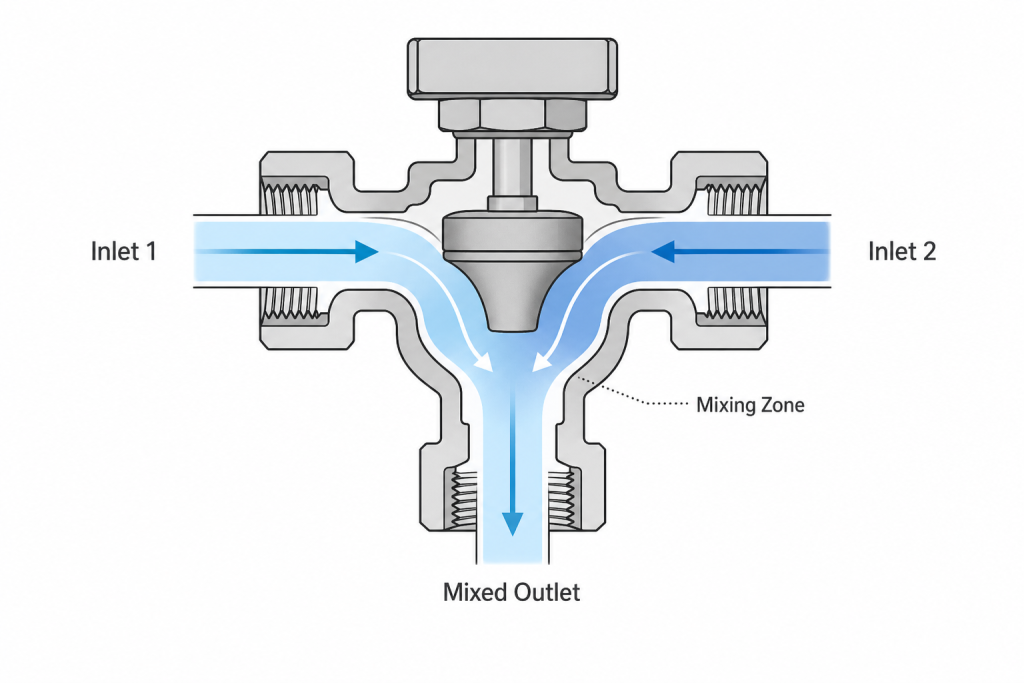
A 3 way mixing valve combines two separate inlet flows into a single, blended outlet flow. It’s typically characterized by two inlet ports (often labeled ‘A’ and ‘B’) and one common outlet port (often labeled ‘AB’ or ‘C’) where the mixed fluid exits.
How a Mixing Valve Works
- Function: To achieve a desired blend temperature or concentration by accurately proportioning the mix of two different fluid streams (e.g., hot and cold water).
- Flow Path: Flow enters ports A and B, mixes inside the valve body, and exits through the common port C.
- Applications: Common in HVAC for maintaining desired supply air temperatures (mixing hot and cold water to a coil), domestic hot water systems, and industrial processes requiring precise temperature blending.
3. The 3 Way Diverting Valve: Splitting Flows
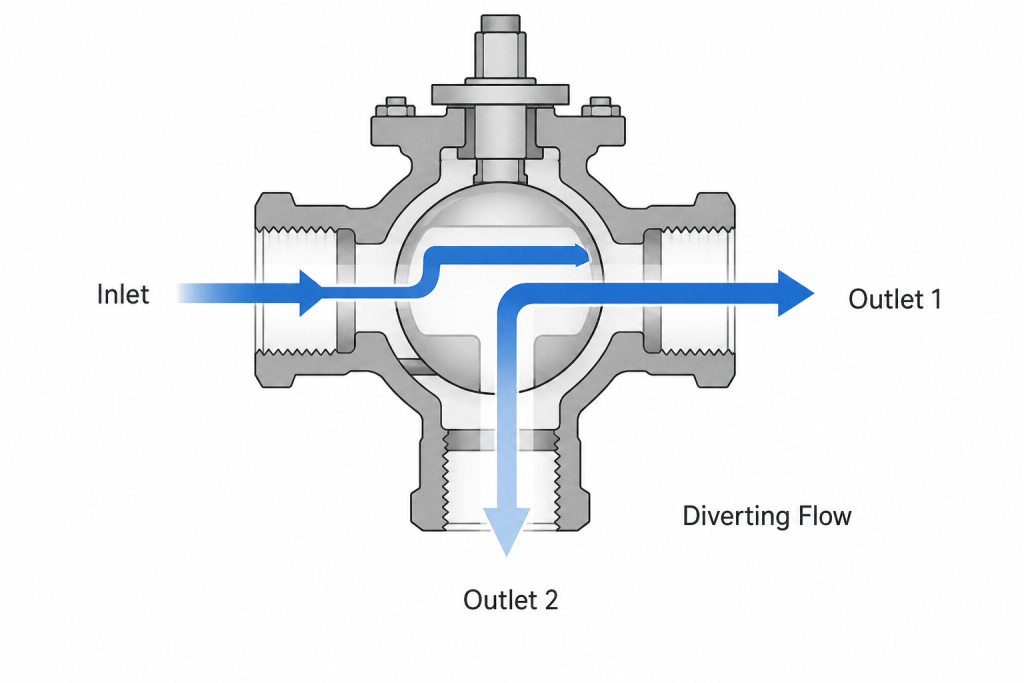
A 3 way diverting valve takes a single inlet flow and splits or diverts it between two distinct outlet paths. It typically has one common inlet port (often ‘AB’ or ‘C’) and two outlet ports (‘A’ and ‘B’).
How a Diverting Valve Works
- Function: To direct a single fluid stream to one of two destinations, or to proportionally split the flow between them.
- Flow Path: Flow enters through the common port C and exits through either port A, port B, or a controlled split between them.
- Applications: Bypass applications (like those causing low ΔT in chilled water systems), coil face/bypass control, and routing fluids to different process vessels or heat exchangers.
4. Critical Differences: A Side-by-Side Comparison
The distinction between a 3 way mixing valve and a 3 way diverting valve might seem subtle, but their hydraulic behavior and application suitability are vastly different.
| Feature | 3 Way Mixing Valve | 3 Way Diverting Valve |
|---|---|---|
| Hydraulic Function | Combines 2 flows into 1 | Splits 1 flow into 2 |
| Common Port | Outlet (e.g., AB or C) | Inlet (e.g., AB or C) |
| Inlets | Ports A & B | Common Port (AB/C) |
| Outlets | Common Port (AB/C) | Ports A & B |
5. Consequences of Wrong Porting or Application
Using the wrong type of 3-way valve, or simply reversing flow through a correctly chosen valve, can lead to severe operational issues that manifest as inefficient control, premature wear, and even system damage. This is the essence of 3 way valve porting mistake problems.
Impact on System Performance
- Poor Control Authority: The valve’s inherent flow characteristic (linear, equal percentage) is optimized for its intended flow path. Incorrect 3 way valve flow direction or valve type can result in a highly non-linear response, making precise control impossible.
- Excessive Pressure Drop: Unintended turbulence, cavitation, and increased pressure drop can occur if flow is forced through ports or passages not designed for that direction or flow pattern.
- Hydraulic Imbalance: In HVAC loops, this can lead to unstable system pressure, poor flow distribution to coils, and energy waste.
- Erosion and Premature Wear: Incorrect flow patterns can cause localized high velocity, leading to erosion of internal valve components or damage to seals.
6. How to Correctly Identify and Apply Your 3 Way Valve
Avoiding 3 way valve application errors requires careful attention during both specification and installation. Always refer to manufacturer’s documentation for specific flow arrow markings and port designations.
Key Identification and Application Steps
- Check Markings: Most quality 3-way valves have clear flow arrows indicating the intended direction, or port labels (e.g., ‘A’, ‘B’, ‘AB/C’). The common port (AB/C) is crucial: if it’s the inlet, it’s a diverting valve; if it’s the outlet, it’s a mixing valve.
- Consult Manuals: Always refer to the valve’s technical data sheet or installation manual. These explicitly state the valve’s intended service and correct piping.
- Match to Function:
- Need to combine two sources into one stream? Use a 3 way mixing valve.
- Need to send one source to either of two destinations? Use a 3 way diverting valve.
- Consider Retrofit Challenges: When replacing older units, be aware that existing piping may not be ideal. A 3 way valve retrofit might require careful planning to align with proper porting without costly re-piping.
7. FAQ on 3 Way Mixing vs. Diverting Valves
Can I use a mixing valve as a diverting valve by reversing flow, or vice-versa?
While physically possible to connect, it is strongly advised against. The internal plug/ball and flow passages are designed for specific flow patterns. Reversing flow or using a mixing valve as a diverting valve (or vice-versa) will lead to poor control, increased pressure drop, noise, and likely premature wear or failure.
Are 3-way valves still common in modern HVAC systems?
Yes, 3-way valves remain common, especially for mixing applications (e.g., blending for coil supply) or in constant primary flow systems. However, in modern variable primary flow systems, 2-way valves are often preferred for coils to improve chiller and pump efficiency by eliminating bypass flow.
What are ports A, B, and AB/C on a 3-way valve?
Typically, ‘A’ and ‘B’ are the individual ports, and ‘AB’ (or ‘C’) is the common port. For a mixing valve, A and B are inlets, and AB/C is the outlet. For a diverting valve, AB/C is the inlet, and A and B are the outlets. Always confirm with the manufacturer’s specific labeling and flow arrows.
Conclusion: Precision Starts with Correct Application
The subtle yet critical distinction between a 3 way mixing valve vs diverting valve lies at the heart of efficient fluid control. Ignoring their unique flow dynamics and proper 3 way valve porting can lead to significant 3 way valve flow direction errors, undermining system performance and inflating operational costs. For optimal hydraulic balance and control, precise application is non-negotiable.
BCST Valve specializes in engineering high-performance 3-way valves, keenly aware of the nuances between mixing and diverting applications. We champion correct valve selection and application fit, ensuring that our valves deliver the reliable, efficient performance your systems demand. Partner with BCST for expert guidance on matching the right 3-way valve to your exact process needs.
Seeking Expert Advice on 3 Way Valves for Your Application?
Ensure optimal performance and avoid costly mistakes. Contact BCST Valve for application-specific recommendations.


 English
 Arabic
 Russian
 French
 Spanish